Portrét Max Beckmann

Najznámejšie obrazy umelca Max Beckmann: Všetkých 100, zoradené podľa popularity

Aktualizované október 2026 · zoradené podľa našej miery popularity (vyhľadávanie, návštevy a objednávky pre každou prácu) · 401 dielov umelca Max Beckmann v našom katalógu

Stručne povedané

Najznámejším obrazom, ktorý tvorí Max Beckmann, je Noc (1919), ktorý môžete vidieť v galérii Kunstsammlung Nordrhein-Westfalen v meste Düsseldorf. Hneď po nich nasledujú Veľká scéna utrpenia (1906) a Železový most (Výhľad na Frankfurt) (1922). Z 401 diel umelca Max Beckmann v našom katalógu je týchto 100 najznámejších. Každá z nich obsahuje rok vytvorenia, názov múzeja a krátku poznámku o tom, čo ju robí výnimočnou.

1884 – 1950, Lipsko German expressionism Najviac diel: Bavarské štátne múzeá výtvarného umenia

Top 10 diel od Max Beckmann: diela, ktoré pozná každý

1
Noc (1919) od Max Beckmann

Noc

1919 · Olej na plátne · Kunstsammlung Nordrhein-Westfalen, Düsseldorf

Noc – Vízia Postvojnového Úzkostného Stavu Max Beckmannova majstrovská dielo z roku 1919, „Noc“, nie je len obrazom; je to silné vyjadrenie spoločenskej traumy po prvej svetovej vojne. Je to viac než reprezentácia – hlboký ponor do surovej emocionálnej krajiny generácie poznačenej konfliktom a základný kameň hnutia *Neue Sachlichkeit* (Nová Objektivita). Táto intenzívne psychologická práca transcenduje prostú vizuálnosť, odhaľujúc drsnú emocionalitu doby. Obraz sa odohráva v klaustrofóbickom interiéri, možno vo…

2
Veľká scéna utrpenia (1906) od Max Beckmann

Veľká scéna utrpenia

1906 · Olej na plátne · Bavarské štátne múzeá výtvarného umenia, Mních

V roku 1906 vytvoril Max Beckmann dielo známe ako “Veľká scéna utrpenia” (Deutsches: *Große Todesszene*), obraz, ktorý sa vymyká jednoduchému zobrazovaniu. Nie je to len portrét troch mužských postáv v nejasnom priestore; je to hlboké a znepokojivé skúmanie ľudskej zraniteľnosti, izolácie a možného úpadku. Beckmann, s využitím expresionistických techník, prináša do plátna obraz, ktorý vyvoláva silné emócie a podnet na rozvoj myšlienok o stavu človeka v 20. storočí. Je to…

3
Železový most (Výhľad na Frankfurt) (1922) od Max Beckmann

Železový most (Výhľad na Frankfurt)

1922 · Olej na plátne · Kunstsammlung Nordrhein-Westfalen, Düsseldorf

Max Beckmannova obrazová kompozícia “Most s železnou oceľou (Výhľad na Frankfurt)” z roku 1922 je fascinujúcou ukážkou expresionistického umenia, ktorá zachycuje pulzujúcu energiu industriálneho mesta. Nie je to len výzdoba; je to živý portrét moderného života, plný dynamiky a symboliky. Beckmann, známy svojím unikátnym prístupom k realizmu a expresionizmu, v tomto dielo dokázal spojiť detailné pozorovanie s intenzívnymi emóciami, čím vytvoril obraz, ktorý sa dotýka srdca pozritecovi. Tento kus je…

4
Kolumbína (1950) od Max Beckmann

Kolumbína

1950 · Olej na plátne · Saint Louis Art Museum, Saint Louis

Dielo „Kolumbína“ od Maxa Beckmanna predstavuje ohromujúci príklad nemeckého expresionizmu, vytvorené v roku 1950 počas neskorých rokov umelcovho života. Táto veľkoformátová olejná maľba na plátne zachytáva sediacu ženskú postavu ozdobený maskou, obklopenú odvážnymi architektonicznými prvkami a živými farbami. Maľba dokonale exemplifikuje Beckmannov charakteristický štýl, ktorý sa vyznačuje deformovanými postavami, bohatým symbolizmom a hlbokou emocionálnou intenzitou.

5
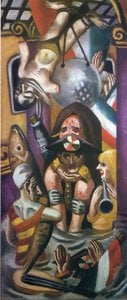
Aktéri (1942) od Max Beckmann

Aktéri

1942 · Olej na plátne

Preskúmavanie ľudskej kondície a spoločnosti Tento silný trojpanelový obraz Maxa Beckmanna zachytáva komplexnú tapisériu ľudskej existencie a spoločenských rolí prostredníctvom živého, emocionálne nabitého kompozície. Každý panel predstavuje dynamickú scénu plnú deformovaných postáv, symbolických predmetov a výrazných gest, ktoré pozývajú diváka k zamysleniu nad témami obmedzenia, identity a sociálnej interakcie. Beckmannovo vyobrazenie ľudských postav – niektoré sediacich, iných stojacich alebo za mrežami – vyvoláva pocit napätia, introspekcie a odporu, čím že…

6
Selfportrait in tuxedo, Busch-Reisinger M (1927) od Max Beckmann

Selfportrait in tuxedo, Busch-Reisinger M

1927 · Oil On Canvas

The gaze of Max Beckmann meets the viewer directly in Selfportrait in tuxedo, Busch-Reisinger M. This oil-on-canvas work, executed in 1927, captures the artist in a moment of poised, formal presence. He stands before us, a figure of quiet strength, wearing the elegant attire of a tuxedo that marks a specific era of social transition. The painting exists as a significant presence within the German Expressionism movement, embodying the tension…

7
Temptation (1937) od Max Beckmann

Temptation

1937 · Oil On Canvas

Max Beckmann, a renowned German Expressionist painter, created his masterpiece Temptation in 1937. This oil on canvas painting is housed at the Bayerische Staatsgemäldesammlungen (Munich, Germany), and it exemplifies Beckmann's unique style and thematic exploration of human nature. The Artistic Context Beckmann was a key figure in the Expressionist movement, which emphasized subjective emotional experience. His work often drew upon historical and mythological themes to convey contemporary moral and spiritual…

9
The argonauts (1950) od Max Beckmann

The argonauts

1950 · Oil On Canvas

The artwork is a triptych titled The Argonauts, created between 1949 and 1950. The composition features a middle panel containing several figures: the poet Orpheus is positioned at the center, with Jason located at his right and the sea god Glaucus at his left. The painting depicts a variety of people in different positions, including individuals who are standing, sitting, or lying down. The scene includes at least 12 people,…

Pokračujte v objavovaní Max Beckmann: 11 až 100

11Quappi in blue in a boat (1950) od Max BeckmannQuappi in blue in a boat1950 12Apachentanz (1938) od Max BeckmannApachentanz1938 · Kunsthalle Bremen 13Still Life with Large Green Fruits od Max BeckmannStill Life with Large Green Fruits 14Galleria Umberto (1925) od Max BeckmannGalleria Umberto1925 15Siesta od Max BeckmannSiesta 16Bathing Scene (The Green Cloak) (1934) od Max BeckmannBathing Scene (The Green Cloak)1934 · National Gallery of Art 17Christ in Limbo (1947) od Max BeckmannChrist in Limbo1947 · National Gallery of Art 18Still Life with Cigar Box (1926) od Max BeckmannStill Life with Cigar Box1926 · Bavarské štátne múzeá výtvarného umenia 19Self Portrait in Olive and Brown (1945) od Max BeckmannSelf Portrait in Olive and Brown1945 · Detroit Institute of Arts 20The Argonauts: Music (1949) od Max BeckmannThe Argonauts: Music1949 · National Gallery of Art 21Self-Portrait in Gray Robe (1941) od Max BeckmannSelf-Portrait in Gray Robe1941 · Bavarské štátne múzeá výtvarného umenia 22Portrait of Carl Couple (1918) od Max BeckmannPortrait of Carl Couple1918 · Städel Museum 23Leave-Taking (1942) od Max BeckmannLeave-Taking1942 · Thyssen-Bornemisza Museum 24Cabins (1948) od Max BeckmannCabins1948 · Kunstsammlung Nordrhein-Westfalen 25Reclining Woman by the Sea (1950) od Max BeckmannReclining Woman by the Sea1950 · Hamburger Kunsthalle 26Farmers Carrying Wood (1941) od Max BeckmannFarmers Carrying Wood1941 · Bavarské štátne múzeá výtvarného umenia 27The Duchess of Malvedi (1926) od Max BeckmannThe Duchess of Malvedi1926 · Bavarské štátne múzeá výtvarného umenia 28The Circus Carriage (1940) od Max BeckmannThe Circus Carriage1940 · Städel Museum 29Lady in gray cap (1944) od Max BeckmannLady in gray cap1944 · Kunsthalle Bremen 30Declaration of War od Max BeckmannDeclaration of War 31Family Scene (Beckmann Family) od Max BeckmannFamily Scene (Beckmann Family) 32Maternidad od Max BeckmannMaternidad 33Departure (1935) od Max BeckmannDeparture1935 34Portrait of Edie Rickey (1949) od Max BeckmannPortrait of Edie Rickey1949 · Saint Louis Art Museum 35Double image. People on the street (1914) od Max BeckmannDouble image. People on the street1914 · Berlinische Galerie 36Hotel de l’Ambre (1949) od Max BeckmannHotel de l’Ambre1949 · Bavarské štátne múzeá výtvarného umenia 37Small cafe, revolving door (1944) od Max BeckmannSmall cafe, revolving door1944 · Kunstmuseum Den Haag 38The argonauts, Detalj, Private collect (1950) od Max BeckmannThe argonauts, Detalj, Private collect1950 39Conversation (Society I) (1908) od Max BeckmannConversation (Society I)1908 · Alte Nationalgalerie 40Vampire (1948) od Max BeckmannVampire1948 · Museum Folkwang 41The removal of the sphinxes (1945) od Max BeckmannThe removal of the sphinxes1945 · Staatliche Kunsthalle Karlsruhe 42Studio with Table and Glasses (1931) od Max BeckmannStudio with Table and Glasses1931 · Bavarské štátne múzeá výtvarného umenia 43Woman Reading at the Beach od Max BeckmannWoman Reading at the Beach 44Fisherwomen od Max BeckmannFisherwomenSaint Louis Art Museum 45Resting Woman with Carnations od Max BeckmannResting Woman with Carnations 46Small italian Landscape od Max BeckmannSmall italian Landscape 47Sinagoga od Max BeckmannSinagogaStädel Museum 48Family Picture (1920) od Max BeckmannFamily Picture1920 · MoMA - Museum of Modern Art 49Girl in Black on Gray / Young Girl (1940) od Max BeckmannGirl in Black on Gray / Young Girl1940 · Bavarské štátne múzeá výtvarného umenia 50Floral still life with mirror (1927) od Max BeckmannFloral still life with mirror1927 51Rugby players, Wilhelm-Lehmbruck-Museum, (1929) od Max BeckmannRugby players, Wilhelm-Lehmbruck-Museum,1929 52Sculpture Studio / Studio Corner (1950) od Max BeckmannSculpture Studio / Studio Corner1950 · Bavarské štátne múzeá výtvarného umenia 53Red Clown / Man with Crown (1941) od Max BeckmannRed Clown / Man with Crown1941 · Bavarské štátne múzeá výtvarného umenia 54The Argonauts: Painting (1949) od Max BeckmannThe Argonauts: Painting1949 · National Gallery of Art 55Still life with yellow roses od Max BeckmannStill life with yellow rosesThyssen-Bornemisza Museum 56The argonauts, Private collection, New (1950) od Max BeckmannThe argonauts, Private collection, New1950 · National Gallery of Art 57Carnival Paris (1930) od Max BeckmannCarnival Paris1930 · Bavarské štátne múzeá výtvarného umenia 58The Trapeze (1923) od Max BeckmannThe Trapeze1923 · Toledo Museum of Art 59Baccarat (1947) od Max BeckmannBaccarat1947 · Nelson-Atkins Museum of Art 60Portrait of Augusta Countess vom Hagen (1908) od Max BeckmannPortrait of Augusta Countess vom Hagen1908 · Staatliche Kunstsammlungen Dresden 61Self-Portrait in Black (1944) od Max BeckmannSelf-Portrait in Black1944 · Bavarské štátne múzeá výtvarného umenia 62Woman with Mirror and Orchids (1947) od Max BeckmannWoman with Mirror and Orchids1947 · Museum of Fine Arts, Houston 63The Harbor of Genoa od Max BeckmannThe Harbor of GenoaSaint Louis Art Museum 64The Rape of Europa od Max BeckmannThe Rape of Europa 65The acrobats (1939) od Max BeckmannThe acrobats1939 · Saint Louis Art Museum 66Flower Shop / In Front of the Hotel (1936) od Max BeckmannFlower Shop / In Front of the Hotel1936 · Bavarské štátne múzeá výtvarného umenia 67Self-Portrait (1905) od Max BeckmannSelf-Portrait1905 · Städel Museum 68Self-portrait (1899) od Max BeckmannSelf-portrait1899 69Self-portrait (1901) od Max BeckmannSelf-portrait1901 70Self-portrait with champagne glass (1919) od Max BeckmannSelf-portrait with champagne glass1919 · Städel Museum 71The street (1914) od Max BeckmannThe street1914 · Berlinische Galerie 72Self-Portrait with Raised Hand (1908) od Max BeckmannSelf-Portrait with Raised Hand1908 · Thyssen-Bornemisza Museum 73Dance halls (1909) od Max BeckmannDance halls1909 74Company III. Family Battenberg (1915) od Max BeckmannCompany III. Family Battenberg1915 75Before the Masked Ball (1922) od Max BeckmannBefore the Masked Ball1922 · Bavarské štátne múzeá výtvarného umenia 76Carnival (1920) od Max BeckmannCarnival1920 77Women's Bath (1919) od Max BeckmannWomen's Bath1919 78Carnival (Pierrette and Clown) (1925) od Max BeckmannCarnival (Pierrette and Clown)1925 79Double Portrait (1923) od Max BeckmannDouble Portrait1923 · Städel Museum 80Portrait of Käthe von Porada (1924) od Max BeckmannPortrait of Käthe von Porada1924 · Städel Museum 81Portrait of an Argentinean (1929) od Max BeckmannPortrait of an Argentinean1929 · Bavarské štátne múzeá výtvarného umenia 82The Beach (1927) od Max BeckmannThe Beach1927 · Städel Museum 83Two Ladies at the Window (1928) od Max BeckmannTwo Ladies at the Window1928 84Carnival (Pierrette and Clown) (1925) od Max BeckmannCarnival (Pierrette and Clown)1925 · Kunsthalle Mannheim 85Portrait of S.H. (1928) od Max BeckmannPortrait of S.H.1928 86Still Life with Gramophone and Irises (1924) od Max BeckmannStill Life with Gramophone and Irises1924 87Reclining woman with book and irises (1931) od Max BeckmannReclining woman with book and irises1931 88The Skaters (1932) od Max BeckmannThe Skaters1932 · Minneapolis Institute of Art 89Departure: The Castle (1933) od Max BeckmannDeparture: The Castle1933 · MoMA - Museum of Modern Art 90Lute Player / Banjo-Playing Woman (1930) od Max BeckmannLute Player / Banjo-Playing Woman1930 91Margarethe Wichert (daughter of Professor Wichert) (1930) od Max BeckmannMargarethe Wichert (daughter of Professor Wichert)1930 92Girls Playing with Dogs (1933) od Max BeckmannGirls Playing with Dogs1933 93Woman in Bed (1932) od Max BeckmannWoman in Bed1932 94Claridge II (1930) od Max BeckmannClaridge II1930 95Portrait of the Family Lütjens (1944) od Max BeckmannPortrait of the Family Lütjens1944 · Museum Boijmans Van Beuningen 96Self-Portrait (1938) od Max BeckmannSelf-Portrait1938 · Solomon R. Guggenheim Museum 97Artist (1936) od Max BeckmannArtist1936 98Portrait of a Frenchmen (1933) od Max BeckmannPortrait of a Frenchmen1933 · Centre Pompidou 99Heinrich George Family Portrait (1935) od Max BeckmannHeinrich George Family Portrait1935 100Death (1938) od Max BeckmannDeath1938

Obrazy umelca Max Beckmann podľa jednotlivých období

Čo najčastejšie mal Max Beckmann

Štyri témy, ktoré sa v týchto díelach najčastejšie vyskytujú, každá s jej najznámejším príkladom.

Kde si môžete pozrieť obrazy od Max Beckmann

8 múzeá, v ktorých sa nachádza najviac obrazov z tejto stránky.

Múzeá Mesto Diela umelca Max Beckmann Obrazy z tohto zoznamu
Bavarské štátne múzeá výtvarného umenia, MníchBavarské štátne múzeá výtvarného umenia Mních 39 Veľká scéna utrpenia, Woman with Mandolin in Yellow and Red, Temptation
Städel Museum, FrankfurtStädel Museum Frankfurt 18 Portrait of Carl Couple, The Circus Carriage, Sinagoga
Saint Louis Art Museum, Saint LouisSaint Louis Art Museum Saint Louis 39 Kolumbína, Portrait of Edie Rickey, Fisherwomen
National Gallery of Art, WashingtonNational Gallery of Art Washington 8 Bathing Scene (The Green Cloak), Christ in Limbo, The Argonauts: Music
Thyssen-Bornemisza Museum, MadridThyssen-Bornemisza Museum Madrid 4 Leave-Taking, Still life with yellow roses, Self-Portrait with Raised Hand
Kunstsammlung Nordrhein-Westfalen, DüsseldorfKunstsammlung Nordrhein-Westfalen Düsseldorf 3 Noc, Železový most (Výhľad na Frankfurt), Cabins
MoMA - Museum of Modern Art, New YorkMoMA - Museum of Modern Art New York 5 Family Picture, Departure: The Castle
Kunsthalle Bremen, BremenKunsthalle Bremen Bremen 4 Apachentanz, Lady in gray cap

Jednodné slavné dielo Max Beckmann pre každé desaťročie

Diela podľa dekád

Vyberte si dekádu a pozrite si jej najvýraznejšie dielo.

Obrazy od Max Beckmann: čo si ľudia chcú vedieť zistiť

Akým obrazom je Max Beckmann najznámejší/najznámejšia?Zobraziť odpoveď

Na vrchole zoznamu je Noc (1919), Kunstsammlung Nordrhein-Westfalen, Düsseldorf. Hneď za ním nasledujú: Veľká scéna utrpenia (1906) a Železový most (Výhľad na Frankfurt) (1922).

Koľko rokov mal(a) Max Beckmann v čase vytvorenia Noc?Zobraziť odpoveď

35 rokov. Max Beckmann sa narodil/a v 1884 a dielo Noc pochádza z roku 1919.

Ktorých 10 najznámejších obrazov má Max Beckmann?Zobraziť odpoveď

Noc, Veľká scéna utrpenia, Železový most (Výhľad na Frankfurt), Kolumbína, Aktéri, Selfportrait in tuxedo, Busch-Reisinger M, Temptation, Woman with Mandolin in Yellow and Red, The argonauts a Temptation. V zozname vyššie nájdete rok vytvorenia a múzeu každého z nich.

Koľko je diel umelca Max Beckmann?Zobraziť odpoveď

V našom katalógu máme 401 diel od umelca Max Beckmann, datovaných od 1899 do 1950.

V ktorých múzeách sa nachádzajú najznámejšie obrazy umelca Max Beckmann?Zobraziť odpoveď

Väčšinu z nich nájdete v Bavarské štátne múzeá výtvarného umenia (Mních), Städel Museum (Frankfurt) a Saint Louis Art Museum (Saint Louis). Zoznam múzeí vyššie obsahuje podrobný prehľad.

Kedy boli vytvorené najznámejšie diela umelca Max Beckmann?Zobraziť odpoveď

V období 1930s, viac než v akomkoľvek inom čase: 22 z 100 diel na tejto stránke pochádza z tohto obdobia, pričom Temptation z nich.

Aké sú najstaršie a najnovšie slavné obrazy od Max Beckmann?Zobraziť odpoveď

Najstaršie dielo je z Self-portrait (1899); najnovšie je z Kolumbína (1950).

Čo najčastejšie mal Max Beckmann?Zobraziť odpoveď

Woman (17), Man (15) a People (14), z celkového počtu 100 kusov na tejto stránke.

Čím zvyčajne mal(a) Max Beckmann?Zobraziť odpoveď

Oil On Canvas, použité v 42 z 100 dielov na tejto stránke.

S ktorým umedleckým smerom je spojený/á Max Beckmann?Zobraziť odpoveď

German expressionism, ako môžete vidieť na dielach na tejto stránke.

Čo môžete vidieť od Max Beckmann v Bavarské štátne múzeá výtvarného umenia?Zobraziť odpoveď

Na tejto stránke môžete vidieť 17 diel v múzeu Bavarské štátne múzeá výtvarného umenia, Mních, vrátane Veľká scéna utrpenia, Woman with Mandolin in Yellow and Red a Temptation.

Môžem si objednať reprodukciu Max Beckmann do svojho domova?Zobraziť odpoveď

Áno. Každý obraz na tejto stránke je dostupný ako ručne maľovaná olejná reprodukcia alebo ako tlač, v rozmeroch, ktoré vám vyhovujú. Pre objednanie stačí otvoriť stránku konkrétneho obrazu.

Spoznajte Max Beckmann

The Life and Art of Max Beckmann

Max Beckmann was a man of many disciplines, working as a painter, draftsman, printmaker, sculptor, and writer. He entered the world on February 12, 1884, in Leipzig, Saxony. He grew up in an upper-middle-class family as the youngest of three children. His early years were shaped by the quiet stability of his home until 1894, when his father, Carl Beckmann, a grain merchant, passed away. His mother, Antoine Beckmann, remained a central figure in his life as he began to find his way through the complexities of modern existence.

His work often felt like a confrontation with the reality of the human condition. He did not merely paint scenes; he captured the tension of a changing era through a variety of mediums. His output was vast, ranging from large-scale canvases to intimate prints. He was a man who sought to articulate the weight of history through his hands, often using the tools of his trade to process the shifting landscapes of the twentieth century.

Early Life and Artistic Training

Born into a middle-class family in Leipzig, Germany, Max Beckmann showed an early inclination toward drawing. His initial sketches revealed a precocious talent that hinted at the depth of his later work. During these formative years, he sought out the rigor of the old traditions, training in a conservative academic style that emphasized technical precision. This grounding in formal technique provided him with a solid foundation, even as his own spirit began to push against the boundaries of conventional methods.

As he matured, Beckmann found himself drawn to the Old Masters. He spent much of his time studying their compositions and mastery of form, a fascination that would eventually help him develop a strikingly original style. He was not content with mere imitation; instead, he used the lessons of the past to build a personal visual language. This period of study was marked by a tension between his academic training and a growing desire to express something more profound and less structured.

By 1912, he was already tackling ambitious subjects that required a command of large-scale composition. One such work was his painting of The Sinking of the Titanic, a piece that demonstrated his ability to handle complex, dramatic narratives. At this stage, his work was characterized by academically correct depictions, focusing on the weight and presence of figures within a defined space. He was a history painter at heart, using the grand scale of the past to explore the human condition through a lens of structured, deliberate form.

Experiences During World War I

The outbreak of World War I brought a sudden, violent end to Beckmann's academic training. He did not remain a bystander to the conflict; instead, he volunteered to serve in the medical corps. Working as a medical orderly, he was thrust into the direct reality of human suffering. The clinical, structured world of his early training was replaced by the chaotic and harrowing conditions of the front lines.

The strain of this service eventually became too much to bear. While stationed on the Belgian front, the weight of the war's devastation led to a nervous breakdown. He was discharged from the military in 1915, returning to a life that had been fundamentally altered by what he had witnessed. The horrors he saw during his time in the medical corps ignited a radical shift in his vision. The academic precision of his youth gave way to a new way of seeing, one that reflected a fractured and troubled humanity.

Artistic Style and Technique

Beckmann’s visual language was built from a tension between tradition and a restless, modern impulse. He looked back to the Old Masters, finding a foundation in the works of Rembrandt and Rubens, while also drawing from the structured forms of Cézanne and the emotive brushwork of Van Gogh. His compositions often felt crowded and compressed, utilizing shallow space and dark, heavy outlines to push his subjects toward the viewer. This technique created a sense of claustrophobia, as if the figures were trapped within the frame. He frequently paired this distorted figuration with a brutal realism, using his canvases to offer sharp social criticism of the world around him.

The physical application of paint was central to his expressive power. He favored a masterful impasto technique, applying the medium in thick, gestural brushstrokes that gave his surfaces a palpable, heavy weight. This texture added a sense of urgency to his depictions of human struggle. His interests were not limited to the Western tradition; he also found inspiration in the unsettling, symbolic narratives of Northern European artists like Bosch, Bruegel, and Matthias Grünewald. By blending these influences, he developed a way of painting that felt both ancient and deeply rooted in the anxieties of the twentieth century.

The Weimar Republic and New Objectivity

During the 1920s, Beckmann found himself moving through a Germany that was struggling to find its footing. He became associated with the New Objectivity movement, a style that moved away from the inward-looking emotions of earlier years toward a more direct, often biting, look at reality. His work from this period captured the doomed nature of the Weimar Republic with a sense of acidic cynicism. He did not shy away from the chaos of the era, instead using his brush to document the tension of a society in transition.

Even when his subjects appeared light or festive, such as circus performers or social gatherings, an undercurrent of moodiness or unease often remained beneath the surface. There was a persistent sense of discomfort in his compositions. This tension was particularly evident in his graphic work. He produced several black-and-white print portfolios during these years, including the work titled Hell, which utilized the raw power of printmaking to explore the darker aspects of the human condition.

Exile in Amsterdam and the Nazi Regime

The political climate in Germany grew increasingly hostile toward Beckmann’s vision. In 1933, the rise of the Nazi regime brought direct consequences to his professional life when he was dismissed from his teaching position at the Stadel Art School in Frankfurt. His work was targeted by the authorities and included in the Degenerate Art exhibition, a move that signaled the impossibility of remaining in his homeland. Facing this mounting pressure and the threat of the regime, he chose to leave Germany behind.

Beckmann spent ten years in self-imposed exile in Amsterdam. This period was marked by the profound uncertainty of living through the Second World War. While in Amsterdam, his paintings often turned toward mythic and parabolic images, moving away from the specific realities of the world he had left behind. His art during these years reflected a sense of being unmoored from a particular time or place, focusing instead on the internal struggles of the human condition.

Life and Work in America

After years of living in exile in Amsterdam, Max Beckmann finally immigrated to America in 1947. His arrival marked a new chapter of stability, though his focus remained deeply tied to the act of creation and the sharing of his craft. He spent his first two years in the United States living in St. Louis, Missouri, where he became an active part of the local artistic community. During this time, he shared his knowledge through teaching positions at Washington University in St. Louis and the Brooklyn Museum.

The final years of his life were spent in New York, where he moved in 1949. This period was brief, lasting only until his death in 1950. Even in these concluding months, his work continued to reflect the personal and psychological depth that had characterized his entire career. His presence in the American art scene was marked by a refusal to simplify his complex visual language, even as he settled into a new home far from his German roots.

Notable and Key Artworks

Beckmann’s canvases often felt like crowded, claustrophobic rooms where the tension of the era was physically palpable. In 1919, he produced The Night, a work that captures the fragmentation of modern life through distorted figures and a sense of profound alienation. This piece reflects the societal trauma left in the wake of the Great War, using a heavy, psychological approach to depict the chaos of the post-war period. His ability to translate internal anxiety into a visual language became a defining feature of his output.

As the industrial landscape of Germany shifted, so did his focus. His 1922 painting, The Iron Bridge (View of Frankfurt), uses thick, gestural brushstrokes to depict a city in transition. The composition is anchored by the heavy, geometric silhouette of the suspension bridge, cutting through a palette of saturated earth tones and industrial grays. It captures the pulsating energy of an urban environment caught between the old world and a rapidly modernizing future.

Throughout his life, Beckmann returned to his own image, using his own face to explore the human condition. His 1938 work, Self-Portrait with Horn, shows him navigating a world of increasing uncertainty. Even in his final years, his work remained deeply personal. His Self-Portrait in Blue Jacket, painted in 1950, remains a significant part of his late period, reflecting the man he had become after his time in exile and his move to America.

Legacy and Historical Impact

Max Beckmann remains a central figure in the history of 20th-century painting. While he often resisted the labels placed upon him, his work is widely considered a cornerstone of the German Expressionism movement. He possessed a singular ability to translate the fractured psyche of a continent into a visual language that felt both deeply personal and universally understood. His paintings do not merely depict scenes; they carry an extraordinary psychological depth that forces a confrontation with the human condition.

His influence extended far beyond the borders of Germany. Even as he navigated the difficult years of exile in Amsterdam and his eventual move to the United States, his voice remained distinct. He managed to bridge the gap between traditional academic training and the radical shifts of modernism. By refusing to settle into a single movement, he carved out a space that was entirely his own, characterized by a tension between the physical world and the internal, often troubled, landscape of the mind.

Where to See His Works Today

Finding the physical traces of Beckmann's life requires traveling through the cities that shaped his exile and his later years. In Germany, the Kunstsammlung Nordrhein-Westfalen in Duesseldorf maintains a significant presence of his work, holding pieces like The Night from 1919. His presence in Europe is also felt in Zurich, where the Kunsthaus Zürich preserves his imagery. These collections offer a way to see how his vision shifted as he moved through the complexities of the early twentieth century.

For those following his path to the United States, his later life is documented in American institutions. The Metropolitan Museum of Art in New York holds works from his final years, including his 1950 Self-Portrait in Blue Jacket. The Museum of Modern Art (MoMA) also maintains his works within its permanent collection. These pieces reflect the final chapter of a man who spent his last years navigating the streets of New York.

Všetky 401 diela od Max Beckmann →