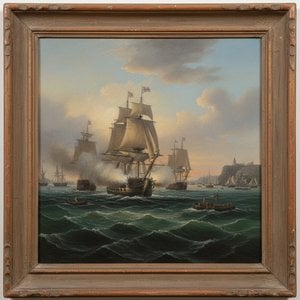
Thomas Luny: A Master of the Waves – Capturing the Spirit of Britannia’s Naval Age
Thomas Luny, a name inextricably linked to the dramatic and meticulously rendered depictions of naval battles and coastal scenes that defined much of 19th-century British art, emerged from the rugged Cornish coastline in 1759. His life wasn't one of formal academic training, but rather a profound immersion into the world of the sea – a world he captured with an unparalleled blend of technical skill, dramatic flair, and a deep understanding of the era’s spirit. Luny’s legacy isn’t simply about painting ships; it’s about documenting a pivotal moment in British history—an age of imperial ambition, relentless naval conflict, and a burgeoning Romantic fascination with nature's immense power.
Luny’s early years were shaped by his Cornish upbringing, a region steeped in centuries of seafaring tradition. The constant presence of ships in the bustling ports, the salty air carrying tales of distant voyages, and the ingrained knowledge of maritime life all contributed to an innate artistic sensibility. At approximately eleven years old, he embarked on a journey to London, where he became apprenticed to Francis Holman, a respected marine painter whose influence proved transformative. Holman’s mentorship extended beyond mere technique; it instilled in Luny a deep appreciation for accuracy and the intricate details of naval architecture – elements that would become hallmarks of Luny's distinctive style.
Developing a Distinct Artistic Voice: Beyond Topographical Accuracy
What immediately distinguished Luny from his contemporaries was his ability to transcend purely topographical depictions of ships. While he maintained an unwavering commitment to accuracy—a direct inheritance from Holman—he infused his paintings with a dynamic energy and dramatic flair that set him apart. He wasn’t content to simply record the appearance of a vessel; he sought to capture its essence within the context of its environment, conveying the feeling of being at sea – the raw power of storms, the tension of naval combat, and the quiet beauty of coastal landscapes. His canvases became stages for maritime drama, populated by meticulously rendered ships engaged in turbulent waves or locked in fierce battles.
This shift towards emotional expression aligned Luny with the core tenets of the Romantic movement, which emphasized imagination, intuition, and a profound connection to nature’s sublime power. He skillfully employed light and shadow, creating a sense of depth and realism that drew viewers into the heart of his scenes. The brushwork itself often mirrored the energy he sought to portray – bold and vigorous for depictions of conflict, more delicate and nuanced for tranquil coastal views. This versatility allowed him to tackle a wide range of subjects within the maritime realm, from grand naval engagements to intimate portraits of vessels at anchor.
Naval Life and Historical Record: A Window into Britannia’s Golden Age
Luny's paintings offer an invaluable visual record of naval life during a period of immense change and expansion. His works aren’t merely aesthetically pleasing; they are historical documents, providing insights into ship design, naval tactics, and the daily realities faced by sailors. He meticulously documented vessels like HMS 'Victory', capturing their form and function with remarkable precision. His depictions of battles such as the Bombardment of Algiers (1816) and engagements like the Raking Of The ‘Salvador Del Mundo’ At The Battle Of Cape St Vincent are not just illustrations of military action; they are windows into a world of strategy, courage, and sacrifice.
Beyond grand naval conflicts, Luny also demonstrated a sensitivity to quieter moments – peaceful coastal scenes like Fishing Scene, Teignmouth Beach And The Ness, Devon, showcasing his versatility and ability to capture the diverse facets of maritime life. These scenes offer glimpses into an era of national pride, imperial expansion, and the constant interplay between humanity and the unforgiving sea. He wasn’t simply glorifying naval power; he was documenting a way of life, acknowledging both its heroism and its hardships.
Later Years and Enduring Legacy
Despite facing challenges in his later years, including arthritis that impacted his hands, Luny remained dedicated to his art until his death in Teignmouth in 1837. He continued to produce works of exceptional quality, demonstrating a remarkable resilience and unwavering passion for his craft. His paintings are now held in prestigious collections worldwide, including the National Maritime Museum in Greenwich, a testament to their artistic merit and historical significance.
Thomas Luny’s legacy extends far beyond mere technical skill; he possessed an ability to imbue his canvases with a sense of drama and authenticity that continues to resonate with viewers today. He wasn't simply painting ships; he was telling stories—stories of courage, conflict, and the enduring allure of the sea. His work remains a vital link to a bygone era, offering a captivating window into the world of naval warfare, maritime commerce, and the lives of those who braved the waves.
- Born: Cornwall, United Kingdom (1759)
- Died: 1837
- Influences: Francis Holman, Romanticism, the maritime world of 18th and 19th century Britain.
- Notable Works: The Bombardment Of Algiers, East Indian ‘cumberland’ Off Dover, Men-o'-war And Figures On The Shore At Teignmouth
Otázky a odpovede
Kde a kedy sa narodil/a Thomas Luny?
Thomas Luny sa narodil v meste Cornwall v roku 1759.
Pod akými ďalšími menami je známy/á Thomas Luny?
Thomas Luny je známy aj pod menom Luny.
Kde nájdem diela umelca Thomas Luny zoradené podľa techniky?
Ak chcete nájsť všetky diela umelca Thomas Luny v konkrétnej technike, navštívte jeho stránku Všetky médiá.
Kde si môžem pozrieť farebnú paletu tvorby umelca Thomas Luny?
Spôsob využitia farieb u umelca Thomas Luny v rámci diel uvedených na táto webstránka je možné študovať na stránke Genetika palety umelca.
Kde môžem nájsť štatistiky o dieloch umelca Thomas Luny?
Štatistiky o dielach umelca Thomas Luny sú dostupné na jeho stránke Štatistiky.
V akom meste a v ktorej krajine sa narodil/a Thomas Luny?
Thomas Luny sa narodil v meste Cornwall v krajine Spojené kráľovskosti.
Kde nájdem diela umelca Thomas Luny zoradené podľa umeleckých smerov?
Príspevky z movementov, v ktorých tvoril Thomas Luny, si môžete pozrieť na stránke Všetky smery umelca, ktorá zoradila diela podľa jednotlivých umeleckých smerov.
V akom historickom období tvoril/a Thomas Luny?
Thomas Luny tvoril v období Raná modernosť. Toto obdobie zaradením umeleckej činnosti umelca do historického kontextu definuje.