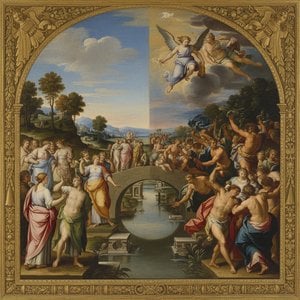
The Bolognese Tradition
Bologna, 1715. The air in the city carries the weight of a long-standing artistic lineage. Giuseppe Varotti enters this world, shaped by the hand of his father, Pier Paolo Varotti. The training is rigorous, rooted in the shadow of Giuseppe Maria Crespi. It is a lineage of brushstrokes and specific visual languages. Varotti does not merely learn to paint; he learns to navigate the transition between the heavy drama of the late-Baroque and the lighter, more decorative sensibilities of the Rococo.
His early years are defined by this apprenticeship. He absorbs the techniques of his father, refining a style that favors sacred and historical narratives. The brush moves with a purpose dictated by the religious fervor of the era, yet there is a distinct shift in the way light and shadow interact on his canvases. He moves through the Bolognese art scene not as a radical, but as a skilled practitioner of the established order.
Technical Focus and Subject Matter
The work of Varotti often centers on the tension of biblical and historical moments. He finds his voice in the depiction of justice and divine intervention. His compositions frequently utilize monochrome oil on paper, a choice that emphasizes form and light over excessive color. This technique lends a certain gravity to his subjects, stripping away the distractions of a full palette to focus on the essential drama of the scene.
His repertoire includes several significant thematic explorations:
- The Triumph of David
- The Banquet of Ahasuerus
- The Judgment of Solomon
- The Expulsion of the Merchants from the Temple
- St. Roch
Legacy and Influence
By the time he reaches the end of his life in Bologna in 1780, Varotti has established a clear presence in the regional art scene. His influence extends through his pupils, most notably Jacopo Alessandro Calvi. The transmission of his method ensures that the specific nuances of his training continue into the next generation. His works, such as those held in the Gemäldegalerie, Staatliche Museen zu Berlin, remain as physical records of this period of transition in Italian painting.