The Architect of Color: The Life and Legacy of Gene Bernard Davis
In the vibrant tapestry of mid-century American abstraction, few threads shine as brightly or as rhythmically as those woven by Gene Bernard Davis. A pioneer of the Color Field movement, Davis possessed a singular ability to transform the canvas into a rhythmic experience of light and motion. Born in Brooklyn, New York, in 1920, his artistic journey was not one of immediate abstraction but rather a gradual, profound evolution shaped by a keen observational eye and an unwavering dedication to color theory. His early years were marked by a fascinating confluence of experiences, including a youthful immersion in sports journalism and a deep engagement with the social landscape of Washington D.C., which would later inform his unique perspective on visual rhythm.
Davis’s artistic sensibilities were deeply rooted in the teachings of the European avant-garde. His formal training at Yale University under the legendary Josef Albers proved transformative, instilling in him a fascination with geometric abstraction and the complex mechanics of optical illusions. From Albers, Davis learned that color could communicate emotion and intellect simultaneously, a conviction that became the heartbeat of his career. He drew inspiration from the structured precision of Piet Mondrian and the perceptual harmonies of Albers, blending these influences to create a style that was both mathematically disciplined and emotionally resonant.
A Symphony of Stripes: Technique and Innovation
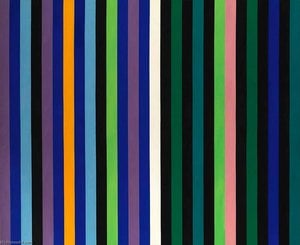
The true breakthrough for Davis arrived in 1953 with his monumental canvas, “Bay.” Executed in evocative shades of blue, this work established him as a visionary innovator within the Washington Color School. It was here that he perfected his signature technique: the deliberate layering of vertical and horizontal stripes, meticulously calibrated to create an illusion of depth, vibration, and movement. For Davis, the stripe was never merely decorative; it was a scientific tool used to investigate the fundamental principles of color perception and the relationship between pigment and surface texture.
As his career progressed, his palette expanded into breathtaking explorations of chromatic energy. His works often featured:
- Chromatic Vibrancy: The use of bold, juxtaposed colors such as red, yellow, blue, and green to create a sense of pulsating light.
- Geometric Precision: A mastery of the stripe pattern to guide the viewer's eye across the canvas in a rhythmic dance.
- Scale and Presence: Large-scale compositions, such as “The Red Witch” (1966), designed to fill the viewer's entire field of vision and envelop them in color.
This exploration reached iconic heights in works like “Flower Machine” (1964), where a colorful striped pattern of pink, purple, orange, and blue evokes a sense of joy and organic creativity, blending the boundaries between geometric abstraction and the essence of nature.
Historical Significance and Enduring Vision
Gene Bernard Davis stands as a monumental figure in the history of 20th-century art, bridging the gap between the raw energy of Abstract Expressionism and the calculated precision of Post-Painterly Abstraction. His ability to manipulate the viewer's perception through color alone helped define the aesthetic of the Washington Color School, leaving an indelible mark on American modernism. Even in his later works, such as the striking 1984 piece “Color Needles,” he continued to refine his use of gold and brown lines, proving that his fascination with Op Art and geometric rhythm remained undiminished.
Today, the legacy of Davis lives on through the enduring power of his canvases. He remains a master of the chromatic experience, reminding us that art can be both a cerebral investigation of light and a deeply visceral encounter with beauty. His work continues to captivate collectors and historians alike, serving as a testament to a life spent decoding the infinite possibilities of the spectrum.