Dwight William Tryon: The Silent Symphony of Light and Shadow
Dwight William Tryon, born in Hartford, Connecticut, on August 13, 1849, emerged from the quiet landscapes of New England as a painter deeply attuned to the subtle poetry of nature. His early life, marked by the sudden loss of his father, instilled within him a profound connection to the rural world – a connection that would become the very foundation of his artistic vision and define his enduring legacy as one of America’s foremost Tonalist painters. His upbringing on his grandparents' farm in East Hartford provided an intimate familiarity with the rhythms of the countryside, fostering a keen observation of light, color, and texture that he would later translate onto canvas with remarkable sensitivity. Without formal training initially, Tryon’s artistic journey began organically, fueled by a natural inclination and a deep appreciation for the beauty surrounding him. He honed his skills through self-study, meticulously sketching the rolling hills, dense forests, and shimmering waterways of Connecticut, patiently capturing the ephemeral effects of light and shadow. This dedication culminated in his first sale in 1870 – a modest beginning that nonetheless ignited his passion and set him on a path toward recognition. Subsequent local exhibitions further showcased his burgeoning talent, hinting at a promising career destined to gain wider acclaim.The Parisian Awakening: Influences and Early Style
Driven by an ambition to refine his craft and immerse himself in the artistic currents of Europe, Tryon embarked on a transformative journey to France in 1876. He enrolled in the atelier of Jacquesson de la Chevreuse at the École des Beaux-Arts in Paris, seeking formal training and exposure to the established artistic traditions of the continent. However, his education extended far beyond the confines of the classroom; he actively sought guidance from a constellation of influential artists, including Charles-François Daubigny, Henri Harpignies, and Jean Baptiste-Antoine Guillemet – masters renowned for their mastery of light, color, and atmospheric perspective. Initially, Tryon’s style leaned towards Luminism—a movement characterized by its emphasis on capturing the effects of natural light and creating a sense of luminous atmosphere through subtle gradations of tone. Yet, as he spent time in France, he became increasingly drawn to the principles of the Barbizon School – a revolutionary movement that prioritized direct observation of nature, eschewed academic conventions, and favored a more subdued palette. The Barbizon painters, working primarily outdoors (“en plein air”), sought to capture the essence of their subjects with immediacy and honesty, rejecting the artificiality of studio painting. The influence of James McNeill Whistler was particularly profound; Tryon admired Whistler’s ability to evoke mood and atmosphere through carefully controlled color harmonies—a technique that would become a hallmark of his own style.Shaping a Distinctive Palette: Tonalism Takes Root
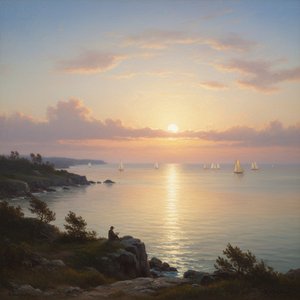
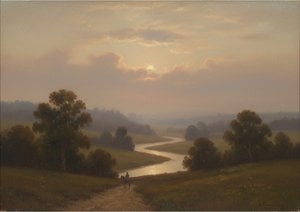
Returning to the United States in 1881, Tryon began to develop a distinctly personal artistic voice – one that fused the lessons he had learned in Paris with his deep-rooted connection to the American landscape. He embraced the principles of Tonalism—a movement characterized by its emphasis on subtle tonal variations and atmospheric effects, often achieved through the use of muted colors and delicate brushwork. Unlike the brighter, more vibrant palettes favored by Impressionists, Tryon’s paintings were imbued with a sense of quiet contemplation and understated beauty. His compositions frequently featured groupings or broken rows of trees positioned in the middle distance, acting as visual anchors that connected a luminous sky above to a foreground marsh or pasture below. These scenes—often depicting autumnal landscapes—were rendered with remarkable sensitivity, capturing the fleeting effects of light and shadow with exquisite detail. His masterful control of color and texture allowed him to evoke a profound sense of atmosphere – a feeling of stillness, serenity, and almost melancholic beauty. Works like *Salt-Marsh, December* exemplify this approach, showcasing his ability to capture the subtle nuances of light and color in a way that resonated deeply with viewers.Recognition and Legacy: Patronage and Smith College
Throughout the 1890s and early 1900s, Tryon’s work gained increasing recognition within the American art world. He exhibited regularly at prestigious venues such as the Pennsylvania Academy of Fine Arts and the Montross Gallery, attracting the attention of discerning collectors and critics alike. A pivotal moment in his career came with the patronage of Charles Lang Freer, an industrialist and art connoisseur who became Tryon’s most important supporter. Freer acquired dozens of Tryon's paintings, providing him with the financial security to dedicate himself fully to his artistic pursuits. Furthermore, Freer’s generosity extended beyond mere monetary support; he collaborated with Tryon on interior design projects for his Detroit mansion, further solidifying their creative partnership. In 1893, Tryon was commissioned to decorate Freer's Detroit mansion with a series of murals depicting the changing seasons—a testament to his artistic skill and reputation. Beyond his commercial success, Tryon also found fulfillment in teaching, serving as a professor at Smith College from 1886 until his retirement in 1923. During this time, he established the Tryon Gallery of Art, nurturing the talents of aspiring artists and contributing to the development of the college’s art program. Dwight William Tryon passed away on July 1, 1925, in South Dartmouth, Massachusetts, leaving behind a substantial body of work that continues to be celebrated for its quiet beauty, atmospheric depth, and profound connection to the natural world. His paintings—now housed in prominent collections such as the Smithsonian American Art Museum and the Freer Gallery of Art—stand as enduring testaments to his artistic vision and his lasting contribution to the history of American art.Key Works
* *Salt-Marsh, December* (1879) * *Spring* (c. 1880) * *Newbury Haystacks in Moonlight* (1891) * *The First Leaves* (1889 - Carnegie Prize Winner)Otázky a odpovede
Ako nájdem diela od Dwight William Tryon v konkrétnej farebnej palete?
Ak chcete nájsť diela umelca Dwight William Tryon v konkrétnej farebnej palete, navštívte jeho stránku Podľa farebnej palety.
Môžem si prehliadnuť diela umelca Dwight William Tryon podľa farebného spektra?
Stránka Spektrálny index organizuje diela umelca Dwight William Tryon podľa farieb.
Kde nájdem diela umelca Dwight William Tryon zoradené podľa techniky?
Diela umelca Dwight William Tryon si môžete prehliadnuť podľa použitého média na stránke Všetky médiá pre Dwight William Tryon.