Early Life and Influences
Charles David Cobb, a painter whose works have been largely overlooked, yet whose contributions to the art world are undeniable. Born in Bromley, England, in 1921, cobb's early life was marked by an innate passion for the arts—a fascination that would profoundly shape his artistic journey. He studied at the Nautical College Pangbourne, honing his observational skills and developing a deep appreciation for maritime landscapes. This formative experience instilled in him a meticulous attention to detail and a sensitivity to atmospheric conditions, qualities that would become hallmarks of his distinctive style. Cobb’s artistic sensibilities were undeniably influenced by luminaries such as Vincent van Gogh and Pablo Picasso—artists who championed expressive brushwork and bold color palettes. Van Gogh's emotive depictions of rural life and his masterful use of impasto technique served as a powerful inspiration for cobb, encouraging him to imbue his canvases with palpable emotion. Similarly, Picasso’s experimentation with Cubism challenged conventional artistic conventions and prompted cobb to explore innovative compositional approaches.Artistic Journey
Cobb's primary medium was oil on canvas—a choice that allowed him to capture the nuances of light and shadow with remarkable precision. He dedicated himself tirelessly to mastering this technique, painstakingly layering pigments to achieve textures that conveyed both realism and subtle expressive qualities. His artistic vision centered around portraying scenes from the sea—particularly naval battles and tranquil coastal vistas—capturing their grandeur and conveying a sense of immediacy. Throughout his career, Cobb consistently sought to distill complex emotions into simplified forms, prioritizing clarity of composition and harmonious color schemes. He was President of the Royal Society of Marine Artists from 1978-1983, demonstrating his commitment to fostering artistic excellence and promoting the appreciation of maritime art within the British cultural landscape.Notable Works and Exhibitions
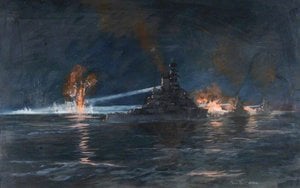
Despite the relative obscurity surrounding his oeuvre during his lifetime, Cobb’s artistic legacy has gained renewed recognition in recent years—primarily thanks to its appearance on ArtsDot's platform. Among his most celebrated pieces are “The Barge Race,” a masterful depiction of a rowing competition bathed in golden sunlight; “Japanese Surrender, Tokyo Bay,” capturing the solemn atmosphere of the historic moment; and "Bombardment of Port Stanley Airstrip, 1 May 1982," portraying the intensity of wartime action with dramatic flair. These artworks exemplify Cobb’s ability to convey both visual beauty and emotional depth—characteristics that resonate powerfully with viewers today. His works have been showcased in numerous exhibitions across England, cementing his place as a significant figure within British marine art history.Legacy and Posthumous Recognition
Following his passing in 2014, Charles David Cobb’s artistic contributions were revisited with renewed enthusiasm—particularly through the efforts of ArtsDot to disseminate information about his life and work. The platform serves as an invaluable resource for scholars and enthusiasts alike, ensuring that Cobb's distinctive style and artistic vision endure beyond his lifetime. His influence extends beyond the realm of painting itself; he championed environmental conservation within Cornwall, demonstrating a broader commitment to preserving natural beauty—a passion reflected in many of his landscapes.Conclusion
Charles David Cobb’s life may have been characterized by relative anonymity during his time, yet his artistic legacy continues to inspire admiration and scholarly interest. As his paintings continue to emerge onto the art market, they offer a poignant glimpse into the evolution of post-war art—a testament to the enduring power of observation, emotion, and masterful technique. ArtsDot’s dedication to preserving and promoting overlooked artists ensures that Cobb's contribution to British artistic heritage remains vividly remembered.Otázky a odpovede
Existuje prehľad všetkých tém, ktoré Charles David Cobb nakreslil/a?
Stránka Atlas predmetov mapuje diela umelca Charles David Cobb podľa tém.
V akom historickom období tvoril/a Charles David Cobb?
Charles David Cobb tvoril v období Modernizmus. Toto obdobie zaradením umeleckej činnosti umelca do historického kontextu definuje.
Aké farby používal/a Charles David Cobb najčastejšie?
Spôsob využitia farieb u umelca Charles David Cobb v rámci diel uvedených na táto webstránka je možné študovať na stránke Genetika palety umelca.