1813 - 1876

Základné informácie

  • Copyright status: Public domain
  • Top 3 works:
    • Mountain Landscape with the Wiesbachhorn
    • Wengeralpe in the Berner Oberland (Jungfrau and Mönch)
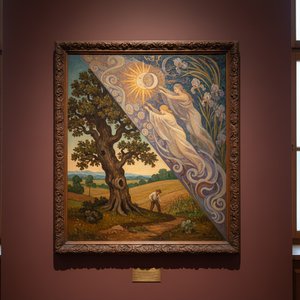
    • landscape: river-valley in the mountains + 3 woman
  • Color intensity: monochromatic
  • Died: 1876
  • Born: 1813, Vienna, Austria
  • Art period: 19th Century

The Life and Art of Anton Hansch

Born in Vienna, Austria, Anton Hansch began his journey in a family that operated a factory for artificial flowers. This early environment served as his training before he attended the Vienna Academy to become a flower painter. Between 1826 and 1836, he studied under Josef Mössmer. Before transitioning into a landscape painter, he spent time making artificial flowers. His artistic evolution saw him move from a baroque classicist style in his early landscapes toward a more naturalistic tradition, which eventually developed into an idealized, heroic style.

Hansch's travels took him through Germany, Austria, Belgium, Switzerland, and Italy. His mastery of the landscape was recognized through various honors, including the Grand Court Prize and the Rosenbaum Composition Prize. In 1839, he was awarded first prize for landscape painting by the Vienna Academy. His work has been held in prestigious collections, such as the Kunsthistorisches Museum, the Museum of Fine Arts, Budapest, the Salzberg Museum, the Lichtenstein Museum Princely Collection, and the Vienna Museum.

Later Years and Legacy

Throughout his career, Hansch received numerous accolades, including an appointment to the Academy of Fine Arts in 1848 and becoming a member of the Vienna Künstlerhaus in 1861. His talent was noted by royalty; for instance, a painting of a night scene titled Unter den Linden won a purchase prize by the Belvedere in Vienna, and a work depicting Lake Langbath was presented as a gift to the Emperor Franz Josef. He was also awarded the Knight's Cross of the Franz Josef Order and the Order of Guadalupe prize from Emperor Maximillian I of Mexico.

Following a financial crisis during the Panic of 1873, Hansch settled in Salzburg in 1875, where he focused on the surrounding landscapes, including the Golling waterfall, Berchtesgaden, Königssee, and Chiemsee lake. In his final years, as his eyesight began to fail, he remained active in the region until his death in Salzburg.

Krátky kvíz

Pri každej otázke je iba jedna správna odpoveď.

Otázka 1:
In which city was Anton Hansch born?
Otázka 2:
Before becoming a landscape painter, what did Hansch make?
Otázka 3:
Which institution did Hansch attend as a pupil from 1826–1836?
Otázka 4:
What event in 1873 caused Hansch to lose his fortune?
Otázka 5:
In which city did Anton Hansch die?

Otázky a odpovede

Môžem si prehliadnuť diela umelca Anton Hansch podľa nálady?

Diela umelca Anton Hansch si môžete prejsť podľa nálady na jeho stránke Izba nálad, kde sú diela usporiadané podľa ich vyjadrených nálad.

Kde si môžem pozrieť všetky diela umelca Anton Hansch?

Všetky diela umelca Anton Hansch na táto webstránka si môžete pozrieť na jeho stránke Všetky diela umelcov.

Kde a v ktorom roku sa narodil/a Anton Hansch?

Anton Hansch sa narodil v meste Vienna v roku 1813.

Ako nájdem všetky diela umelca Anton Hansch v konkrétnej technike?

Ak chcete nájsť všetky diela umelca Anton Hansch v konkrétnej technike, navštívte jeho stránku Všetky techniky.

Odkiaľ pochádza Anton Hansch?

Anton Hansch sa narodil/a v krajine Austria.

Kde nájdem diela umelca Anton Hansch zoradené podľa umeleckých smerov?

Stránka Všetky umelecké smery uvádza diela umelca Anton Hansch rozdelené podľa umeleckých smerov.

Kde nájdem diela umelca Anton Hansch usporiadané podľa farieb?

Spektrálny výber umelca Anton Hansch je stránka, ktorá organizuje jeho diela podľa farieb.

Aké farby používal/a Anton Hansch najčastejšie?

Genetika palety umelca Anton Hansch je stránka, ktorá predstavuje farebný profil jeho tvorby.

Pod akými ďalšími menami je známy/á Anton Hansch?

Anton Hansch sa objavuje aj pod inými menami: Hantsch Anton, Hansch, A. Hansch, Hansch Anton.