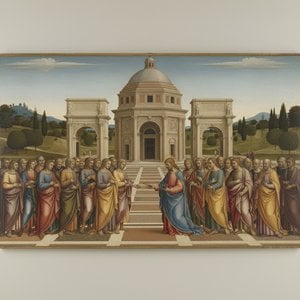
Agnolo Bronzino: The Sculptor's Touch in Florentine Mannerism
Agnolo di Cosimo, known to history as Bronzino, emerged from the vibrant artistic landscape of Renaissance Florence in 1503, a period already brimming with genius. Born the son of a butcher, his path diverged sharply from familial trade, guided instead by an innate talent that would see him become one of the most sought-after portraitists of his era and a defining figure of Mannerism. His early training began with Raffaellino del Garbo, but it was under the tutelage of Jacopo da Pontormo that Bronzino’s artistic sensibilities truly took shape. While absorbing Pontormo's innovative style—characterized by expressive emotion and dynamic movement—he ultimately forged his own distinct voice—one characterized by a cool composure and refined detail markedly different from his teacher’s often emotionally charged works. This early period was also influenced by studies with Andrea del Sarto, exposing him to the legacies of Michelangelo and Leonardo da Vinci, foundational influences that would subtly permeate his mature style. The young Bronzino quickly demonstrated an aptitude for capturing not just physical likeness but a certain psychological depth, even in his earliest commissions.Early Influences and Artistic Formation
Bronzino’s formative years were marked by exposure to the artistic currents of Florence under Pontormo and Sarto. Pontormo's dramatic use of color and distorted perspective—particularly evident in *Joseph with Jacob in Egypt*—challenged conventional aesthetic norms, pushing boundaries of representation and fostering experimentation. Bronzino absorbed these stylistic innovations, adapting them to his own distinctive approach. Simultaneously, the monumental sculptures of Michelangelo instilled in him a profound appreciation for anatomical precision and sculptural form—a fascination that would inform his later portraits and contribute to their remarkable realism. Leonardo da Vinci’s meticulous observation of nature and mastery of sfumato—the subtle blending of tones to create atmospheric depth—served as another crucial inspiration, shaping Bronzino's technique and elevating the expressive potential of his paintings. These influences coalesced into a synthesis that would define Bronzino’s artistic vision throughout his career.The Medici Patronage and Florentine Court Style
Bronzino ascended to prominence thanks to the unwavering patronage of Cosimo I de’ Medici, Duke of Tuscany. Recognizing Bronzino's exceptional talent, Cosimo appointed him as the official court painter—a position he held until his death in 1572—solidifying his reputation as Florence’s foremost artistic figure. During this period, Bronzino produced a prolific output of portraits depicting members of the Medici family and their entourage—works that epitomized Florentine court style: characterized by aristocratic aloofness, polished elegance, and an unwavering commitment to formal conventions. These paintings weren't merely decorative; they functioned as powerful statements of dynastic authority and served as visual emblems of Medici prestige. The meticulous attention to detail—the sumptuous fabrics, the glittering jewelry, the carefully crafted poses—reflected Cosimo’s desire to project an image of grandeur and sophistication. Bronzino skillfully captured not only physical likeness but also psychological nuance—revealing glimpses of inner character through subtle expressions and gestures—establishing himself as a master of portraiture who elevated the genre to new heights.A Mannerist Vision: Sculpture's Influence on Painting
Bronzino’s artistic style is fundamentally rooted in Mannerism—a movement that emerged in Florence during the mid-16th century as a reaction against the idealized beauty and harmonious balance championed by the High Renaissance. Unlike his predecessors, Bronzino rejected naturalistic representation in favor of stylized forms, exaggerated proportions, and an emotionally restrained aesthetic. He embraced elongated figures, flattened perspectives, and dramatic lighting—techniques that prioritized intellectual contemplation over sensory pleasure. This stylistic choice was profoundly influenced by Michelangelo’s sculptures—particularly *David*—which demonstrated a mastery of anatomical precision combined with expressive dynamism. Bronzino internalized Michelangelo's sculptural ethos, applying it to his paintings—resulting in works that possessed an almost sculptural quality—characterized by smooth surfaces and refined modeling. His portraits are devoid of sentimental emotion; instead, they convey an aura of dignified composure—reflecting Cosimo’s desire for a visual language that projected intellectual sophistication rather than emotional vulnerability.Legacy and Enduring Influence
Agnolo Bronzino's contribution to Florentine art history is undeniable. He established himself as the premier portrait artist in Florence, shaping the aesthetic standards of his time and influencing generations of painters who followed him. His distinctive Mannerist style—characterized by cool composure, refined detail, and sculptural form—became a hallmark of aristocratic representation throughout Europe. Bronzino’s meticulous technique—particularly his mastery of sfumato—elevated the expressive potential of painting—demonstrating that art could transcend mere imitation of nature to achieve profound psychological insight. His enduring legacy resides not only in his iconic portraits but also in his pioneering role as a sculptor and his unwavering devotion to artistic excellence—solidifying his place among the greatest artists of the Renaissance. He passed away in Florence in 1572, leaving behind a body of work that continues to inspire admiration and scholarly debate—a testament to Bronzino’s genius and his indelible mark on art history.Otázky a odpovede
Ako nájdem diela od Agnolo Bronzino na konkrétnu tému?
Diela umelca Agnolo Bronzino si môžete preskúmať podľa kľúčových slov na jeho stránke Podľa kľúčových slov. Každé kľúčové slovo spája súvisiace diela do tematických celkov.
Existuje časová os diel umelca Agnolo Bronzino?
Diela umelca Agnolo Bronzino si môžete pozrieť v chronologickom poradí na jeho stránke Chronológia diel.
Kde môžem nájsť štatistiky o dieloch umelca Agnolo Bronzino?
Štatistiky o dieloch umelca Agnolo Bronzino nájdete na jeho stránke Štatistiky.