

R.A. Benjamin Williams: Victorian Genre Painting & Social Commentary

Obsah článku
The Rise of Genre Painting: A Victorian Shift in Artistic Focus
Victorian painting refers to the distinctive styles of painting in the United Kingdom during the reign of Queen Victoria (1837–1901). Victoria's early reign was characterised by rapid industrial development and social and political change, which made...
The early decades of Victoria’s reign witnessed a profound shift in the artistic landscape, moving away from the grand historical narratives and idealized portraits that had dominated previous eras. This wasn't merely a change in subject matter; it reflected a burgeoning middle class with disposable income and a desire to see their own lives – their everyday experiences, domestic comforts, and quiet moments – represented on canvas. Genre painting, depicting scenes of ordinary life, rose to prominence, offering a compelling alternative to the aristocratic themes favored by the Royal Academy for so long. Artists began to scrutinize the world around them with unprecedented realism, capturing not just *what* people did, but *how* they lived, their social interactions, and the subtle nuances of Victorian society. This burgeoning interest coincided with advancements in printing technology, allowing wider dissemination of images and fostering a broader appreciation for art beyond the confines of elite circles.
Benjamin Williams Leader: Biography & Early Influences
Born in Worcester in 1831, Benjamin Williams Leader emerged as one of the most successful practitioners of this new wave of genre painting. His artistic lineage was steeped in a reverence for nature; his father, Edward Leader Williams, was a close friend of John Constable and instilled in young Benjamin a deep passion for naturalism and meticulous observation. While working alongside his father in his office, Leader diligently pursued studies at the Worcester School of Design, supplementing formal training with countless hours sketching directly from life – often accompanying his father on painting excursions along the River Severn. This early immersion in the English countryside would become a defining characteristic of his oeuvre.
Unlike Constable, who faced considerable criticism for his naturalistic style during his lifetime, Leader benefited from a more receptive art market. He entered the Royal Academy Schools at age 23 and immediately garnered attention with works that showcased his remarkable talent for capturing light, atmosphere, and detail. His early success allowed him to dedicate himself fully to painting, establishing a career built on portraying the beauty and tranquility of rural England.
Naturalism and Detail: Examining Leader’s Distinctive Style
Leader's paintings are immediately recognizable for their painstaking attention to detail and unwavering commitment to naturalism. He wasn’t simply recreating landscapes; he was meticulously documenting them, capturing the subtle variations in foliage, the play of light on water, and the textures of weathered wood and stone. This dedication extended beyond mere visual accuracy; Leader sought to convey the *feeling* of a place – the crispness of the air, the warmth of the sun, the quiet solitude of the countryside. His technique involved layering thin glazes of oil paint to create depth and luminosity, resulting in surfaces that shimmer with life.
He masterfully balanced precise rendering with broader brushwork, avoiding a static or overly-polished appearance. This skillful interplay prevented his work from becoming merely photographic and instead imbued it with a sense of vitality and movement. His compositions are often carefully constructed to draw the viewer’s eye into the scene, creating an immersive experience that evokes a feeling of peaceful contemplation.
Social Commentary Embedded Within Pastoral Scenes
Social realism is work produced by painters, printmakers, photographers, writers, filmmakers and some musicians that aims to draw attention to the real socio-political conditions of the working class as a means to critique the power structures behind...
While Leader is celebrated for his idyllic landscapes, a closer examination reveals subtle yet poignant social commentary woven into his work. His paintings often depict scenes of rural life with a quiet dignity, portraying the working class not as objects of pity but as individuals deserving of respect and admiration. Cottages are rendered with care and affection, suggesting a sense of domestic warmth and stability. Farmhands are shown engaged in their labor, highlighting the importance of hard work and connection to the land.
This wasn’t overt political messaging; rather, it was a reflection of the changing social landscape of Victorian England – a growing awareness of class disparities and a desire for greater empathy and understanding. Artists like Leader played a crucial role in shaping public perception, offering nuanced portrayals of everyday life that challenged traditional hierarchies and celebrated the virtues of simplicity and authenticity. Samuel Edmund Waller’s “Success” (1881), with its depiction of leisurely countryside pursuits, offers a complementary perspective on Victorian leisure and social aspirations.
Leader's Legacy and Influence on British Landscape Art
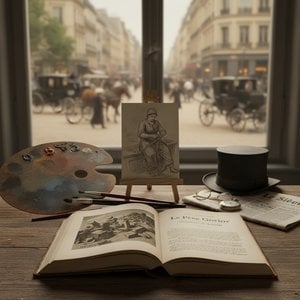 The Enduring Legacy of 19th-Century Realism: A Reflection of Society & Artistic Innovation
Explore the captivating world of 19th-century Realism! Discover key artists, masterpieces & the social commentary behind this influential art movement. Expert insights at .
Benjamin Williams Leader enjoyed remarkable success throughout his long career, exhibiting annually at the Royal Academy for over sixty years. He was elected an Associate in 1883 and a full Royal Academician in 1898 – accolades that cemented his position as one of Britain’s leading landscape painters. His influence extended beyond his own prolific output; he inspired a generation of artists to embrace naturalism and to find beauty in the ordinary.
While later movements, such as Impressionism and Modernism, challenged the conventions of Victorian painting, Leader's work continues to resonate with audiences today. His paintings offer a glimpse into a bygone era – a time of rapid change, social upheaval, and a growing appreciation for the beauty and tranquility of the English countryside. Works by artists like William Powell Frith, known for his detailed genre scenes, share a similar commitment to realism and social observation.
Collecting Benjamin Williams Leader Today
Today, paintings by Benjamin Williams Leader are highly sought after by collectors who appreciate his masterful technique, evocative atmosphere, and subtle social commentary. Major collections of his work can be found at Worcester City Art Gallery & Museum, the Victoria and Albert Museum, and Birmingham Museum and Art Gallery. His enduring appeal lies in his ability to capture not just a place but a feeling – a sense of peace, tranquility, and connection to nature.
For those seeking to acquire a piece of Victorian history, ArtsDot
offers high-quality reproductions of Leader’s most iconic works. Whether you prefer the intimacy of a small oil painting or the grandeur of a large canvas print, we can help you bring the beauty and tranquility of Benjamin Williams Leader's world into your home. Explore our collection today and discover the enduring legacy of this remarkable British artist.Súvisiace články

Thomas Barker of Bath: Landscape Painting & Societal Reflection in Early 19th-Century England
Explore the life & work of Thomas Barker of Bath, a key figure in 19th-century English Romanticism. Discover his Parisian success, iconic paintings like 'The Bride of Death', and lasting artistic legacy. Learn more at ArtsDot.


Thomas Phillips: Portraiture, Patronage & the Rise of Victorian Society Art
Explore the life & work of Thomas Phillips (1770-1845), a leading Victorian portrait painter renowned for his captivating portrayals of Britain's 'men of genius'. Discover his artistic journey, patronage, and lasting legacy.

