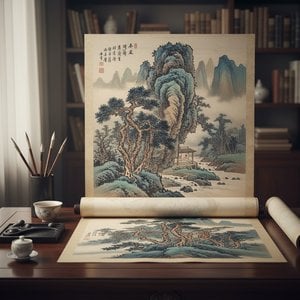
Wu Guxiang (1848–1903): The Poet Painter of Tranquility
Wu Guxiang (吳穀祥), born in Jiangsu Province, China, was a pivotal figure in the late Qing Dynasty’s artistic landscape. He emerged as a prominent Shanshui painter—a genre emphasizing idealized depictions of mountainous landscapes—whose work embodies both meticulous technique and profound philosophical contemplation. His art reflects the spirit of Neo-Confucianism, prioritizing harmony with nature and inner reflection alongside masterful brushwork.
Early Life & Education: Guxiang’s formative years were marked by a rigorous Confucian upbringing, instilled in him by his father, who recognized his artistic talent early on. He studied calligraphy and painting under renowned masters, honing his skills and absorbing the aesthetic principles of traditional Chinese art.
Influences: His artistic vision was deeply impacted by Tang Dynasty landscape painters like Wang Wei and Guo Xi, whose serene depictions of mountains and rivers served as models for Guxiang’s compositions. Furthermore, he embraced Zen Buddhism's emphasis on simplicity and mindfulness, translating into a restrained palette and understated brushstrokes.
The Art of Shanshui: Technique & Symbolism
Guxiang’s Shanshui paintings are characterized by exceptional mastery of ink wash technique—known as Guan hua qi shi. He skillfully employed layering, hatching, and blending to create textures that capture the misty grandeur of mountainous terrains. Beyond mere representation, his works convey deeper meanings rooted in Confucian cosmology. Pine trees, often depicted prominently, symbolize longevity and resilience – enduring symbols of virtue and spiritual fortitude. Waterfalls represent purity and transformation, mirroring the Buddhist concept of overcoming obstacles on the path to enlightenment.
Critical Reception: Contemporary critics lauded Guxiang's work for its aesthetic beauty and intellectual depth. He was recognized as one of the foremost Shanshui painters of his era, securing a place among the giants of Chinese art history.
Legacy & Historical Significance
Wu Guxiang’s influence extended far beyond his lifetime. His paintings continue to inspire artists and scholars alike, serving as benchmarks for Shanshui aesthetics. He championed a contemplative approach to artistic creation—emphasizing inner harmony and spiritual awareness alongside technical virtuosity. As a symbol of Neo-Confucian ideals embodied in visual art, Guxiang’s oeuvre remains an enduring testament to China's cultural heritage and its profound engagement with the natural world.
Continuing Influence: His stylistic innovations—particularly his use of subtle color gradations—influenced subsequent generations of painters. He solidified Shanshui painting as a genre dedicated to conveying moral and spiritual truths alongside visual splendor.
Explore the captivating world of Pu Xinyu (Puru), the last great literati painter. Discover his imperial heritage, masterful ink wash techniques & enduring legacy – a valuable addition to any discerning art collection.
Погрузитесь в мир искусства XIX века! От реализма до импрессионизма – 10 величайших картин, истории художников и вдохновение для вашего интерьера. Репродукции высокого качества на ArtsDot.com. Откройте всю коллекцию онлайн!
Bada Shanren, born into the imperial House of Zhu, sought refuge in Buddhist monasteries after the Ming Dynasty fell. How did political upheaval shape his art?
Где я могу увидеть цветовую палитру работ Wu Guxiang?
Цветовой профиль работ Wu Guxiang представлен на странице Палитра художника художника.
Как мне найти работы Wu Guxiang по определенной теме?
Работы Wu Guxiang можно найти по ключевым словам на странице художника По ключевым словам. Каждое ключевое слово объединяет соответствующие произведения искусства.
Известен ли Wu Guxiang под какими-либо другими именами или псевдонимами?
Wu Guxiang также известен под именами 吳穀祥.
Как мне найти работы Wu Guxiang в определенной цветовой гамме?
Работы Wu Guxiang можно просмотреть по цветовой палитре на странице По палитрам художника.
Где я могу посмотреть все работы Wu Guxiang?
Все работы Wu Guxiang на данный сайт можно найти на странице Все работы художника художника.
Насколько популярны произведения Wu Guxiang?
Для Wu Guxiang доступна страница Статистика просмотров, где представлена статистика произведений этого художника на данный сайт.
Можно ли посетить виртуальный музей работ Wu Guxiang?
Страница художника художника Wu Guxiang — это страница, на которой произведения автора представлены в виртуальной трехмерной галерее.
Как я могу проследить творческий путь Wu Guxiang по годам?
Существует хронология работ Wu Guxiang: на странице Хронология работ произведения художника расположены в порядке даты их создания.
Где можно найти работы Wu Guxiang, сгруппированные по направлениям в искусстве?
С направлениями, в которых работал Wu Guxiang, можно ознакомиться на странице Все направления, где произведения сгруппированы по стилям.