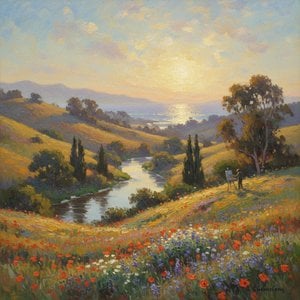
Soren Emil Carlsen: The Quiet Mastery of Light and Stillness
Soren Emil Carlsen (1848 or 53 – 1932) stands as a singular figure in American painting, embodying the harmonious blend of tonalism and Impressionism—a stylistic crossroads that yielded extraordinary results. Born in Copenhagen, Denmark, he embarked on an artistic journey marked by architectural studies followed by a transformative relocation to Chicago in 1872, where he swiftly established himself as “The American Chardin,” honoring the profound influence of Jean-Baptiste-Siméon Chardin’s approach to depicting the serene beauty of everyday objects.
- Early Life and Training: Carlsen's formative years were steeped in artistic tradition. His family fostered a passion for art, and he honed his skills at the Royal Academy in Copenhagen before dedicating himself to architectural design. However, it was his encounter with Lauritz Holst, a celebrated marine artist, that ignited his interest in capturing atmospheric effects on water—a technique that would subtly shape his later landscapes.
- Immigration and Parisian Influence: The decision to immigrate to the United States at age 19 proved pivotal. Immediately upon arrival, he adopted an alternative birthdate (1853), reflecting a desire for consistency with scholarly records. His time in Paris between 1872 and 1875 cemented his artistic vision under Chardin’s guidance—a master known for distilling emotion into simple forms and textures.
- The American Tonalist: Carlsen returned to Chicago armed with Parisian techniques, yet he retained the core tenets of tonalism. This aesthetic favored muted palettes, subtle gradations of light, and an unwavering focus on mood and atmosphere—a deliberate departure from Impressionistic vibrancy. His early works showcased a masterful ability to convey tranquility and contemplation through carefully rendered surfaces.
- Teaching Legacy: Carlsen’s dedication extended beyond his canvases; he became the inaugural instructor of drawing and painting at the Chicago Academy of Design, nurturing generations of aspiring artists. Later, he served as director of the California School of Design (now San Francisco Art Institute), shaping the artistic landscape of the West Coast—a role that cemented his reputation as a visionary educator.
- Later Career and Recognition: Carlsen continued teaching until his death in New York City in 1932, leaving behind an impressive oeuvre characterized by landscapes infused with Impressionistic light and color. He achieved considerable acclaim throughout his life, earning prestigious awards including the Samuel T. Shaw Purchase Prize and a Gold Medal at the Louisiana Purchase Exposition—a testament to his enduring contribution to American art history.
Carlsen’s artistic legacy resides in his ability to distill profound emotion into deceptively simple compositions. His paintings continue to resonate with audiences today because they capture not merely what he saw but *how* he felt—a characteristic that distinguishes him from many of his contemporaries and secures his place as one of the most influential artists of his era.