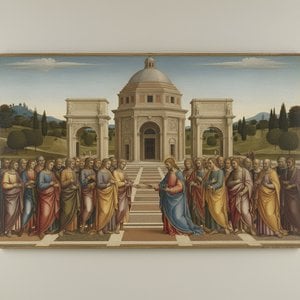
The Córdoba School and the Sacred Canvas
The air in Andalusia during the late fifteenth century carries the weight of religious devotion, a period where the brush was the primary tool for communicating the divine. Around 1460, Pedro Romana begins his presence in this landscape, eventually becoming a central figure in the Córdoba School. His hands move between the traditions of the local region and the shifting currents of European influence. He does not work in isolation; instead, his compositions reflect a dialogue between the meticulous detail of Flemish art and the structural clarity of the Italian Renaissance.
His career finds its rhythm in the service of the church. He specializes in the creation of altarpieces, those massive, decorated screens designed to anchor the spiritual life of a community. In 1488, the Museo de Bellas Artes in Córdoba holds a Virgin and Child that marks his early mastery. These works are not merely decorations; they are the visual focal points for local congregations, designed to bridge the gap between the earthly and the celestial through oil and panel.
Guilds and Financial Shadows
By 1515, Romana has ascended to a position of significant professional authority, elected as the president of the Guild of Saint Luke. This role confirms his status among the elite practitioners of his time, a man whose technical skill and leadership were recognized by his peers. Yet, the stability of his professional standing does not mirror his personal circumstances. The records of the era reveal a sudden, sharp descent into hardship.
The year 1528 brings a stark contrast to his previous prestige. Legal documents record his arrest for debt, a moment where the struggles of the material world collide with the dignity of his station. This period of financial difficulty marks a turning point in his later years, a shadow cast over a career that had previously been defined by institutional respect and religious commission.
The Final Brushstrokes
Even as his fortunes wavered, his output remained significant. The Adoration of the Magi, created for the altarpiece in the church of Espejo, remains a key marker of his contribution to the religious landscape of Córdoba. His work often utilizes specific symbolism to convey theological truths, such as the lilies and the pomegranate found in his Annunciation, which allude to purity and the fruit of the womb.
His legacy is preserved in the quiet halls of museums, where his ability to blend diverse European styles into a cohesive Spanish Renaissance voice is still visible. His life, spanning from his birth around 1460 to his death in 1536, remains etched in the wood and canvas of the altarpieces he left behind.