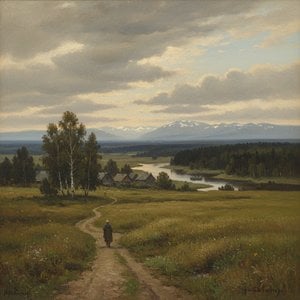
The Quiet Grace of Maria Feodorova
In the annals of late nineteenth-century Russian art, certain names resonate with a profound, quiet strength, capturing the fleeting essence of the natural world through a lens of disciplined observation. Maria Feodorova (1859–1934) stands as a testament to this enduring tradition. A dedicated landscape painter, her life and work were deeply intertwined with the rigorous academic training and the burgeoning artistic societies of her era. Her journey began in earnest in 1878, when she entered the prestigious Ophitsaia Khvostova School (OPH), a period that laid the foundational stones for her technical mastery and her sensitive approach to light and atmosphere.
Feodorova’s artistic development was marked by a commitment to both practice and service within the art community. Between 1881 and 1892, she served as a volunteer for the Imperial Academy of Arts (IAH), an experience that likely allowed her to immerse herself in the highest standards of classical technique while observing the evolving trends of the Russian landscape movement. This period of apprenticeship was not merely about skill acquisition but about absorbing the very soul of the academic tradition, which she would later translate into her own unique, evocative depictions of nature.
A Legacy of Landscape and Instruction
Beyond the canvas, Feodorova’s life was characterized by a pursuit of intellectual and professional growth. In 1892, she achieved a significant milestone by receiving a certificate for teaching in a girls' school, suggesting a person of great discipline and a desire to pass on the values of culture and aesthetics to the next generation. Her presence in the art world was solidified through her participation in several esteemed exhibitions, including those hosted by the St. Petersburg Society of Artists and the IAH. These venues provided her with a platform to showcase her ability to capture the subtle nuances of the Russian countryside.
Her work is often celebrated for its ability to evoke a sense of place and time, utilizing the landscape as a medium for emotional resonance. While much of her historical record focuses on her formal affiliations, the true impact of her art lies in the way she navigated the transition between the rigid academicism of the nineteenth century and the shifting artistic landscapes of the early twentieth century. Through her brush, the natural world was not merely documented but felt, leaving behind a legacy that honors the quiet beauty of the earth.