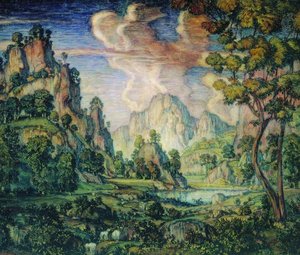
A Dreamer of Crimea: The Evocative World of Konstantin Bogaevsky
Konstantin Fyodorovich Bogaevsky, born in 1872 in the Crimean port city of Feodosia, was an artist whose work exists suspended between reality and reverie. His canvases aren’t merely depictions of landscapes; they are portals to “Bogaevia,” a fantastical realm born from his imagination, steeped in symbolism, and profoundly influenced by both the natural beauty of his homeland and the artistic currents sweeping through Europe at the turn of the 20th century. Bogaevsky's story is one of early struggle, persistent vision, and ultimately, lasting recognition as a key figure in Russian Symbolism. His lineage itself was a blend of cultures – descended from an old Italian-German family with Genoese roots – perhaps foreshadowing his own artistic synthesis of diverse influences. From his earliest lessons with the renowned marine painter Ivan Aivazovsky, Bogaevsky demonstrated a sensitivity to light and atmosphere that would become hallmarks of his style. However, his path wasn’t immediately assured; initial studies at the Imperial Academy of Arts in St. Petersburg were met with skepticism, even temporary dismissal for perceived lack of talent. It was the unwavering support of Arkhip Kuindzhi, another master of landscape, that allowed him to persevere and ultimately hone his skills.The Shaping of a Vision: Italy, Symbolism, and ‘Bogaevia’
A pivotal moment in Bogaevsky's artistic development came with travels to Italy and France in 1898. While he absorbed the lessons of various masters, it was Claude Lorrain who profoundly resonated with him, becoming, as Bogaevsky declared, his “true teacher.” Lorrain’s classical landscapes, bathed in golden light and imbued with a sense of idyllic calm, provided a foundation upon which Bogaevsky would build his own unique vision. However, he didn't simply imitate; instead, he began to infuse his work with the burgeoning spirit of Symbolism. This movement, rejecting realism in favor of subjective experience and emotional resonance, found fertile ground in Bogaevsky’s imagination. He started creating imaginary landscapes—the aforementioned “Bogaevia”—populated by ancient ruins, fantastical architecture, and an ethereal light that hinted at hidden meanings. These weren't mere escapist fantasies; they were explorations of the subconscious, reflections on history, and meditations on the human condition. A later visit to Italy in 1911 brought a new influence: the powerful compositions and dramatic perspective of Andrea Mantegna, which further refined his approach to form and structure. The artist’s unique world wasn't simply invented; it was *felt*, a distillation of Crimean history, personal longing, and artistic inspiration coalescing into something wholly original.Crimean Roots and Artistic Development
Bogaevsky’s early years were deeply intertwined with the landscape of his native Crimea. Born in Feodosia, a city steeped in maritime history and surrounded by dramatic mountains and coastlines, he developed an intimate understanding of its unique beauty. His initial training under Ivan Aivazovsky, a master of capturing the light and atmosphere of the Black Sea, instilled in him a fundamental appreciation for color and form. However, it was his subsequent studies at the Imperial Academy of Arts that presented challenges. Despite demonstrating considerable talent, he faced criticism and temporary dismissal, highlighting the prevailing artistic conservatism of the time. The intervention of Arkhip Kuindzhi, a fellow artist known for his own evocative landscapes, proved crucial in securing Bogaevsky’s future. Kuindzhi recognized Bogaevsky's potential and provided him with invaluable guidance, helping him to develop his distinctive style and vision. This mentorship was instrumental in shaping Bogaevsky’s artistic trajectory, allowing him to overcome early obstacles and pursue his creative aspirations.The World of ‘Bogaevia’ and Recognition
It was during his travels abroad that Bogaevsky truly began to forge his own artistic identity. Inspired by the classical landscapes of Claude Lorrain and the dramatic compositions of Andrea Mantegna, he developed a unique style characterized by dreamlike imagery, symbolic details, and an evocative use of color. He created “Bogaevia,” a fantastical realm rooted in his imagination—a place where ancient ruins mingled with ethereal landscapes, reflecting both his personal longing for the past and his artistic vision. This imaginary world became the central theme of much of his work, offering a space for introspection and exploration. The recognition of his talent came gradually, beginning with exhibitions in Moscow and culminating in the attention of Maximilian Voloshin, a prominent poet and art critic who championed Bogaevsky’s symbolism. Voloshin's essays brought Bogaevsky to a wider audience, establishing him as a significant voice within the Russian avant-garde.Legacy and Enduring Influence
Konstantin Fyodorovich Bogaevsky tragically died in 1943 during World War II, but his artistic legacy continues to resonate today. His paintings are celebrated for their evocative quality, historical allusions, and profound emotional depth. A testament to his enduring influence, a minor planet – 3839 Bogaevskij – was named in his honor in 1971, ensuring that his name will continue to orbit within the vast cosmos of artistic achievement. His work stands as a powerful example of Russian Symbolism, blending Romanticism with early modern trends and offering viewers a glimpse into a dreamlike world born from the heart of Crimea. Bogaevsky’s legacy lies not only in his technical skill but also in his ability to transport viewers to a realm where imagination reigns supreme.Key Characteristics and Influences
- Symbolism: Bogaevsky was deeply influenced by the Symbolist movement, prioritizing subjective experience and emotional resonance over realistic representation. His landscapes are imbued with hidden meanings and symbolic imagery.
- Influence of Claude Lorrain: The classical landscapes of Lorrain, characterized by golden light and idyllic calm, provided a foundational influence on Bogaevsky’s style.
- The Creation of ‘Bogaevia’: Bogaevsky’s most distinctive contribution was the creation of “Bogaevia,” an imaginary world populated with ancient ruins and fantastical architecture, reflecting his inner landscape and artistic vision.
- Crimean Landscape as Inspiration: The natural beauty of Crimea served as a constant source of inspiration for Bogaevsky, shaping the atmosphere and mood of his paintings.
- Connection to Russian Intellectual Circles: His friendships with prominent writers and artists like Alexander Grin and Marina Tsvetaeva enriched his artistic perspective and contributed to his recognition within the Russian avant-garde.
Вопросы и ответы
Какие цвета Konstantin Fyodorovich Bogaevsky использовал чаще всего?
Использование цвета в работах Konstantin Fyodorovich Bogaevsky, представленных на данный сайт, можно изучить на странице Палитра художника художника.
Как менялось творчество Konstantin Fyodorovich Bogaevsky с течением времени?
Хронологический обзор творчества Konstantin Fyodorovich Bogaevsky представлен на странице Хронология работ, где произведения сменяют друг друга в порядке их создания, разделенные по периодам.
К каким направлениям относится творчество Konstantin Fyodorovich Bogaevsky?
С направлениями, в которых работал Konstantin Fyodorovich Bogaevsky, можно ознакомиться на странице Все направления, где произведения сгруппированы по стилям.