António Areal: Bridging Surrealism and Action Painting
The trajectory of twentieth-century Portuguese art is marked by moments of profound transition, and few figures embody this metamorphosis as poignantly as António Santiago Gonçalves Areal e Silva. Born in Porto in 1934, Areal emerged during a period of intense cultural shifts, navigating a landscape caught between the weight of tradition and the burgeoning hunger for modernist experimentation. Though his life was tragically short—concluding in Lisbon in 1978—his artistic output remains a vital bridge between the dreamlike explorations of Surrealism and the visceral, kinetic energy of Action Painting. His work does not merely exist as static imagery but as a record of movement, emotion, and the psychological depths of the human experience.
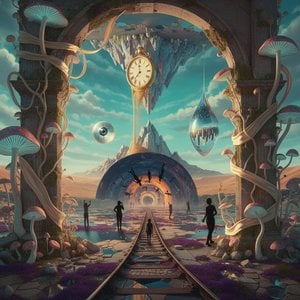
Areal’s early creative impulses were deeply rooted in the principles of Surrealism, drawing inspiration from the revolutionary theories of André Breton. During his formative years, he embraced the concept of automatism, seeking to bypass the constraints of rational thought to tap into the subconscious. This fascination with the dreamscape is beautifully preserved in his early drawings and sketches, where fantastical realism and gothic imagery take flight. In works such as 'Paisagem' (1957), one can observe a haunting mastery of pen and ink, creating otherworldly landscapes populated by mysterious towers and dramatic, light-drenched scenes that evoke a sense of profound solitude and wonder.
The Evolution of Gesture and Spontaneity
As the mid-1950s approached, Arel underwent a decisive stylistic evolution, moving away from the controlled imagery of Surrealism toward the raw, uninhibited language of Action Painting. Influenced by the global shift toward abstraction led by titans such as Jackson Pollock and Willem de Kooning, Areal began to prioritize the physical process of creation over the finished subject matter. This era of his work is characterized by a rejection of traditional composition in favor of spontaneous gesture and the fluid movement of pigment across the canvas. He allowed paint to drip, flow, and collide, mirroring the broader artistic preoccupation with immediacy and the visceral reality of the moment.
This transition was not an abandonment of his previous sensibilities but rather an expansion of them. The psychological depth found in his earlier surrealist explorations found a new, more explosive medium in abstraction. His later works also began to reflect a dialogue with other contemporary movements, including the graphic boldness of Pop Art and the material-focused inquiries of Nouveau Réalisme. This synthesis of styles allowed him to create a body of work that was uniquely his own—a blend of rhythmic energy and profound emotional resonance that captured the turbulent spirit of his generation.
A Lasting Legacy in Portuguese Modernism
Despite a relatively small oeuvre—estimated at only around fifty paintings produced during his lifetime—the impact of António Areal on the Portuguese art scene is immeasurable. He stands as a pioneer who helped steer the nation's visual language away from provincialism and toward the international avant-garde. His ability to navigate the transition from the subconscious imagery of the early century to the gestural abstraction of the later decades makes him a pivotal figure in the history of modern Portuguese art.
Beyond his individual canvases, Arel’s influence extends through his familial and intellectual connections within the arts. His legacy is carried forward by a lineage of creativity, most notably through his daughter, the acclaimed abstract painter Sofia Areal, who continues to explore organic forms and chromatic intensity. To study the work of António Areal is to witness a brief but brilliant flash of innovation—a lifetime of focused vision that transformed the canvas into a site of both psychological exploration and physical liberation.