Краткая справка

  • Copyright status: Public domain
  • Top 3 works:
    • Mountain Landscape with the Wiesbachhorn
    • Wengeralpe in the Berner Oberland (Jungfrau and Mönch)
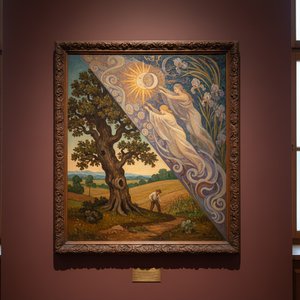
    • landscape: river-valley in the mountains + 3 woman
  • Color intensity: monochromatic
  • Died: 1876
  • Born: 1813, Vienna, Austria
  • Art period: 19th Century

The Life and Art of Anton Hansch

Born in Vienna, Austria, Anton Hansch began his journey in a family that operated a factory for artificial flowers. This early environment served as his training before he attended the Vienna Academy to become a flower painter. Between 1826 and 1836, he studied under Josef Mössmer. Before transitioning into a landscape painter, he spent time making artificial flowers. His artistic evolution saw him move from a baroque classicist style in his early landscapes toward a more naturalistic tradition, which eventually developed into an idealized, heroic style.

Hansch's travels took him through Germany, Austria, Belgium, Switzerland, and Italy. His mastery of the landscape was recognized through various honors, including the Grand Court Prize and the Rosenbaum Composition Prize. In 1839, he was awarded first prize for landscape painting by the Vienna Academy. His work has been held in prestigious collections, such as the Kunsthistorisches Museum, the Museum of Fine Arts, Budapest, the Salzberg Museum, the Lichtenstein Museum Princely Collection, and the Vienna Museum.

Later Years and Legacy

Throughout his career, Hansch received numerous accolades, including an appointment to the Academy of Fine Arts in 1848 and becoming a member of the Vienna Künstlerhaus in 1861. His talent was noted by royalty; for instance, a painting of a night scene titled Unter den Linden won a purchase prize by the Belvedere in Vienna, and a work depicting Lake Langbath was presented as a gift to the Emperor Franz Josef. He was also awarded the Knight's Cross of the Franz Josef Order and the Order of Guadalupe prize from Emperor Maximillian I of Mexico.

Following a financial crisis during the Panic of 1873, Hansch settled in Salzburg in 1875, where he focused on the surrounding landscapes, including the Golling waterfall, Berchtesgaden, Königssee, and Chiemsee lake. In his final years, as his eyesight began to fail, he remained active in the region until his death in Salzburg.

Короткий тест

В каждом вопросе только один правильный ответ.

Вопрос 1:
In which city was Anton Hansch born?
Вопрос 2:
Before becoming a landscape painter, what did Hansch make?
Вопрос 3:
Which institution did Hansch attend as a pupil from 1826–1836?
Вопрос 4:
What event in 1873 caused Hansch to lose his fortune?
Вопрос 5:
In which city did Anton Hansch die?

Вопросы и ответы

Можно ли просматривать работы Anton Hansch по настроению?

Работы Anton Hansch можно подобрать по настроению на странице Подбор по настроению, где произведения распределены в соответствии с их эмоциональной окраской.

Где я могу посмотреть все работы Anton Hansch?

Все работы Anton Hansch на данный сайт можно найти на странице Все работы художника художника.

Где и в каком году родился Anton Hansch?

Anton Hansch родился в Vienna в 1813 году.

Как найти все работы Anton Hansch, выполненные в определенной технике?

Чтобы найти все работы Anton Hansch в определенной технике, воспользуйтесь страницей По технике исполнения художника.

Откуда Anton Hansch?

Anton Hansch родился в Austria.

Где можно найти работы Anton Hansch, сгруппированные по направлениям в искусстве?

На странице Все направления работы Anton Hansch сгруппированы по направлениям в искусстве.

Где можно найти работы Anton Hansch, распределенные по цветам?

Страница Спектральный индекс художника Anton Hansch позволяет просматривать его работы, распределенные по цветам.

Какие цвета Anton Hansch использовал чаще всего?

Палитра художника художника Anton Hansch — это страница, представляющая цветовую палитру всего его творчества.

Под какими еще именами известен Anton Hansch?

Anton Hansch также известен под именами Hantsch Anton, Hansch, A. Hansch, Hansch Anton.