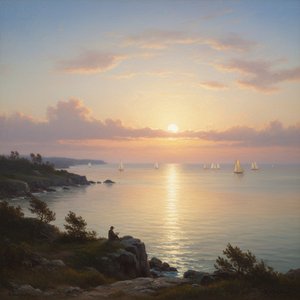
Alfred Thompson Bricher: Luminism's Mariner of Grand Manan
Alfred Thompson Bricher (1837-1908) stands as a singular figure within the Hudson River School, an artistic movement that championed Romantic ideals and celebrated the grandeur of American landscapes. Yet unlike many of his contemporaries who focused on monumental vistas—the Rockies, Yosemite—Bricher’s gaze was drawn to the quieter beauty of coastal scenes, particularly those dominated by the turbulent waters off Grand Manan Island in New Brunswick.
- Early Life and Education: Born in Portsmouth, New Hampshire, Bricher received a solid grounding in classical education at Newburyport Academy. This formative experience instilled in him an appreciation for meticulous observation and artistic discipline—qualities that would define his entire oeuvre.
- Boston Beginnings & Artistic Formation: Following graduation, Bricher established himself as a businessman in Boston but quickly recognized the allure of art. He studied diligently with luminist masters like Albert Bierstadt and William Morris Hunt, absorbing their techniques for capturing atmospheric effects and conveying profound emotion through subtle tonal gradations.
- The Luminist Vision: Bricher’s artistic philosophy centered on “luminism,” a style characterized by its emphasis on diffused light—the soft glow that permeates misty mornings or twilight evenings. Rejecting the dramatic chiaroscuro favored by Rembrandt and Caravaggio, luminists sought to depict nature as it appeared to the human eye, prioritizing tonal harmony over theatrical contrasts.
- Grand Manan & Maritime Mastery: Bricher’s lifelong fascination with the sea culminated in his extended explorations of Grand Manan Island. He spent seventeen summers meticulously documenting its dramatic cliffs and crashing waves—a period during which he produced some of his most iconic paintings, including “Morning at Grand Manan” (1878), now housed in the Indianapolis Museum of Art.
- Legacy & Recognition: While Bricher’s work didn't achieve widespread acclaim during his lifetime, it experienced a resurgence of interest in the 1980s and subsequently gained recognition as one of the most accomplished maritime painters of the nineteenth century. His unwavering dedication to capturing the sublime beauty of coastal landscapes cemented his place within American art history.
His paintings are notable for their remarkable detail, achieved through painstaking layering of thin washes of color—a technique that allowed him to convey not only visual accuracy but also a palpable sense of atmosphere and emotion. Bricher’s legacy resides in his ability to transform fleeting moments of natural beauty into enduring images of serenity and contemplation.
- Notable Works: “Morning at Grand Manan,” “The Precipice,” “Twilight on Cape Cod”
- Associations: Hudson River School, Lowell Institute
- Awards & Recognition: Elected Associate Member of the National Academy of Design (1879)
Bricher’s artistic journey exemplifies the Romantic spirit—a commitment to observing and interpreting the natural world with reverence and sensitivity. He remains a testament to the power of focused artistic practice and the enduring appeal of luminist aesthetics.