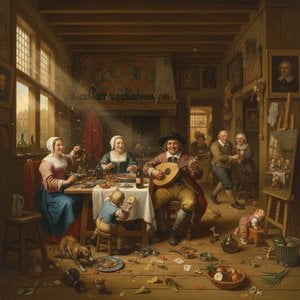
Adriaen Jansz van Ostade: A Master of Dutch Genre Painting
Adriaen Jansz van Ostade (1610 – 1685) stands as a pivotal figure in the history of Dutch Golden Age art, renowned for his unflinching depictions of everyday life—particularly scenes featuring peasants and laborers—that captured the spirit of his era with remarkable realism and psychological insight. Unlike many of his contemporaries who favored grand narratives or idealized portraits, Ostade focused on the mundane realities of rural existence, offering viewers a glimpse into the social fabric of seventeenth-century Holland.
- Early Life & Training: Born in Haarlem to Jan Hendricx van Eyndhoven and Janneke Hendriksdr., Ostade’s artistic inclinations were nurtured by his father's profession as a tapestry weaver. He received formative training under Frans Hals, a celebrated portraitist whose loose brushwork influenced Ostade’s initial stylistic explorations. However, he quickly diverged from Hals’s approach, establishing his own distinctive visual language.
- Distinctive Style: Ostade's artistic hallmark was meticulous detail combined with subtle chiaroscuro—the dramatic interplay of light and shadow—creating a palpable sense of atmosphere within his canvases. He possessed an extraordinary ability to render textures convincingly, from the rough wool of peasant clothing to the weathered surfaces of rural buildings. This dedication to realism distinguishes him from other artists of his time.
- Major Works & Themes: Ostade’s oeuvre is characterized by a preoccupation with genre subjects—tavern scenes, village fairs, domestic interiors—where he portrayed figures engaged in ordinary activities with remarkable sensitivity. Notable masterpieces include *Saying Grace*, which exemplifies his poetic vision of humble piety, and *A Laughing Peasant*, capturing the expressive nuances of human emotion.
- Influences & Legacy: Ostade’s artistic trajectory was profoundly shaped by Frans Hals's influence, yet he also drew inspiration from David Teniers the Younger, whose depictions of Brabant landscapes offered a contrasting perspective. More importantly, his commitment to naturalism paved the way for subsequent movements like Impressionism and Realism, cementing his place as one of the most influential artists of the Baroque period.
- Later Life & Recognition: Ostade became a respected member of Haarlem’s Guild of St. Luke in 1634, securing his professional standing. He continued to produce prolifically throughout his life, fostering a workshop and mentoring talented pupils who carried on his artistic legacy. His enduring fame testifies to the power of art to illuminate human experience and capture the essence of its time.
Ostade’s paintings continue to resonate with audiences today, offering invaluable insights into Dutch society during the Golden Age—a testament to his unparalleled skill as a storyteller and his unwavering devotion to portraying the complexities of everyday life.