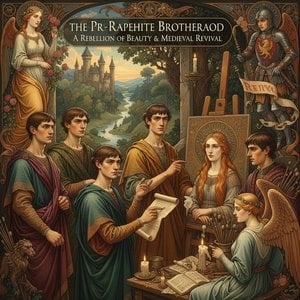
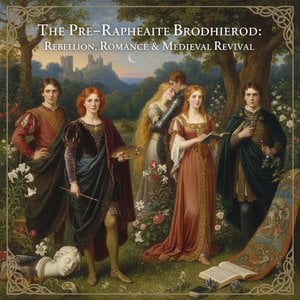
The Pre-Raphaelite Brotherhood: Origins & A Rejection of Academic Art
In the turbulent year of 1848, as revolutionary fervor swept across Europe and social unrest simmered in Britain’s Chartism movement, a small group of rebellious young artists coalesced in London. Disenchanted with the prevailing artistic conventions dictated by the Royal Academy, they formed a secret society that would irrevocably alter the course of British art: The Pre-Raphaelite Brotherhood (PRB). Their name, though debated in its precise origins, signaled a deliberate turning away from the established norms and a fervent embrace of the artistic principles preceding Raphael – specifically, the period before 1520. This wasn’t merely an aesthetic preference; it was a philosophical rejection of what they perceived as the artificiality and academic stagnation that had gripped the art world.
The Academy, led by figures like Sir Joshua Reynolds, championed a polished, idealized style often rooted in classical antiquity. The Pre-Raphaelites found this approach sterile and lacking genuine emotion. They believed that true artistic expression lay in meticulous observation of nature, an unwavering commitment to detail, and a return to the sincerity and spiritual depth they saw in early Renaissance masters like Fra Angelico and Botticelli. Founding members – William Holman Hunt, John Everett Millais, Dante Gabriel Rossetti, along with James Collinson, William Michael Rossetti, Frederic George Stephens, and Thomas Woolner – sought not just to paint differently but to fundamentally change the way art was conceived and created. Their initial aim wasn’t simply stylistic innovation; it was a moral one—to imbue their work with seriousness, truth, and a renewed sense of purpose.
Millais's Radical Realism: Technique, Detail, and 'Truth to Nature'
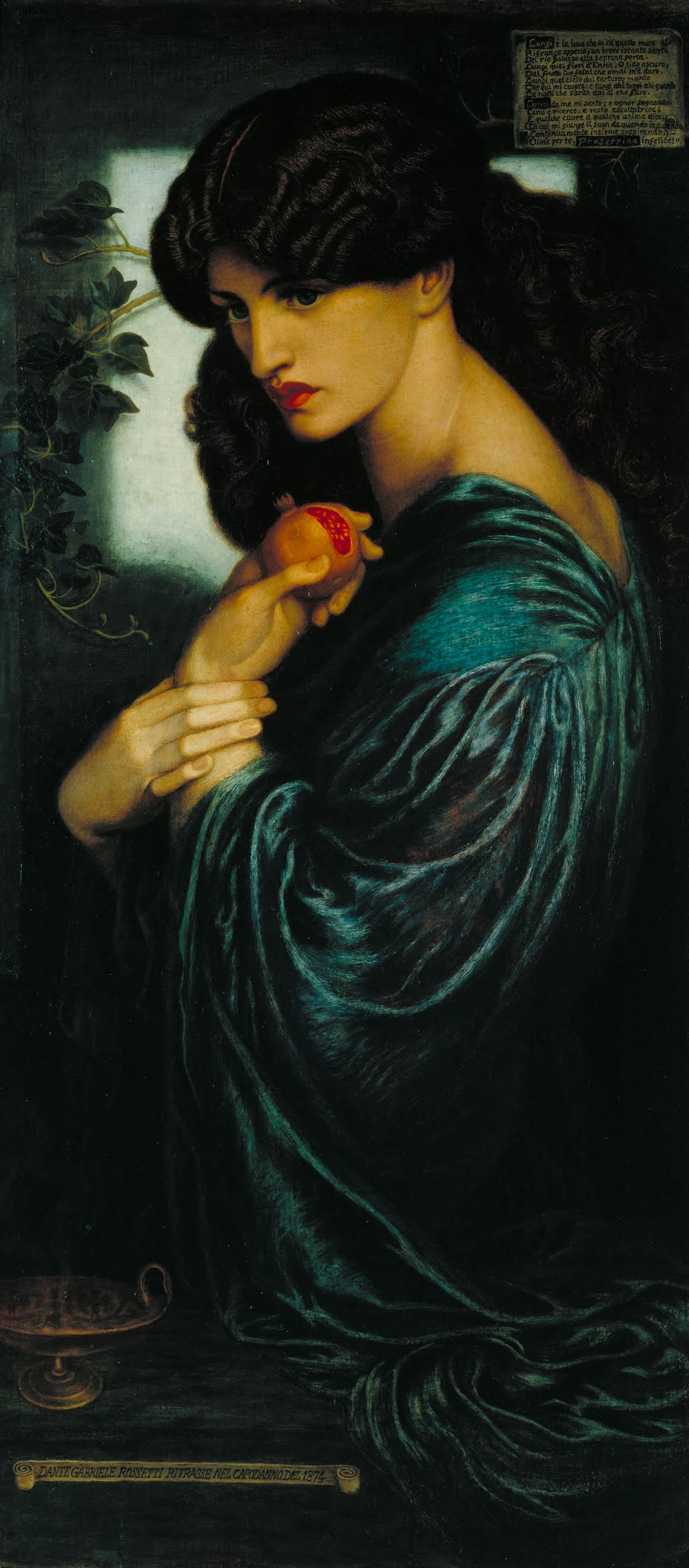 Wikipedia: Pre-Raphaelite Brotherhood
The Pre-Raphaelite Brotherhood (PRB), later known as the Pre-Raphaelites, was a group of English painters, poets, and art critics, founded in 1848 by William Holman Hunt, John Everett Millais, Dante Gabriel Rossetti, William Michael Rossetti, James ...
John Everett Millais quickly emerged as a leading figure within the Brotherhood, embodying its principles with unparalleled intensity. His commitment to “truth to nature” wasn’t merely a slogan; it was a rigorous methodology that demanded painstaking accuracy in every brushstroke. Unlike his contemporaries who often relied on studio models and idealized forms, Millais insisted on painting directly from life, even enduring arduous conditions to achieve authenticity. Consider his iconic *Ophelia* (1851-52), where the tragic heroine is depicted floating in a stream—a scene meticulously rendered after months of studying the natural environment along the Hogsmill River. The wildflowers are botanically precise, the textures of her clothing realistically portrayed, and the light subtly reflects off the water’s surface.
This dedication extended beyond mere representation; Millais sought to capture the very *essence* of nature. He employed a technique known as “wet-in-wet” painting, applying layers of translucent oil paint onto a wet white ground. This allowed for an extraordinary luminosity and vibrancy of color, reminiscent of medieval tempera paintings. However, this method also presented challenges—the colors could easily become muddied if not applied with precision. Millais’s meticulous approach often involved working outdoors, battling the elements to faithfully reproduce the nuances of light and shadow. His landscapes weren't simply backdrops; they were integral components of the narrative, imbued with symbolic meaning and emotional resonance.
Narrative Painting in the Victorian Era: Storytelling Beyond History
Narrative art is art that tells a story, either as a moment in an ongoing story or as a sequence of events unfolding over time. Some of the earliest evidence of human art suggests that people told stories with pictures. Although there are some common...
The Victorian era was a period captivated by storytelling, fueled by the rise of popular literature and serialized novels. Narrative painting flourished, offering visual interpretations of literary classics, historical events, and moral allegories. The Pre-Raphaelites excelled in this genre, but they approached it with a distinct sensibility. While traditional narrative paintings often emphasized grand gestures and heroic figures, Millais and his colleagues focused on intimate moments, psychological depth, and the complexities of human emotion. They weren’t interested in simply illustrating a story; they sought to *interpret* it, revealing hidden layers of meaning and challenging conventional interpretations.
Isabella (1849), for example, based on Keats' poem, depicts a poignant scene from Boccaccio’s *Decameron*. Millais doesn’t focus on the dramatic climax of the story but rather on the quiet despair of Isabella as she contemplates the severed head of her beloved. The painting is rich in symbolic detail—the potted geranium representing thwarted love, the decaying fruit foreshadowing tragedy—and its emotional impact stems from its subtle nuances and psychological realism. This emphasis on interiority and moral ambiguity set the Pre-Raphaelites apart from their contemporaries, who often favored more straightforward narratives.
Symbolism & Morality: Deciphering Hidden Meanings in Millais’s Works
Beyond meticulous detail and narrative depth, symbolism played a crucial role in the Pre-Raphaelite aesthetic. Every element within a painting—from flowers and animals to objects and colors—was carefully chosen for its allegorical significance. This wasn't arbitrary ornamentation; it was a deliberate attempt to imbue their work with layers of meaning that resonated with Victorian audiences, who were often well-versed in the language of symbolism. The Wedding of St George and the Princess, by Rossetti, exemplifies this approach, brimming with references to medieval literature and religious iconography.
Flowers, in particular, held a special significance. Lilies represented purity, roses symbolized love, and violets signified faithfulness. Animals were also imbued with symbolic weight—the lamb representing innocence, the owl embodying wisdom, and the serpent signifying temptation. Millais’s paintings often contained subtle moral messages, challenging societal norms and prompting viewers to question their own values. This emphasis on morality wasn't didactic; it was nuanced and open-ended, inviting contemplation rather than imposing a specific interpretation. The Pre-Raphaelites believed that art should not merely be beautiful but also thought-provoking and spiritually enriching.
The Aesthetic Impact of Pre-Raphaelitism on Victorian Society
The initial reception to the Pre-Raphaelites was often hostile. Critics derided their unconventional techniques, perceived lack of perspective, and unflinching realism. They accused them of ugliness, blasphemy, and a general disregard for artistic tradition. However, the Brotherhood quickly gained a devoted following, particularly among progressive intellectuals and art enthusiasts who were drawn to their sincerity and originality. John Ruskin’s enthusiastic support proved pivotal in shaping public opinion. He championed their dedication to nature, praised their meticulous detail, and recognized their potential to revitalize British art.
The Pre-Raphaelites' influence extended beyond the realm of painting. Their aesthetic principles permeated literature, design, and architecture, inspiring a broader movement known as the Arts and Crafts. Their emphasis on craftsmanship, natural forms, and medieval motifs resonated with a growing dissatisfaction with industrialization and mass production. The Brotherhood’s legacy continues to inspire artists today, reminding us of the power of artistic rebellion, the importance of “truth to nature,” and the enduring beauty of narrative detail.
Millais and His Legacy: Influence on Subsequent Art Movements
While the Pre-Raphaelite Brotherhood formally dissolved in 1853, its influence continued to reverberate throughout the art world. Millais himself evolved stylistically over his career, moving away from the intensely detailed realism of his early works towards a more impressionistic approach. However, his commitment to capturing light and atmosphere remained constant. His later portraits, landscapes, and genre scenes demonstrate a mastery of technique and a sensitivity to human emotion.
The Pre-Raphaelites’ emphasis on symbolism, narrative depth, and psychological realism paved the way for subsequent art movements such as Symbolism and Aestheticism. Their rejection of academic conventions inspired generations of artists to challenge established norms and explore new forms of expression. Today, Millais is recognized as one of the most important British painters of the 19th century—a visionary artist who revolutionized the art world with his radical realism, unwavering commitment to truth, and enduring legacy of beauty. Explore the captivating works of Millais and his contemporaries at ArtsDot.com, where you can discover museum-quality reproductions that capture the essence of this transformative artistic movement.