Early Life and Artistic Beginnings: A Foundation Forged in Ohio
Robert Seldon Duncanson’s story is one of quiet determination, a blossoming talent nurtured amidst the complex social currents of 19th-century America. Born around 1821 in Fayette, New York, his early life was marked by movement and a search for opportunity. While often described as having Scottish ancestry through his father, recent scholarship points to roots deeply embedded in the history of freed slaves from Virginia – a lineage that would profoundly shape his artistic vision, even if subtly expressed. The family’s relocation to Monroe, Michigan, provided a stable environment where John Dean Duncanson established himself as a skilled tradesman, passing on his knowledge of house painting and carpentry to his sons. However, it was Robert who demonstrated an exceptional aptitude for art, setting him on a path that would ultimately challenge the prevailing norms of the American art world.
The decision to move to Mount Pleasant, Ohio (later Mount Healthy) in 1840 proved pivotal. Cincinnati, a burgeoning city known as the “Athens of the West,” beckoned with its vibrant cultural scene and a relatively more tolerant atmosphere for African Americans. This was not merely an artistic pursuit; it was a deliberate step towards finding a community where his talents could flourish, and where he might navigate the precarious landscape of race relations in antebellum America. The Graham family, descendants of Virginian slaves themselves, provided crucial support during these formative years, fostering an environment conducive to creative exploration.
Duncanson and the Hudson River School: Embracing Romantic Ideals
 Wikipedia: Robert S. Duncanson
Robert Seldon Duncanson (c. 1821 – December 21, 1872) was a 19th-century American landscapist of European and African ancestry. Inspired by famous American landscape artists like Thomas Cole, Duncanson created renowned landscape paintings and is cons...
Cincinnati’s artistic milieu was heavily influenced by the burgeoning Hudson River School, a movement characterized by its awe-inspiring depictions of the American landscape. Artists like Thomas Cole, Asher Brown Durand, and Frederic Church sought to capture the sublime beauty of nature, imbuing their canvases with a sense of national pride and spiritual resonance. Duncanson quickly absorbed these influences, mastering the techniques of atmospheric perspective, detailed rendering, and dramatic composition. However, he wasn’t simply an imitator; he infused his work with a unique sensibility, a quiet lyricism that distinguished him from his contemporaries.
The core tenets of Romanticism – an emphasis on emotion, individualism, and the power of nature – resonated deeply with Duncanson. His landscapes weren’t merely topographical representations; they were expressions of inner feeling, meditations on the beauty and fragility of the natural world. He skillfully employed light and shadow to create a sense of depth and atmosphere, drawing viewers into his idyllic scenes. While embracing the aesthetic principles of the Hudson River School, Duncanson subtly began to carve out his own artistic identity.
The Ohio River Valley Tradition: Duncanson’s Unique Landscape Vision
 Robert Seldon Duncanson
Discover Robert S. Duncanson (1821-1872), the first African American landscape artist to gain international acclaim. Explore his serene Ohio Valley vistas & potential racial metaphors within Romantic art.
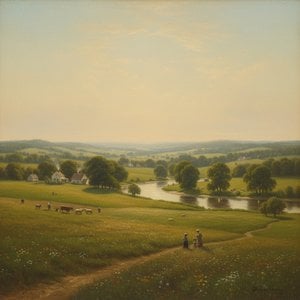
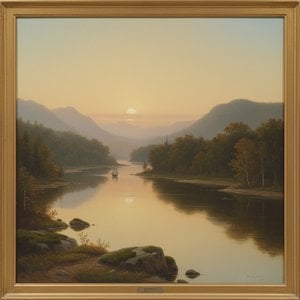
Duncanson didn't simply replicate the dramatic mountain vistas favored by many Hudson River School painters. He focused instead on the serene beauty of the Ohio River Valley, a landscape intimately connected to his own life and experiences. His paintings often depict tranquil rivers, lush forests, and rolling hills – scenes that evoke a sense of peace and harmony. This focus wasn’t accidental; it allowed him to develop a distinctive style rooted in the specific geography and atmosphere of the region.
He became known for his meticulous attention to detail, capturing the nuances of light and shadow with remarkable precision. His palette was often subdued, favoring earth tones and muted greens that conveyed a sense of naturalism. This approach, combined with his masterful composition skills, established him as a leading figure in the development of the Ohio River Valley landscape tradition – a style characterized by its quiet beauty and understated elegance.
Abolitionism and Allegory: Reading Resistance into Duncanson's Canvases
To understand Duncanson’s work fully, one must consider the historical context in which it was created. As a free black man living in antebellum America, he was acutely aware of the injustices of slavery and deeply involved with the abolitionist community. While he rarely depicted overt scenes of protest or resistance, many art historians believe that his paintings contain subtle allegorical references to the plight of enslaved people.
For example, some scholars interpret the ruins in his earlier works as symbolic representations of a fallen society – a veiled critique of slavery and its destructive impact. Others point to the idealized landscapes as representing a vision of freedom and equality, a utopian space where African Americans could thrive. The debate surrounding these interpretations continues, but it underscores the profound connection between Duncanson’s art and his social conscience. His work wasn't simply about capturing beauty; it was about expressing hope, resilience, and a yearning for a more just world.
International Recognition and Legacy: Pioneering African American Representation in Art
Duncanson achieved something remarkable during his lifetime: international recognition as an artist. In the 1850s, he embarked on a successful tour of Europe, exhibiting his work to critical acclaim in England and Scotland. This was a significant achievement for any artist at the time, but it was particularly noteworthy for an African American painter navigating the racial prejudices of the era.
His masterpiece, Land of the Lotus Eaters (1861), solidified his reputation as a leading landscape artist. The painting’s ethereal beauty and symbolic depth captivated audiences on both sides of the Atlantic. Duncanson's success paved the way for future generations of African American artists, demonstrating that talent knew no racial boundaries. He operated within influential cultural circles in Cincinnati, Detroit, Montreal, and London, building a network of patrons and supporters who championed his work. His legacy extends beyond his artistic achievements; he remains an inspiring figure, a testament to the power of art to transcend social barriers and express universal human values.
Exploring 'Falls of Minnehaha': A Case Study in Duncanson’s Style and Symbolism
Consider 'Falls of Minnehaha', a captivating example of Duncanson’s mastery. The cascading waterfall, framed by lush trees and verdant foliage, embodies the beauty and tranquility that characterize his landscapes. But beyond its aesthetic appeal, the painting reveals subtle layers of symbolism. The idyllic setting can be interpreted as representing a haven – a space removed from the harsh realities of slavery and racial discrimination.
Duncanson’s meticulous attention to detail is evident in the rendering of the foliage, the play of light on the water, and the atmospheric perspective that creates a sense of depth. The composition is carefully balanced, drawing the viewer's eye towards the central waterfall – a symbol of renewal and purification. Through works like 'Falls of Minnehaha,' Duncanson not only showcased his technical skill but also conveyed a powerful message of hope and resilience. His paintings offer a glimpse into the soul of an artist who dared to dream of a better world, and whose legacy continues to inspire us today.