

Norman Wilkinson: Camouflage, Colour & the Artistic Response to Modern Warfare
Оглавление
The Shadow of Gallipoli: Wilkinson’s Early Influences
Norman Wilkinson, a name synonymous with the striking visual phenomenon of dazzle camouflage, was not initially a soldier nor a strategist, but an artist—a marine painter deeply attuned to the subtleties of light and shadow on water. His path towards becoming one of Britain’s most unconventional wartime contributors began not in the Admiralty War Rooms, but amidst the sobering realities of the Gallipoli campaign. Serving with the Royal Navy Volunteer Reserve during this disastrous operation proved formative, instilling a profound awareness of the vulnerability of ships silhouetted against the Mediterranean horizon. The stark black livery then standard for naval vessels presented an obvious target, a fatal flaw Wilkinson keenly observed. This early experience wasn’t merely about witnessing failure; it was about recognizing a fundamental problem in visual perception and conceiving a radical solution—a solution born from artistic sensibility rather than military doctrine.
Prior to the war, Wilkinson had established himself as a successful painter of seascapes, railway posters, and sporting scenes. His work demonstrated a mastery of realism, capturing the dynamism of waves and the intricate details of maritime life with impressive skill. However, Gallipoli ignited a new urgency within him, prompting a shift in focus from aesthetic representation to practical application. He possessed an innate understanding of how forms are perceived, how light defines shape, and how colour influences visibility—skills that would prove invaluable when he turned his attention to the problem of ship camouflage.
From Naval Necessity to Artistic Innovation: The Birth of Dazzle Camouflage
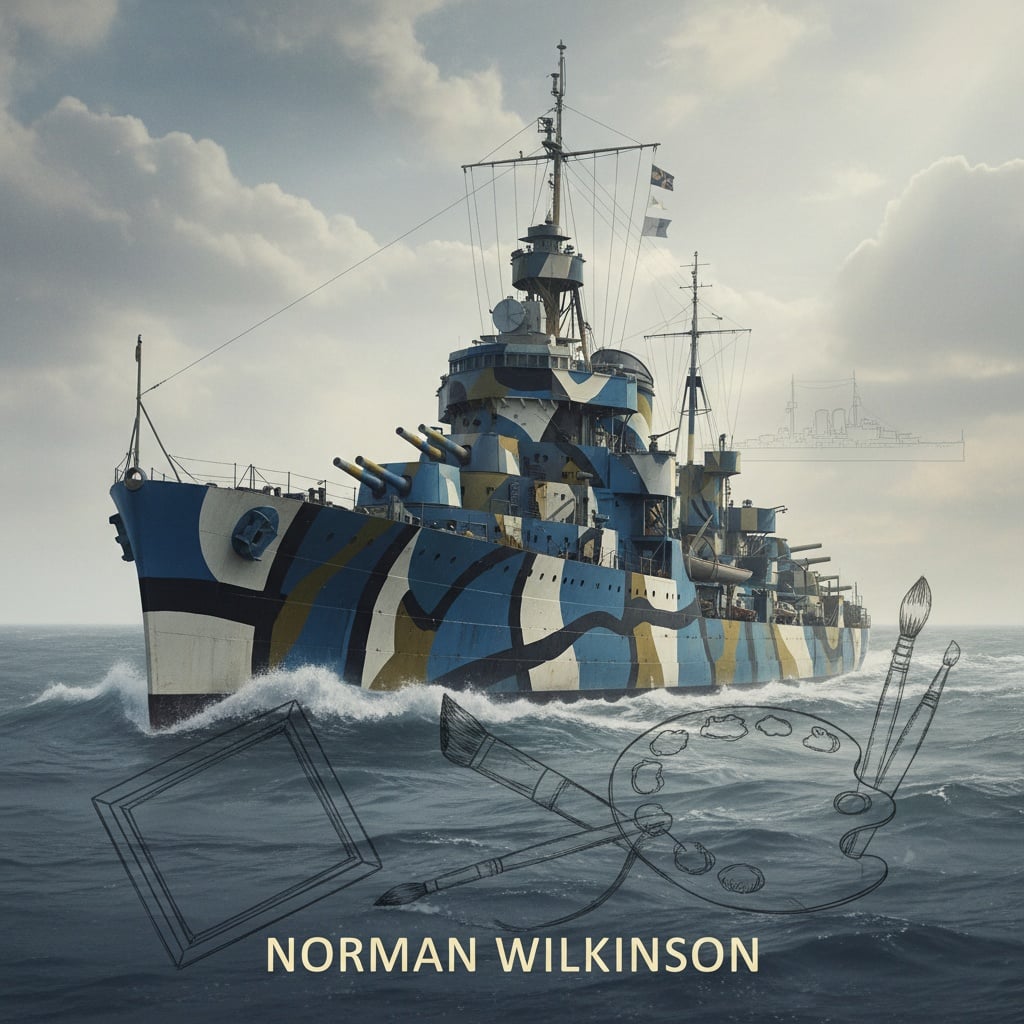
The year 1917 marked a turning point. Faced with escalating U-boat attacks in the Atlantic, the Admiralty sought innovative ways to protect merchant shipping. Wilkinson proposed a counterintuitive approach: instead of concealing ships, he advocated for disrupting their visual form. His idea, initially met with skepticism, centered on applying bold, geometric patterns—strikes, curves, and contrasting colours—to confuse enemy submariners attempting to estimate a vessel’s course and speed. This wasn't about invisibility; it was about creating optical illusion, a deliberate attempt to mislead the eye.
Wilkinson secured permission to establish a naval camouflage unit, drawing upon his connections within the art world to assemble a team of talented painters and designers. He famously recruited female students from the Royal Academy of Arts—around twenty or eleven depending on sources—who brought fresh perspectives and meticulous attention to detail. These artists weren’t simply applying paint; they were engaging in a form of visual engineering, meticulously crafting designs intended to exploit the principles of perception. Wilkinson coined the term “Dazzle Camouflage,” recognizing its inherent theatricality – a deliberate attempt to baffle and disorient.
Breaking Up the Form: Principles and Techniques of Dazzle Painting
The core principle behind dazzle camouflage was not concealment, but *confusion*. Ships were painted with complex patterns that fractured their outlines, making it difficult for enemy periscopes to accurately judge their heading. The designs weren’t random; they were carefully calculated to exploit the way the human eye perceives shape and movement. Wilkinson understood that a ship's silhouette is most easily recognized when viewed at right angles. By disrupting this clear outline with intersecting lines and contrasting colours, he aimed to create ambiguity.
The process involved creating miniature models of ships, which were then painted with various dazzle schemes. These models were inspected through periscopes under different lighting conditions to assess their effectiveness. The resulting designs varied significantly from ship to ship, ensuring that no two vessels presented the same visual profile. While black and white photographs often obscure the vibrant colours used—blues, greens, pinks, and purples were common—the intention was to create a jarring, disorienting effect. This wasn’t about blending into the environment; it was about standing out in a way that made accurate assessment impossible.
A Kaleidoscope of Colour: The Aesthetic Dimensions of Deception
While rooted in practical necessity, dazzle camouflage possessed an undeniable aesthetic quality. The bold geometric patterns and vibrant colour palettes resonated with contemporary art movements, particularly Cubism and Vorticism. Artists like Edward Wadsworth, who supervised the camouflaging of over 2,000 ships during the war, recognized a connection between their abstract explorations of form and the disruptive designs being applied to naval vessels. Wadsworth himself produced a series of striking paintings depicting dazzle-painted ships after the war, capturing the dynamic energy and visual complexity of these wartime creations.
The use of colour was particularly significant. Wilkinson deliberately eschewed muted tones in favour of brighter hues, believing that they would further enhance the disorienting effect. The resulting ships were not merely camouflaged; they were transformed into floating works of art—a testament to the power of artistic innovation in the face of adversity. Even King George V was reportedly fooled by a dazzle-painted ship, misjudging its direction of travel, demonstrating the effectiveness of Wilkinson’s designs.
Beyond the Battleships: Wilkinson’s Wider Artistic Practice & Legacy
Norman Wilkinson's contribution extended far beyond dazzle camouflage. He continued to paint seascapes throughout his life, capturing the beauty and power of the ocean with remarkable skill. His wartime experiences undoubtedly informed his artistic vision, imbuing his later works with a heightened sense of drama and realism. He also produced numerous railway posters, showcasing his versatility as an artist and his ability to capture the spirit of the age.
Wilkinson’s legacy lies not only in his striking dazzle designs but also in his demonstration of the power of artistic thinking to solve practical problems. His work challenged conventional notions of camouflage, proving that deception can be just as effective as concealment. Today, dazzle camouflage remains a fascinating example of wartime innovation and a testament to the enduring appeal of abstract art. ArtsDot
Похожие статьи

Искусство 1940-х: 10 шедевров, отражающих эпоху. Купить репродукции в ArtsDot.
Погрузитесь в эпоху 1940-х с 10 величайшими шедеврами! Узнайте истории художников, техники и значение этих культовых картин. Репродукции высокого качества на ArtsDot.com – вдохновение для вашего интерьера. Откройте всю коллекцию онлайн!


Pop Surrealism: A Collision of Culture, Dreams & the Subconscious in Post-War Art
Explore the captivating world of Pop Surrealism with ArtsDot. Discover key artists like George Condo & Robert Williams, investment potential, and the movement's cultural impact. Expert insights for collectors.

Alexandre Benois: A Life Dedicated to Russian Art & the 'World of Art' Aesthetic
Explore the life & art of Alexandre Benois, a pivotal figure in Russian art history and founder of 'World of Art'. Discover his stunning stage designs for the Ballets Russes and lasting influence on modern aesthetics.

F.A.Q.: Бесплатная доставка по всему миру – Ответы для ценителей искусства
предлагает бесплатную доставку произведений искусства по всему миру. Узнайте о деталях международной доставки, таможенном оформлении и гарантиях для ценителей искусства.

Транспортировка холстов в рулонах: безопасное и экономичное решение для отелей
Узнайте о безопасной и экономичной транспортировке холстов в рулонах для вашего отеля от . Профессиональная упаковка, надежная логистика и выгодные решения для оформления интерьера.

