

Echoes of Antiquity: Exploring Themes & Techniques in Classical Art Masterpieces
Оглавление
The Foundations of Classical Ideals: Beauty, Harmony & Proportion
Ancient Greek art is the visual and applied arts, as well as the architecture, produced by the Hellenes or Greek peoples from the start of the Iron Age to the Hellenistic period, ending with Roman conquest of Greece at the Battle of Corinth in 146 BC...
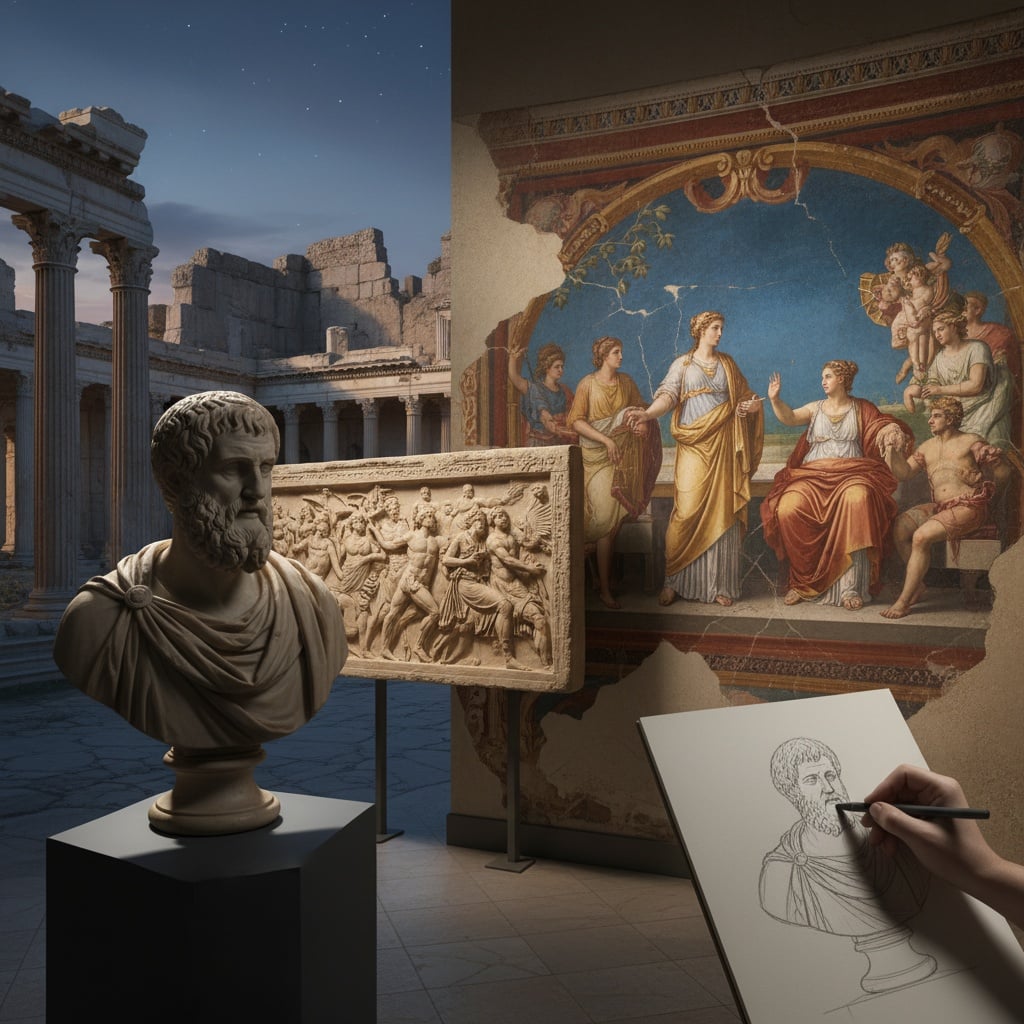
Classical art, a term encompassing the visual cultures of ancient Greece and Rome, represents more than just a historical period; it embodies a foundational philosophy that continues to resonate through Western civilization. At its core lies an unwavering pursuit of beauty, not as mere aesthetic pleasure, but as a reflection of underlying order and truth. This wasn’t simply about replicating reality, but rather about distilling it into its most perfect form – a harmonious balance achieved through meticulous proportion and carefully considered composition. The Greeks believed that mathematical ratios governed the universe, and artists sought to embody these principles in their work, creating pieces that weren't just visually appealing, but intellectually satisfying. This emphasis on idealized forms wasn’t arbitrary; it was seen as a pathway to understanding the divine, a way of elevating humanity through artistic expression. The concept of kalokagathia – the unity of beauty and goodness – permeated Greek thought, influencing everything from sculpture to architecture.
Greek Sculpture: Naturalism, Idealization & the Canon of Polykleitos
 Triumphs of Caesar
Andrea Mantegna
The evolution of Greek sculpture is a testament to this relentless pursuit of perfection. Beginning with the somewhat rigid forms of the Geometric period, artists gradually moved towards increasingly naturalistic representations of the human body. However, this wasn’t about slavish imitation; rather, it was a process of selective refinement. Sculptors like Myron captured dynamic movement – as seen in his Discobolus – but even these works were imbued with an idealized quality. The High Classical period witnessed the emergence of the Canon of Polykleitos, a set of mathematical proportions believed to define the ideal male form. This wasn’t simply about physical measurements; it was about creating a sense of balance and harmony that resonated on a deeper level. The Doryphoros (Spear-Bearer), though known primarily through Roman copies, exemplifies this canon perfectly – a figure radiating strength, poise, and an almost divine serenity. The subtle contrapposto pose, with its shifting weight distribution, further enhanced the sense of lifelike movement and naturalism. While we often associate Greek sculpture with marble, it’s crucial to remember that these works were originally vibrantly painted, challenging our modern perception of pristine white forms.
Roman Art: Realism, Grandeur & Imperial Propaganda
Greek art is known for its beauty and balance, while Roman art is famous for its realistic portraits and grand architecture.
Roman art inherited much from its Greek predecessors, but it wasn't merely a copy. The Romans possessed a pragmatic sensibility and a penchant for grandeur that shaped their artistic output. While they admired the idealized beauty of Greek sculpture, Roman artists also embraced realism, particularly in portraiture. They sought to capture individual likenesses with remarkable accuracy, often depicting wrinkles, imperfections, and signs of age – a stark contrast to the smooth perfection favored by the Greeks. This emphasis on realism served a practical purpose: it was used to commemorate emperors, generals, and prominent citizens, reinforcing their power and authority. Roman architecture, too, reflected this desire for grandeur. Massive structures like the Colosseum and the Pantheon showcased engineering prowess and imperial ambition. The use of concrete allowed for unprecedented scale and complexity, while decorative elements – often incorporating Greek motifs – added a layer of sophistication. Art became inextricably linked with imperial propaganda, serving to legitimize Roman rule and celebrate its achievements.
Beyond Greece and Rome: The Enduring Influence on Greco-Buddhist Art
The Greco-Buddhist art or Gandhara art is the artistic manifestation of Greco-Buddhism, a cultural syncretism between Ancient Greek art and Buddhism. It had mainly evolved in the ancient region of Gandhara, located in the northwestern fringe of the I...
The influence of Classical art wasn’t confined to the Mediterranean world. Alexander the Great's conquests opened up new avenues for cultural exchange, leading to a fascinating synthesis in the region of Gandhara – modern-day Pakistan and Afghanistan. Greco-Buddhist art emerged as a unique fusion of Greek artistic traditions and Buddhist philosophy. This is most evident in early depictions of the Buddha himself. Prior to this period, Buddhism largely eschewed representational imagery; however, under the influence of Greek sculpture, artists began to create anthropomorphic representations of the Buddha, often incorporating elements of Greco-Roman style – flowing drapery, realistic facial features, and a sense of idealized beauty. The Gandharan Buddhas possess a distinctly Hellenistic aesthetic, yet they are imbued with Buddhist symbolism and spiritual significance. This cultural exchange demonstrates the remarkable adaptability and enduring power of Classical artistic principles, extending their reach far beyond their original context.
Revivals of Classicism: Neoclassicism and 19th-Century Painting
The rediscovery of Pompeii and Herculaneum in the 18th century sparked a renewed interest in Classical art, leading to the rise of Neoclassicism. Artists like Jacques-Louis David rejected the frivolity of the Rococo style, embracing instead the perceived purity and moral virtue of ancient Greece and Rome. Neoclassical paintings often depicted scenes from classical history or mythology, emphasizing civic duty, heroism, and sacrifice. The compositions were typically characterized by clarity, restraint, and a sense of order – a deliberate attempt to emulate the artistic principles of antiquity. This movement wasn’t simply about stylistic imitation; it was also deeply intertwined with political ideals, particularly those of the Enlightenment and the French Revolution. Later in the 19th century, artists continued to draw inspiration from Classical themes and techniques, though often with a more romantic or allegorical bent. Painters like Jean-Auguste-Dominique Ingres blended Neoclassical precision with a heightened sense of color and emotion.
Collecting Classical Echoes: Bringing Timeless Art into Your Home
The allure of Classical art endures to this day, offering a timeless elegance and intellectual depth that transcends fleeting trends. Whether you’re drawn to the idealized beauty of Greek sculpture, the grandeur of Roman architecture, or the refined compositions of Neoclassical painting, incorporating these artistic principles into your home can create a sense of harmony, balance, and sophistication. At ArtsDot, we offer high-quality reproductions of masterpieces from across the Classical world, allowing you to experience the beauty of antiquity firsthand. From meticulously hand-painted oil paintings to stunning museum-quality prints, we provide a range of options to suit your taste and budget. Explore our collection today and discover how these timeless echoes can enrich your living space and inspire generations to come.
Похожие статьи

The Enduring Legacy of Marble: A Comprehensive Exploration of Technique, Symbolism & Artistic Expression
Explore the rich history of marble sculpture from antiquity to the Renaissance! Discover key techniques, influential artists & enduring themes in classical art. Expert insights for collectors and enthusiasts at ArtsDot.


Топ-10 шедевров искусства для создания классической атмосферы в интерьере
Погрузитесь в мир классического искусства! Откройте для себя 10 шедевров живописи – от Ван Гога до Моне. Узнайте истории художников, техники и вдохновение для создания элегантного интерьера с репродукциями картин на ArtsDot.com.

