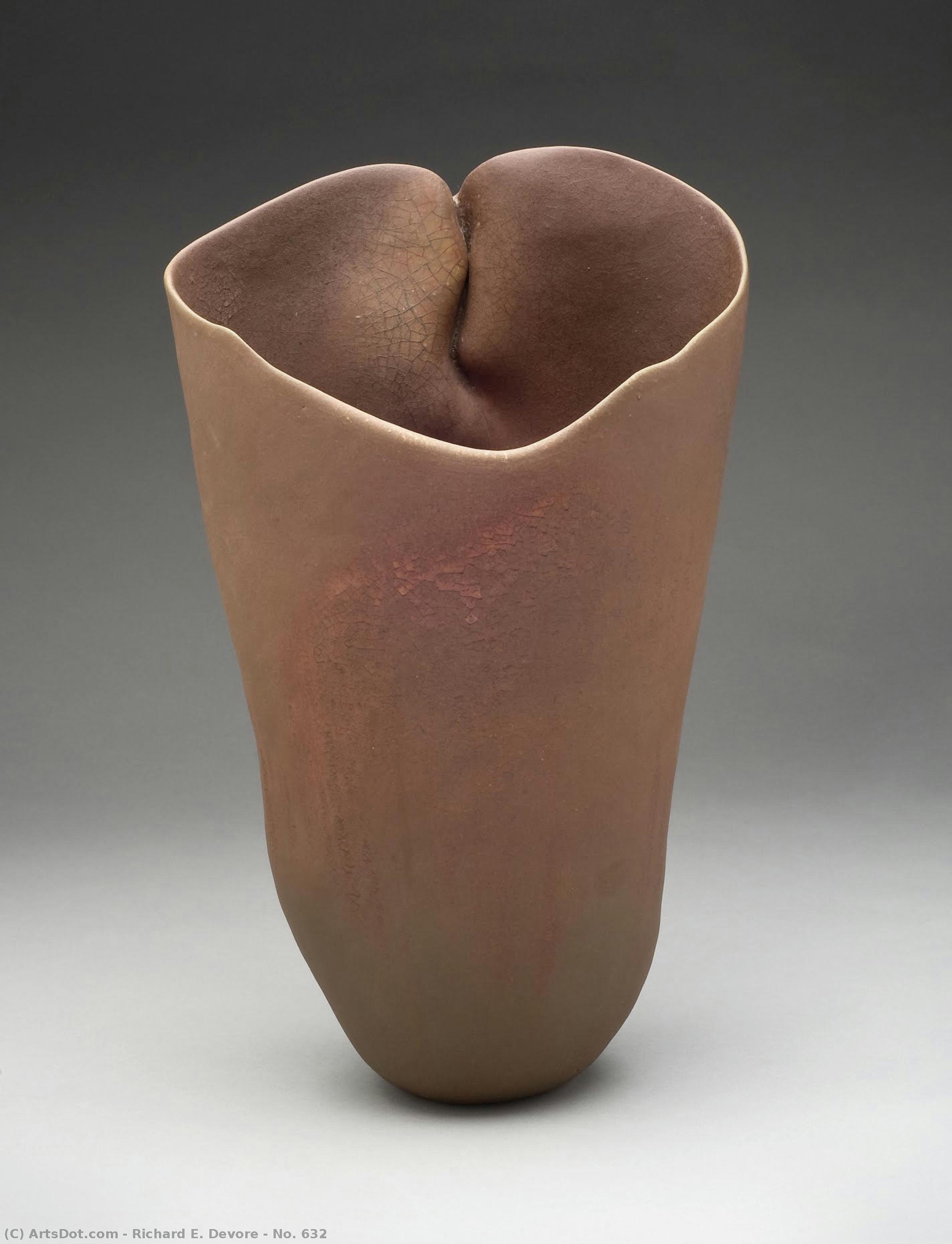
The Essence of Earth and Form: The Life of Richard E. DeVore
In the quiet, tactile world of American ceramics, few names resonate with the same elemental power as Richard E. DeVore. Born in Toledo, Ohio, in 1933, DeVore did not merely work with clay; he seemed to coax it into a state of primordial memory. His journey began at the University of Toledo, where he earned a Bachelor of Education in 1955, but it was his subsequent move to the prestigious Cranbrook Academy of Art that would define his artistic soul. Under the mentorship of the legendary Finnish-American ceramicist Maija Grotell, DeVore learned to embrace the spontaneous and the intuitive. This formative period instilled in him a lifelong reverence for the organic, leading him to view the potter’s wheel not just as a tool for utility, and certainly not merely for sculpture, but as a means to capture the very breath of the natural world.
DeVore’s aesthetic was a masterclass in restraint. While many of his contemporaries sought brilliance through vibrant pigments and complex ornamentation, DeVore turned inward toward the subtle. His mature works are celebrated for their minimalist elegance, often characterized by muted glazes in shades of beige, gray, and soft green that evoke the weathered surfaces of sun-bleached bones or the smooth, cool touch of river stones. There is a profound, almost haunting stillness in his stoneware. He possessed a singular ability to manipulate surface texture so that a vessel might possess the parchment-like translucency of human skin or the rugged, distressed markings of ancient earth. To look upon a DeVore piece is to witness a dialogue between the permanence of stone and the fragility of life.
A Legacy of Pedagogy and Presence
Beyond the studio, DeVore was a pillar of the American ceramic community, serving as a bridge between generations of makers. His tenure at the Cranbrook Academy of Art, where he served as the Head of the Ceramics Department from 1966 to 1978, allowed him to shape the trajectory of modern craft. He did not teach his students to mimic his hand, but rather to find their own truth within the medium, emphasizing the beauty of irregularity and the importance of embracing imperfection. This philosophy of studied spontaneity followed him to Colorado State University, where he remained a dedicated faculty member from 1978 until his retirement in 2004.
The significance of DeVore’s contribution to the medium lies in his refusal to be pigeonholed. Though critics often debated whether his work should be classified as ceramic sculpture or pottery, DeVore remained steadfast in his identity as a potter. He viewed the vessel as an aesthetic departure point—a container that had transcended its utility to become a vessel for pure form and emotion. His achievements were rightfully recognized by the highest institutions of craft, including:
When Richard E. DeVore passed away in 2006, he left behind a body of work that continues to pulse with a quiet, erotic tension—a subtle suggestion of the human form within the undulating rims and sinuous lines of his clay. His legacy remains etched in the very texture of the stoneware he mastered, reminding us that true beauty often resides in the simplest, most elemental forms of our existence.