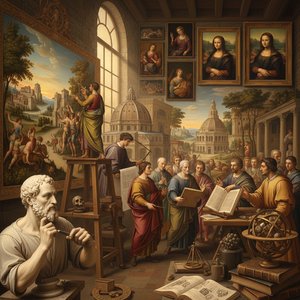
Masaccio (1401-1428): The Dawn of Renaissance Realism
Tommaso di Ser Giovanni di Simone Cassai, better known as Masaccio (meaning "clumsy Tom"), was a pivotal figure in the Early Italian Renaissance. Born on December 21, 1401, in San Giovanni Valdarno, Italy, and dying tragically young in 1428, his brief career revolutionized painting with groundbreaking realism, perspective, and chiaroscuro (the use of strong contrasts between light and dark). Despite his short life, Masaccio’s impact on subsequent generations of artists was profound, establishing a new standard for naturalism and influencing the course of Western art.Early Life and Training
Masaccio's origins were humble; he descended from Ser Giovanni di Mone Cassai, a notary, and Jacopa di Martinozzo di Dino. His family name, Cassai, derived from his paternal grandfather’s trade as a cabinet maker—a craft that instilled in him an appreciation for meticulous detail and craftsmanship. Orphaned at age five when his father perished unexpectedly, Masaccio was cared for by his brother Giovanni (Lo Scheggia), who also pursued artistic endeavors. The precise details of Masaccio's formative years remain shrouded in obscurity – a rarity amongst Renaissance artists—underscoring the mystery surrounding his rapid ascent to mastery and the innovative techniques he pioneered. Scholarly speculation suggests that he likely apprenticed around the age of 12, though definitive documentation confirming his teacher is absent. This lack of verifiable biographical information adds to the fascination surrounding Masaccio’s artistic journey. He joined the painters’ guild (Arte de’ Medici e Speziali) in Florence on January 7, 1422, marking his emergence as an independent artist and signaling a decisive step toward realizing his creative ambitions.Artistic Development and Major Works
Masaccio's artistic vision was profoundly shaped by Giotto di Bondone—a predecessor who championed naturalism and imbued his frescoes with emotive depth. However, Masaccio swiftly surpassed Giotto’s achievements in mastering perspective and anatomical accuracy. He also absorbed inspiration from Filippo Brunelleschi’s revolutionary rediscovery of linear perspective—a breakthrough that fundamentally altered artistic representation. This intellectual engagement fueled Masaccio's groundbreaking innovations:- Linear Perspective: Masaccio meticulously applied vanishing points and mathematical precision to create a convincing illusion of depth on canvas, mirroring Brunelleschi’s architectural experiments.
- Chiaroscuro: He wielded light and shadow with unparalleled skill—a technique perfected by Leonardo da Vinci—to sculpt forms and imbue his paintings with palpable emotion and realism.
Historical Significance and Legacy
Giorgio Vasari, the celebrated Renaissance biographer, eloquently captured Masaccio’s genius—declaring him “the best painter of his generation” due to his unwavering commitment to imitating nature and conveying human emotion with breathtaking fidelity. Masaccio's influence extended far beyond Florence, inspiring artists across Italy and shaping the trajectory of Western art for centuries to come. He fundamentally challenged prevailing artistic conventions, ushering in an era of unprecedented realism and psychological depth—a transformation that continues to resonate today. His untimely demise at the age of 26—likely due to malaria—was mourned by contemporaries like Filippo Brunelleschi, who lamented the loss of such a prodigious talent. Masaccio’s legacy endures as one of the most important and influential artists in history—a beacon illuminating the path toward artistic innovation and demonstrating the transformative power of creative vision.Întrebări și răspunsuri
Unde pot fi găsite operele lui Masaccio, grupate pe mișcări artistice?
Stilurile în care a activat Masaccio pot fi vizualizate pe pagina de Toate mișcările de artă a artistului, care grupează operele pe mișcări artistice.
Din ce epocă face parte Masaccio?
Masaccio a activat în perioada Renașterea. Această perioadă situează activitatea artistului în context istoric.
Unde și când s-a născut Masaccio?
Masaccio s-a născut în San Giovanni Valdarno, în anul 1401.