The Quiet Presence of M. Bullheim
The history of the early twentieth century is often told through the grand movements of politics and empire, yet it is frequently captured in the quiet, deliberate strokes of the painter. M. Bullheim belonged to this era of transition, working within the stylistic currents of Art Nouveau. The artist’s output reflects a period where the rigid lines of the past began to soften into the organic, flowing sensibilities of a new age. While the details of a personal life remain obscured by the passage of time, the work left behind offers a window into a specific moment of European history.
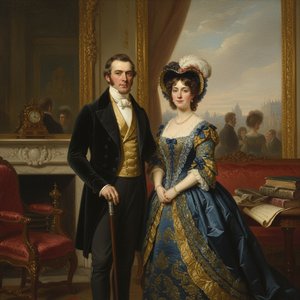
Bullheim’s contribution to the visual record is defined by a singular, significant portrait. This work, executed in oil on canvas, captures a figure of immense historical weight. The composition is a portrait, oriented vertically to command the viewer's attention through its formal structure. It is a piece that demands a certain stillness, reflecting the gravity of its subject matter.
Artistic Focus and Technique
In the creation of his primary known work, Bullheim utilized the traditional medium of oil on canvas to achieve a sense of permanence. The technique allows for a subtle layering of color, essential for capturing the dignity required of a royal subject. The artist’s hand is visible in the signature located in the lower right, a mark of personal identity on a work that has since moved through significant collections.
The technical aspects of the work include:
- Medium: Oil on canvas
- Style: Art Nouveau
- Orientation: Portrait
- Aspect Ratio: 3 : 4
Historical Placement
The year 1910 marks a definitive point in the artist's catalog, specifically with the creation of the portrait of Emperor Franz Joseph I. This work serves as a bridge between the nineteenth-century tradition of imperial portraiture and the emerging modernism of the twentieth century. The painting has been preserved through careful stewardship, moving from the Kunsthistorisches Museum in Vienna to the Belvedere collection. It remains a part of the public domain, a fragment of a vanished era preserved for the modern eye.