The Wandering Soul of American Abstraction
Louis Schanker was an artist whose life was as much a tapestry of movement and grit as the layered compositions he left behind. Born in 1903 amidst the vibrant, Orthodox Jewish community of the Bronx, New York, his early years were shaped by the rich traditions of his Romanian immigrant parents, Sam and Fannie. While his upbringing provided a foundation of intellectual curiosity and craftsmanship, Schanker possessed a restless spirit that could not be contained by the city limits. In 1920, he embarked on a nomadic odyssey across the United States, a period of profound transformation where he lived the life of a traveler, joining circus troupes like Barnum and Bailey and enduring the grueling labor of wheat threshing in the Great Plains. These formative, often difficult experiences—the dust of the plains and the spectacle of the circus—would later seep into his artistic consciousness, manifesting as evocative imagery and a deep-seated respect for organic, natural forms.
Upon returning to New York in the mid-1920s, Schanker began to weave these disparate threads of experience into a formal artistic language. His education was nothing short of legendary, as he studied at prestigious institutions such as Cooper Union and the Art Students League. It was within these hallowed halls that he rubbed shoulders with the titans of modernism; his mentors included Barnett Newman, Mark Rothko, and Milton Avery. This period of intense study was further enriched by a shared studio space with the Soyer brothers, Chaim Gross and Adolph Gottlieb, creating a crucible of experimental dialogue that would define his approach to form. His travels to Europe in the early 1930s, including time spent at the Académie de la Grande Chaumière in Paris, allowed him to absorb the nuances of Cubism, which he would eventually re-interpret through a uniquely American lens.
A Legacy of Color and Form
Schanker’s mature style emerged as a sophisticated interplay between geometric precision and expressive vitality. He became a pioneer of color-patch compositions, a technique where vibrant, often fragmented planes of color interact to create depth and rhythm. His work is characterized by a remarkable ability to balance the rigid structures of abstraction with the fluid energy of life. Whether through his woodcut prints or his large-scale murals, Schanker sought to capture the essence of movement—a quality perhaps inherited from his years on the move. His contributions to the Works Progress Administration (WPA) and the Public Works of Art Project allowed him to leave a tangible mark on the American landscape, working alongside other luminaries like Jackson Pollock and Lee Krasner to redefine the boundaries of graphic arts and mural painting.
The significance of Schanker’s oeuvre lies in its role as a bridge between early 20th-century Cubism and the burgeoning Abstract Expressionist movement. His ability to translate lived, visceral experience into a language of pure form makes his work deeply resonant. Some of his most notable artistic milestones include:
- Founding Membership: His pivotal role as a member of the American Abstract Artists group, helping to establish a distinct identity for American modernism.
- WPA Contributions: His impactful work as an artist and supervisor in the mural and graphic arts departments during the Great Depression.
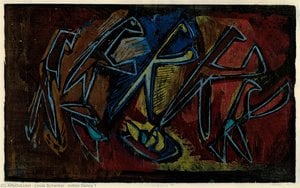
- Masterful Printmaking: The creation of striking woodcuts, such as Forms in Action, which demonstrate his mastery of texture and structural depth.
- Iconic Imagery: Works like Man Cutting Wheat, which serve as poignant reflections of his time spent in manual labor across the American heartland.
Ultimately, Louis Schanker remains a vital figure in the history of American art—a painter who could find the universal in the particular, and the abstract in the earthly. His life was a journey from the structured traditions of the Bronx to the wide-open expanses of the Great Plains, and finally into the profound, silent depths of color and shape. Through his hands, the chaos of a wandering life was distilled into a lasting legacy of beauty and structural innovation.
Întrebări și răspunsuri
Pot vizita un muzeu virtual al lucrărilor lui Louis Schanker?
Pagina Muzeu 3D a lui Louis Schanker este o pagină care prezintă operele de artă ale artistului într-o galerie virtuală tridimensională.
Unde pot fi găsite lucrările lui Louis Schanker, grupate pe tehnici?
Pagina Toate mediile grupează operele lui Louis Schanker pe tehnici.
Unde pot fi găsite operele lui Louis Schanker, organizate pe subiecte?
Atlas pe subiecte lui Louis Schanker este o pagină care organizează operele de artă ale artistului în funcție de subiectele acestora.