John Charlton (1849–1917): The Mariner’s Dream and Beyond
Liverpool Gothic Scroll Artist, known formally as Henry John Charlton, was born in Bamburgh Castle, Northumberland, England, on June 28th, 1849. His father, Thomas Vaughan, a prominent figure in the Cleveland Iron Trade, instilled in him an early appreciation for observation and detail—qualities that would define his artistic trajectory. Despite facing considerable financial hardship during his formative years, Charlton’s determination propelled him toward education at Dr. Sharp’s Charity School followed by enrollment at Armstrong College, Newcastle-upon-Tyne where he honed his skills under William Bell Scott. This period cemented his reputation as a masterful painter of horses and dogs, securing commissions for portraying beloved family pets—a testament to his empathetic understanding of the human condition.
- Early Career: Charlton’s artistic journey commenced in London in 1874, where he studied at the South Kensington Museum (now Victoria and Albert Museum), immersing himself in the techniques of renowned artists like Gustave Courbet.
- Royal Academy Debut: He debuted at the Royal Academy in 1870, showcasing his talent for capturing dramatic landscapes and historical scenes—a tradition that would continue until 1904.
Maritime Gothic Art: Capturing Turbulent Seascapes
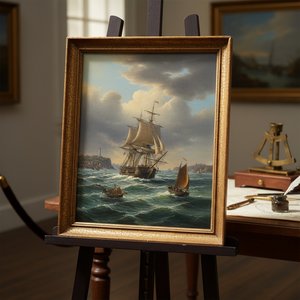
Charlton’s artistic vision found its most compelling expression in Maritime Gothic Art, a genre characterized by brooding skies, turbulent seas, and figures rendered with palpable emotion. Influenced profoundly by Caspar David Friedrich's sublime landscapes—particularly his depiction of the solitary wanderer confronting the immensity of nature—Charlton sought to convey a sense of awe and vulnerability before the forces of the natural world. His canvases pulsated with atmospheric depth, utilizing chiaroscuro techniques to illuminate key elements against dark backgrounds—a stylistic choice that mirrored the Romantic preoccupation with emotional intensity.
- Notable Works: Among his most celebrated paintings are “The Mariner’s Dream,” a monumental seascape capturing the raw power of a storm; and “Bad News from the Front,” depicting soldiers battling valiantly amidst the horrors of World War I—works that exemplify Charlton's commitment to portraying both beauty and suffering with uncompromising honesty.
Military Inspiration: From Zulu Wars to Trench Warfare
Charlton’s artistic sensibilities were irrevocably shaped by his involvement in military illustration, particularly during the Zulu War of 1879 and subsequently during World War I. He meticulously researched historical accounts and painstakingly recreated battle scenes with astonishing accuracy—a skill honed through extensive sketching expeditions and studio studies. His depictions of soldiers engaged in combat conveyed not merely physical action but also psychological complexity, capturing the courage, fear, and camaraderie experienced by those serving on the front lines.
Legacy: A Painter’s Grief and Enduring Artistic Influence
The tragic loss of his sons—Hugh Vaughan Charlton (killed in action June 24th, 1916) and John Macfarlane Charlton (killed July 17th, 1916)—deepened Charlton's artistic introspection. He channeled his grief into a poignant canvas portraying his sons alongside their grandmother—a testament to the enduring bonds of family amidst profound sorrow. His unwavering dedication to ornithology—documented in numerous watercolors and sketches—further solidified his reputation as an artist attuned to the subtleties of the natural world. Charlton’s work continues to inspire artists today, serving as a reminder that art can transcend mere representation, conveying universal themes of beauty, loss, and resilience—a legacy etched indelibly into the annals of British Art History.