The Soul of the Scottish Landscape: The Life and Art of Francis Patrick Martin
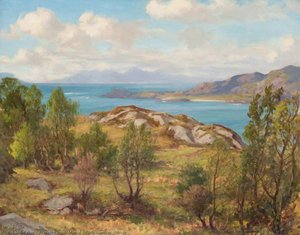
Born in 1883 amidst the rugged beauty of Anstruther, Fife, Francis Patrick Martin emerged as a profound observer of the natural world, a painter whose brush captured the very breath of the Scottish Highlands and the restless energy of its coasts. His journey was one of deep connection to the earth, shaped by a childhood spent in the rural landscapes that would later become his most enduring musel. While his early years were rooted in the coastal traditions of Fife, his artistic spirit found a home in the dramatic vistas of the Cairngorms and the mysterious depths of Loch Ness. Martin did not merely seek to replicate scenery; he sought to translate the emotional resonance of light and atmosphere, creating works that serve as windows into a vanishing era of pastoral tranquility and maritime strength.
The development of Martin’s unique aesthetic was deeply informed by his formal training at the Glasgow School of Art, where he studied under the esteemed David Forrester Wilson between 1919 and 1920. This period of academic rigor provided him with a foundation in classical technique, yet his heart leaned toward the burgeoning influences of Impressionism and Post-Impressionism. Drawing inspiration from masters like Claude Monet and Vincent van Gogh, Martin embraced the challenge of capturing fleeting moments—the way sunlight dissolves into mist or how shadows lengthen across a heather moorland. His mastery lay in a meticulous layered glazing technique, a painstaking process of building translucent washes of pigment that allowed light to appear as if emanating from within the canvas itself, lending his landscapes a luminous, ethereal quality.
A Tapestry of Genre and Maritime Mastery
Beyond the sweeping vistas of the Highlands, Martin’s repertoire was remarkably diverse, often blending the grandeur of landscape with the intimate storytelling of genre painting. He possessed a rare ability to imbue human figures with dignity and weight, as seen in works like “To Their Daily Task,” where the heavy toil of agricultural workers is rendered with a poignant sense of character and light. This fascination with the rhythms of rural life allowed him to document the social fabric of Scotland during a period of rapid industrialization. His work often bridged the gap between the monumental and the mundane, finding epic drama in the simple movement of a herd or the quietude of a spring morning in Blaven.
The sea, too, played a pivotal role in his creative evolution. The rugged coastlines of Fife and Northumberland provided him with a different kind of dynamism—one defined by the rhythmic pulse of the tides and the salt-sprayed textures of maritime life. In these coastal scenes, Martin’s technical skill shone through his ability to render the complex interplay of water, sky, and stone. His paintings from this period are characterized by:
- Atmospheric Precision: The use of subtle tonal variations to recreate the damp, heavy air of the North Sea.
- Textural Depth: A command over oil mediums that captured the roughness of coastal cliffs and the smoothness of calm bays.
- Luminous Color Palettes: The application of golden light to contrast against the deep blues and greys of maritime weather.
Legacy and Historical Significance
Throughout his prolific career, which produced over 300 paintings, Francis Patrick Martin achieved significant acclaim within the British art establishment. His presence in prestigious institutions was felt through frequent exhibitions at the Royal Glasgow Institute of Fine Arts and the Royal Scottish Academy at the Walker Art Gallery in Liverpool. His leadership within the artistic community was equally notable; serving as the President of the Glasgow Art Club and Secretary of the Royal Glasgow Institute, he helped foster the very environment that nurtured his own talent. Even his brief tenure as a telegraphist for the General Post Office contributed to his versatility, leading to commissioned works that showcased his ability to merge graphic design with fine art.
Today, the significance of Martin’s work lies in its role as a historical and emotional archive. He captured a specific Scottish identity—one caught between the ancient traditions of the Highlands and the encroaching modern world. His paintings remain vital testaments to the beauty of the natural landscape and the enduring spirit of the people who inhabit it. Through his dedication to light, texture, and truth, Francis Patrick Martin secured his place as a visionary whose work continues to evoke the timeless majesty of the British Isles.