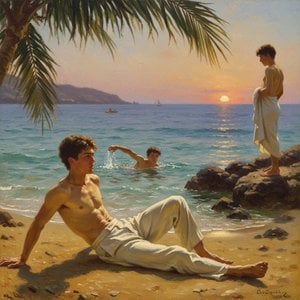
Elizabeth Forbes (1859–1912): The Queen of Newlyn and the Poetic Landscape
Elizabeth Adela Armstrong Forbes (née Armstrong; 29 December 1859 – 16 March 1912) was a Canadian painter who achieved considerable renown in Britain during the Edwardian era. Her distinctive style—characterized by luminous watercolors, meticulous detail, and an unwavering focus on capturing the essence of rural life—established her as one of the foremost figures within the Newlyn Art Colony, earning her the moniker “the Queen of Newlyn.” Forbes’ artistic journey was profoundly shaped by influences ranging from Whistler's ethereal aesthetic to Sickert’s gritty realism, reflecting a broader engagement with the intellectual currents of her time.- Early Life and Education: Born in Kingston, Ontario, Canada West, Forbes experienced a formative childhood immersed in the artistic milieu fostered by her father, William Armstrong—a government employee who instilled in her a love for observation and meticulous rendering. Following his untimely death shortly after her birth, she moved with her mother to Chelsea, London, where she cultivated her burgeoning talent under the tutelage of Dante Gabriel Rossetti.
- Formal Artistic Training: Forbes pursued formal artistic training at South Kensington Art School (later Royal College of Art), honing her skills in watercolor and pastel—techniques that would become central to her oeuvre. Simultaneously, she traveled extensively abroad, immersing herself in continental European culture and absorbing the stylistic innovations of Impressionism.
The Brittany Period: Plein Air Painting and Whistler’s Influence
A pivotal moment in Forbes' artistic development occurred during her residency at Pont-Aven, Brittany—a pilgrimage to the epicenter of Breton Impressionism. Inspired by James Abbott McNeill Whistler’s ethereal approach to landscape painting, Forbes embraced *plein air* techniques—working directly from nature—resulting in canvases imbued with atmospheric luminosity and psychological depth. Whistler's emphasis on tonal harmony and subtle color gradations served as a guiding principle for Forbes, informing her compositions and elevating them beyond mere depiction to convey profound emotional resonance.Newlyn School and the New Cornish Landscape
Forbes’ relocation to Cornwall in 1885 marked the genesis of her association with the Newlyn Art Colony—a collective of artists dedicated to portraying the rugged beauty of the Cornish coastline and rural communities. Alongside Stanhope Forbes, she founded the Newlyn Art School in 1899, nurturing a new generation of painters committed to capturing the spirit of place through observation and artistic experimentation. Her paintings exemplify the distinctive Cornish landscape style—characterized by muted palettes, atmospheric perspective, and an unwavering commitment to conveying the tactile qualities of weathered stone and damp foliage.- Notable Works: School Is Out: Forbes’ most celebrated masterpiece exemplifies her mastery of watercolor and pastel, capturing a moment of idyllic childhood innocence against a backdrop of autumnal splendor.
- Blackberry Gathering: This evocative depiction of rural life—executed in 1912—demonstrates Forbes' ability to distill complex emotions into simple visual forms.
- Volendam, Holland, from the Zuidende: Forbes’ masterful rendering of Volendam—a Dutch fishing village—captures the shimmering light and subtle color harmonies characteristic of Impressionist painting.
Achievements and Legacy
Forbes garnered international acclaim for her artistic endeavors, securing a medal at the Paris International Exhibition in 1891 and receiving a gold medal at the World’s Columbian Exposition in Chicago in 1893. Her unwavering dedication to her craft—coupled with her pioneering role in establishing the Newlyn Art School—solidified her position as a trailblazing figure within Victorian genre painting and cemented her enduring legacy as “the Queen of Newlyn.” Her paintings continue to resonate with audiences today, serving as testament to Forbes’ profound understanding of art's capacity to illuminate the human experience.Concluding Remarks
Forbes’ artistic vision—informed by Whistler’s aesthetic principles and rooted in a deep appreciation for the Cornish landscape—represents a pivotal contribution to Edwardian art history. Her unwavering commitment to observation, coupled with her skillful execution of watercolor and pastel, ensured that her work would endure as an exemplar of Victorian genre painting and a beacon of inspiration for aspiring artists across generations.Întrebări și răspunsuri
În ce oraș și țară s-a născut Elizabeth Forbes?
Elizabeth Forbes s-a născut în Kingston, în Canada.
De unde este Elizabeth Forbes?
Elizabeth Forbes s-a născut în Canada.
Ce culori a folosit cel mai des Elizabeth Forbes?
Genoma Paletei lui Elizabeth Forbes este o pagină care prezintă profilul cromatic al întregii creații a artistului.
Cât de populare sunt operele lui Elizabeth Forbes?
Există o pagină Statistici pentru Elizabeth Forbes, care prezintă statistici despre operele de artă ale artistului pe acest site.
Care sunt locul și anul nașterii lui Elizabeth Forbes?
Elizabeth Forbes s-a născut în Kingston, în anul 1859.
Există o cronologie a operelor lui Elizabeth Forbes?
Pagina Cronologia operelor de artă a artistului prezintă lucrările lui Elizabeth Forbes ordonate cronologic, an de an.
Unde pot fi găsite operele lui Elizabeth Forbes organizate pe culori?
Indice Spectral lui Elizabeth Forbes este o pagină care organizează operele de artă ale artistului în funcție de culorile acestora.