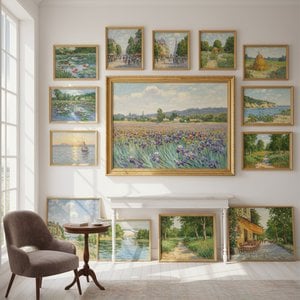
Edmund William Greacen: A New York Impressionist’s Journey Through Europe and Beyond
Edmund William Greacen (1876-1949) stands as a significant, yet often overlooked, figure in the American Impressionist movement. Born into a privileged background in New York City—his father an immigrant shoe merchant who amassed considerable wealth—Greacen’s early life was marked by both comfort and a yearning for artistic expression. This unique confluence of circumstance shaped his trajectory, leading him from a childhood spent amidst the burgeoning skyscrapers of Manhattan to a lifelong pursuit of capturing light and atmosphere across Europe and beyond. His career spanned nearly four decades, during which he established himself as a respected painter, educator, and influential figure in the New York art scene.
Early Life and Artistic Beginnings
Edmund Greacen’s story begins in 1876, amidst the rapid industrialization of New York City. His father, Thomas Edmund Greacen, a shrewd businessman who arrived from Scotland in 1868, provided his family with a comfortable existence—a sprawling brownstone at 6 West 50th Street (now occupied by Rockefeller Center) and a summer estate in Sullivan County. This privileged upbringing initially steered young Edmund toward more conventional pursuits – a degree from New York University, followed by a “shoe-selling world cruise” orchestrated by his father as a distraction from his burgeoning interest in the Spanish–American War. However, this seemingly frivolous journey ignited a genuine passion for art, leading him to enroll at the prestigious Art Students League of New York and later study under William Merritt Chase at the New York School of Art.
Crucially, Greacen’s artistic development was profoundly influenced by his mentor, Chase. Chase's emphasis on *plein air* painting—working directly from nature—became a cornerstone of Greacen’s technique. He also benefited immensely from the tutelage of Robert Henri, Louis Mora, and Everett Shinn, all prominent figures in the American modernist movement. These formative years laid the groundwork for his distinctive style, characterized by luminous color palettes, loose brushwork, and an acute sensitivity to light and atmosphere.
European Exploration and Artistic Maturation
In 1905, Greacen embarked on a transformative journey with Chase’s class to Spain, followed by extended studies in the Netherlands, Belgium, and England. This immersion in European art—particularly the Impressionist traditions of Monet, Renoir, and Pissarro—proved pivotal to his artistic evolution. Notably, he spent a summer near Claude Monet at Giverny, France, an experience that deeply resonated with him. While he never formally met Monet, the proximity to the master’s home and studio profoundly influenced his approach to painting, particularly his fascination with water lilies and the play of light on foliage.
His marriage to Ethol Booth in 1904 further fueled this artistic exploration. Ethol, an art student herself, became a constant companion and model for Greacen’s *plein air* paintings. The family relocated to Giverny in 1907, creating a vibrant artistic community centered around the American expatriates who flocked to the region. This period marked a significant shift in his style—a move toward capturing fleeting moments of light and color with an increasingly expressive brushstroke.
New York Contributions: Education and Artistic Legacy
Returning to New York City in 1910, Greacen established a studio that would remain his base for the remainder of his career. He also played a vital role in shaping the next generation of American artists by founding and directing the Grand Central School of Art in 1917—a pioneering institution that offered comprehensive instruction in various artistic disciplines. The school’s success reflected Greacen's commitment to fostering artistic talent and promoting contemporary art.
Beyond his teaching, Greacen was a prolific painter, producing a vast body of work encompassing landscapes, portraits, and still lifes. His paintings are characterized by their vibrant colors, atmospheric perspective, and a subtle sense of melancholy—a reflection of the changing world around him. He achieved recognition for his work through exhibitions at prestigious galleries such as Macbeth Gallery and the Salmagundi Club, culminating in the coveted Samuel T. Shaw Prize in 1922. His influence extended beyond individual works; he was instrumental in establishing the Grand Central Art Galleries, a cooperative that provided artists with a platform to showcase their art and build professional networks.
A Lasting Impression
Edmund William Greacen’s career spanned over seven decades, during which he left an indelible mark on the American art landscape. His paintings, now held in collections such as the Smithsonian Institution, continue to captivate viewers with their luminous beauty and evocative atmosphere. More than just a painter, Greacen was a teacher, mentor, and advocate for the arts—a true pioneer who helped shape the course of Impressionism in America. His legacy endures not only through his artistic output but also through his contributions to art education and the vibrant cultural community he fostered in New York City.