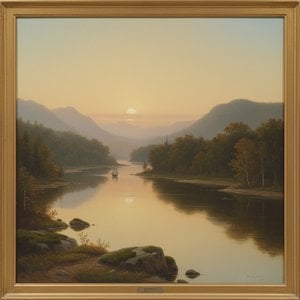
Alexander Helwig Wyant - A Poet of Atmospheric Landscapes
Alexander Helwig Wyant, born in Port Washington, Ohio, stands as a pivotal figure bridging the stylistic currents of the Hudson River School and Tonalism—a testament to American art’s capacity for innovation while retaining its connection to European artistic traditions. His journey began humbly, sketching along the banks of the Ohio River near Cincinnati, yet swiftly ascended into a vocation fueled by encounters with influential mentors and transformative experiences that would shape his distinctive artistic vision.Early Influences and Artistic Formation
Wyant’s formative years were marked by exposure to George Inness's groundbreaking work—a meeting that ignited within him an unwavering dedication to tonal values and atmospheric perspective. Recognizing the profound impact of Inness’s aesthetic, Wyant relocated to New York City, securing invaluable mentorship at the National Academy of Design through the generosity of Nicholas Longworth – a patronage that proved instrumental in nurturing his artistic ambitions. This early immersion into the intellectual ferment of the city served as a catalyst for broadening his horizons beyond Ohio's rural landscapes and propelled him toward formal training under some of America’s most respected artists.The Hudson River School Legacy
Wyant initially embraced the Hudson River School’s celebrated tradition of detailed pastoral narrative, meticulously capturing the grandeur of American wilderness with unwavering precision. However, even within these initial canvases, subtle hints foreshadowed his future trajectory—a burgeoning fascination for atmospheric effects and a predilection for palettes imbued with muted hues. This inclination intensified over time, subtly distancing him from purely representational painting and steering him toward the emerging aesthetic championed by artists like George Inness and John Constable: Tonalism. The movement prioritized mood, atmosphere, and poetic interpretation above meticulous detail—a deliberate rejection of academic conventions that resonated deeply with Wyant’s artistic sensibilities.The Barbizon Influence and Artistic Evolution
A pivotal moment arrived in 1873 when Wyant suffered a debilitating stroke which paralyzed his right arm – an adversity that fundamentally altered the course of his artistic practice. Forced to adapt, he remarkably mastered painting with his left hand—a feat that underscored not only physical resilience but also a profound commitment to distilling his vision to its purest essence. This transformative experience profoundly impacted his technique, prompting him to embrace looser brushwork and prioritizing tonal harmonies over technical virtuosity. Simultaneously, Wyant absorbed the influence of the Barbizon painters – French artists who championed *plein air* painting and prioritized capturing the fleeting effects of natural light—further enriching his artistic repertoire and solidifying his connection to European artistic heritage.A Lasting Impression: Landscapes That Breathe
Wyant’s final paintings, particularly those executed in Arkville, New York, exemplify this culmination of stylistic influences—a harmonious blend of meticulous observation and atmospheric sensitivity that captures the sublime beauty of the Adirondack Mountains. His landscapes are imbued with a palpable sense of tranquility and contemplation—inviting viewers to pause, breathe deeply, and immerse themselves fully in the subtle grandeur of nature. Like Constable and Turner before him, Wyant sought to convey not merely what he *saw*, but what he *felt*—a testament to his enduring artistic legacy as a poet of atmospheric landscapes who elevated American painting to new heights of expressive power. His work continues to inspire artists today, reminding us that true beauty resides in capturing the ephemeral qualities of light and shadow and conveying profound emotional resonance within the natural world.Întrebări și răspunsuri
Câte opere de artă ale lui Alexander Helwig Wyant pot fi vizualizate?
Puteți vizualiza 74 opere de artă de opere ale lui Alexander Helwig Wyant pe pagina Toate operele de artă.
Cum pot găsi lucrările lui Alexander Helwig Wyant într-o anumită paletă de culori?
Operele lui Alexander Helwig Wyant pot fi explorate pe baza paletei cromatice în pagina de După palete de culori a artistului.
Pot să vizualizez lucrările lui Alexander Helwig Wyant în funcție de tehnică?
Operele lui Alexander Helwig Wyant pot fi vizualizate pe baza mediului utilizat în pagina de Toate mediile a artistului.