The Reaction Against Excess: From Rococo Frivolity to Neoclassical Order
The mid-18th century witnessed a profound shift in the visual language of Europe. Before the structured ideals of the early 1800s took hold, the Rococo style dominated the courts, characterized by asymmetrical curves, pastel palettes, and a sense of playful, often superficial, ornamentation. This was an era of sensory indulgence, where art often served as a backdrop for the lighthearted pursuits of the aristocracy. However, as the Enlightenment began to prioritize reason and intellectual rigor, this perceived frivolity started to feel out of step with a changing world. This tension finds a historical echo in the way we approach modern design today. Just as the Neoclassical movement sought to strip away the unnecessary to find a more structured truth, contemporary minimalism often acts as a response to the visual clutter of the digital age. We see this impulse for order in the clean lines and mathematical precision used by architects to create calm within chaotic urban environments. The desire to find clarity through structure remains a recurring human response to periods of social and visual upheaval. By rejecting the exuberant dynamism of the Baroque and the ornate theatricality of the Rococo, artists began to seek a sense of stability. They moved away from the swirling, unpredictable energy of their predecessors toward a style that emphasized clarity and restraint. This was not merely a change in fashion; it was a fundamental shift in how art was intended to function within society.The Archaeological Spark: How Pompeii and Herculaneum Fueled a Visual Revolution
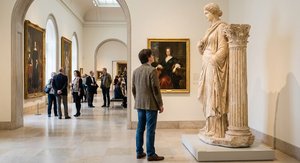
The movement gained significant momentum through tangible, physical evidence unearthed from the earth. The rediscovery of the ruins of Pompeii and Herculaneum in the mid-1700s provided a wealth of new archaeological material that fundamentally changed the artistic landscape. For the first time, artists had direct access to the domestic life, decorative schemes, and sculptural forms of the ancient world. This was not a theoretical study of the past, but a direct encounter with it. This fascination with the physical remnants of antiquity mirrors our modern obsession with historical preservation and the way we use heritage to ground our current identities. When we visit museums to see the artifacts of a lost civilization, we are participating in the same impulse that drove 18th-century scholars to meticulously document every fresco and column found in the Roman ruins. We look to the past to find a sense of continuity in an ever-changing present. The impact of these discoveries was profound. Artists began to study ancient sculptures with a precision that had been absent for centuries. They sought to replicate the textures, the drapery, and the idealized proportions found in the excavated marbles. This archaeological accuracy became a hallmark of the movement, ensuring that the art of the period felt authentically connected to the Greco-Roman ideals it sought to revive.The Heroic Ideal: Virtue, Stoicism, and the Moral Weight of Art
 Jacques-Louis David
. A master of Neoclassicism known for The Oath of the Horatii. Discover his powerful historical masterpieces today.
The Architecture of Reason: Symmetry and the Language of Classical Form
 Andrea Palladio
Explore the world of Andrea Palladio (1508-1580), the influential Italian Renaissance architect behind iconic villas & 'The Four Books of Architecture'. Discover his classical designs!
The Pursuit of Clarity: Compositional Balance and the Rejection of Baroque Drama
 The Oath of the Horatii
, Jacques-Louis David
The Enduring Legacy: Neoclassical Principles in Modern Aesthetic Spaces
The influence of Neoclassicism did not vanish with the rise of Romanticism; instead, it evolved, integrating into the broader history of Western art through various stylistic shifts. Its emphasis on proportion, clarity, and the use of classical motifs continued to inform several subsequent movements, ensuring its principles remained central to the Western aesthetic.
This legacy is evident in the Empire style of the Napoleonic era and in the Neoclassical music of the twentieth century. In the latter, composers sought a "call to order" to counter the unrestrained emotionalism and experimentalism of the early 1900s, returning to values of balance and economy. Furthermore, the architectural language of Neoclassicism proved remarkably resilient, with its focus on symmetry and simplicity enduring through the nineteenth and twentieth centuries and into the twenty-first. This persistence highlights a recurring human impulse to find clarity through structure during periods of social upheaval.
We encounter this legacy whenever we view art that brings a sense of balance to a space. Whether it is a structured landscape or a portrait with a clear, focused composition, the principles of Neoclassicism remain a fundamental part of our visual toolkit. The movement demonstrated that beauty could be found in the disciplined application of form and the pursuit of an idealized, rational truth.