


 Vezi în context
 Trimite
 Distribuie
 Detalii
 Ghidul

 Descarcă
 Produse similare
 Radiografie
 Diaporama
 Statistici
Bella


 Citește mai mult
Lucrarea de artă afișată pe această pagină este protejată de legile privind drepturile de autor, ceea ce înseamnă că nu putem crea sau vinde în mod legal o reproducere identică. Această protecție este garantată prin acorduri internaționale, precum Convenția de la Berna și de legile naționale, inclusiv cele prevăzute de Legea dreptului de autor din S.U.A. – Titlul 17. Toate drepturile rezervate. Orice reproducere neautorizată este interzisă.
Această metodă respectă pe deplin reglementările privind drepturile de autor, deoarece nu implică copierea sau duplicarea operei protejate. În schimb, este o reinterpretare creativă – o pictură nouă, influențată de original, dar care nu este identică cu acesta.
Giclée / Imprimare artistică
Printuri giclée sau pe canvas de calitate muzeală, cu proces de producție rapid și opțiuni flexibile de finisare. ( Comandă pictură realizată manual Treci la imagine digitală)




P118B lei10

P118H lei10

P118W lei10

P438Z lei10

P508JH lei12

P508YH lei12

P805H lei10

P805Z lei10

P919BZ lei10

P919G lei10

P919XJ lei10

P959ZH lei10

P968JZ lei12

W106C lei8

W218G lei10

W218JH lei8

W218Y lei10

W307PJ lei10

W316G lei10

W316PJ lei8

W316Y lei10

W398PJ lei8

W4111J lei10

W500HY lei15

W500JH lei15

W692G lei12

W849H lei8

W940BG lei15

W953PJ lei8




Alegeți dintre dimensiunile noastre prestabilite, care respectă proporțiile originale ale operei de artă.

Introduceți lățimea și înălțimea de care aveți nevoie, pentru a se potrivi ramei sau peretelui dumneavoastră. O printare poate fi doar tăiată, niciodată extinsă dincolo de dimensiunea imaginii originale, astfel încât o dimensiune cu o formă diferită va pierde o parte din imagine. Vă trimitem o simulare digitală pentru aprobare înainte de a imprima orice. Imaginea afișată pe această pagină nu prezintă tăierea reală — doar simularea arată acest lucru.
Livrare în întreaga lume () în 2 săptămâni, în loc de cele 4/5 săptămâni standard. (22 Octombrie)

Livrare expres gratuită la nivel mondial

Pânză de in premium

Asigurare completă pentru transport

Garanție de rambursare a taxelor vamale

Garanția fidelității culorilor

Politica de retur în 100 de zile (doar pentru defecte)

Garanție de rambursare 100%

Reducere pentru comenzi multiple
 Opțiunea cu sticlă este disponibilă doar pentru dimensiuni de sub 110 cm

Bella
Giclée / Imprimare artistică
Dimensiune reproducere
-


Preț total
lei 287
The Genesis of a Vision: Marc Chagall’s “Bella”
Marc Chagall's "Bella," painted in 1925, isn’t merely a portrait; it’s an immersion into the artist’s deeply personal and profoundly evocative world. Born Moishe Shagal in Vitebsk, Belarus, Chagall carried within him the vibrant folklore of his Jewish upbringing – a tapestry woven with religious symbolism, rural landscapes, and a persistent yearning for home. “Bella,” rendered in ink on paper, captures this essence perfectly, offering a glimpse into a realm where reality subtly blends with dream and memory. The painting isn’t simply about depicting a woman; it's about conveying an emotional state – a quiet contemplation, a hint of melancholy, and the enduring power of love and connection.

A Symphony of Lines and Shadows: Technique and Style
Chagall’s technique in “Bella” is a masterful blend of Expressionism, Cubism, and Fauvism. Loose, gestural lines dominate the composition, creating a sense of movement and dynamism that contrasts sharply with the flattened perspective. These aren't precise delineations; instead, they are conduits for emotion, suggesting form through their density and direction. The use of hatching and cross-hatching builds up tonal values, lending depth and texture to the image. Notice how the dark inks create a sense of mystery around Bella’s figure, while strategically placed highlights draw attention to her face and dress. The color palette is deliberately restrained – primarily grayscale – which amplifies the emotional impact of the composition, forcing the viewer to focus on line, shape, and gesture rather than purely visual color.
- Ink Medium: Chagall utilized ink on paper, a technique that allowed for expressive layering and spontaneous marks.
- Gestural Lines: The prominent use of loose, flowing lines creates a sense of movement and dynamism.
- Hatching & Cross-hatching: These techniques build up tonal values and create depth within the painting.
Symbolism Woven into the Fabric of Memory
“Bella” is rich in symbolic elements, deeply rooted in Chagall’s personal life and Jewish heritage. The figure of Bella Rosenfeld, Chagall's wife, is presented with a contemplative gaze, her head turned downwards as if lost in thought. Her posture – hand resting on her hip – suggests both strength and vulnerability. The abstracted background, filled with swirling shapes and stylized figures, evokes the landscapes of Vitebsk, his childhood home. The presence of smaller figures within the composition hints at familial connections and a longing for the past. The painting can be interpreted as a meditation on memory, love, and the enduring power of personal history – themes that consistently resonated throughout Chagall’s oeuvre.
A Legacy of Dream and Emotion
Completed in 1925 during a period of significant artistic exploration for Chagall, “Bella” stands as a testament to his unique vision. It's more than just a portrait; it’s an invitation into the artist’s inner world—a realm where dreams and reality intertwine, and where the past is perpetually present. The painting’s enduring appeal lies in its ability to evoke a profound emotional response, prompting viewers to contemplate their own memories, relationships, and the complexities of human experience. Reproductions of “Bella” capture much of this evocative power, offering a window into Chagall's extraordinary artistic legacy.
Întrebări și răspunsuri
Din ce este realizată „Bella”?
Marc Chagall a utilizat tehnica Acrylic On Paper pentru "Bella". Tehnica definește natura materială a lucrării originale.
Ce culori domină în "Bella" de Marc Chagall?
Identitatea cromatică a operei "Bella" de Marc Chagall: o paletă Neutrals, dominată de Rosy Brown (#b0b0ac).
Ce tehnică și stil caracterizează "Bella" de Marc Chagall?
"Bella" de Marc Chagall combină tehnica Acrylic On Paper cu stilul Expressionism. Tehnica și mișcarea descriu modul de execuție și stilul operei.
Opere similare


Biografie artist
A Life Painted in Dreams: The World of Marc Chagall
Marc Chagall, born Moishe Shagal in 1887 in the small Belarussian town of Liozna near Vitebsk, wasn’t merely a painter; he was a poet of color, a weaver of dreams, and a chronicler of memory. His life, spanning nearly a century, mirrored the tumultuous currents of the 20th century, yet his art remained steadfastly rooted in a deeply personal vision—one infused with the folklore of his Hasidic Jewish upbringing and an unwavering belief in the power of imagination. Vitebsk itself was more than just a birthplace; it became the emotional core of his artistic universe, a recurring motif populated by flying figures, whimsical animals, and the vibrant hues of remembered landscapes. The town’s unique blend of cultures—Russian Orthodox churches alongside bustling Jewish marketplaces—forged an aesthetic sensibility that would defy easy categorization throughout his long career. Though he sought formal training first with a local sign painter and later in St. Petersburg under Léon Bakst, and then in Paris at the Académie de la Grande Chaumière, Chagall never fully embraced any single artistic movement. He absorbed elements of Cubism, Symbolism, and Fauvism, but always filtered them through his own intensely personal lens, creating a style that was uniquely, unmistakably Chagall.Early Years and Artistic Beginnings
Chagall’s formative years were marked by hardship and displacement. Born into a family of impoverished Jewish artisans, he experienced the trauma of pogroms—violent anti-Jewish riots—which instilled in him a profound awareness of persecution and loss. Despite these challenges, he pursued his artistic ambitions with unwavering determination, initially studying sign painting before enrolling at St. Petersburg’s Imperial Academy of Arts. However, he quickly rejected the academic conventions of the time, preferring to explore alternative approaches to representation. His early canvases—works like I and the Village (1911)—already demonstrated his distinctive style: fragmented landscapes imbued with symbolic meaning, figures rendered in a stylized manner that defied realistic proportions, and a palette dominated by bold, expressive colors. This stylistic choice wasn’t merely aesthetic; it reflected Chagall's desire to convey emotion rather than simply depicting the external world. He sought to capture the essence of experience—the weight of memory—and to express his inner life through visual imagery.The Symbolist Influence and Vitebsk
Chagall’s artistic development was profoundly shaped by Symbolism, a movement that prioritized emotional expression over literal depiction. Artists like Gustave Moreau and Edvard Munch served as important influences, encouraging him to embrace dreamlike imagery and explore the subconscious mind. Vitebsk remained an enduring presence in Chagall's imagination—a town he revisited repeatedly throughout his life, both physically and artistically. The juxtaposition of Orthodox churches and Jewish marketplaces became a recurring motif in his paintings, symbolizing the tensions between tradition and modernity that characterized Russian Jewish culture. This visual language—characterized by flattened perspectives, stylized figures, and fantastical landscapes—became synonymous with Chagall’s artistic vision.The Revolution and Parisian Years
The Russian Revolution of 1917 irrevocably altered Chagall's life trajectory. He returned to Vitebsk, where he established an art school that briefly flourished before succumbing to the pressures of Soviet repression. This period was marked by both creative energy and political disillusionment—a tension that would continue to inform his artistic output. Simultaneously, Chagall moved to Paris in 1923, immersing himself in the vibrant cultural landscape of the city and engaging with fellow Surrealists like André Breton and Pablo Picasso. He experimented with new techniques and explored themes related to mythology and folklore, solidifying his reputation as a visionary artist.Mature Style and Major Achievements
Chagall’s mature style—characterized by lyrical abstraction and emotionally charged imagery—reached its zenith in the 1930s and 1940s. Paintings like Over Vitebsk (1920-1922) exemplify his masterful blending of Cubist influences with Symbolist sensibilities, creating canvases that are both intellectually stimulating and profoundly moving. The horrors of World War II prompted him to relocate to New York City, where he continued to produce monumental works—including The Four Seasons (1946-1948)—that captured the anxieties of the era while reaffirming his belief in beauty and transcendence. He received numerous prestigious commissions, including the ceiling of the Paris Opera (1964), a breathtaking spectacle of color and form that celebrated musical masterpieces. Chagall’s legacy extends beyond his paintings; he became an internationally recognized icon—a symbol of Jewish culture and artistic innovation—whose work continues to inspire artists and audiences alike. His enduring influence testifies to the power of art to transcend boundaries, to connect us to our shared humanity, and to illuminate the beauty and mystery of life.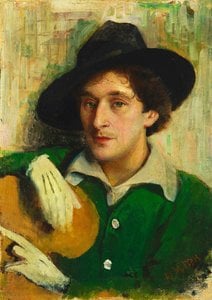
Marc Chagall
1887 - 1985 , Білорусь
Informații rapide
- Artistic Movement Or Style: Cubism și simbolism
- Artists Or Movements Influenced By Acest Artist: ['Surrealism']
- Artists Who Influenced This Artist:
- Bakst
- Delaunay
- Date Of Birth: 6 iulie 1887
- Date Of Death: 28 martie 1985
- Full Name: Marc Chagall
- Nationality: Rusă (acum Belarus)
- Notable Artworks:
- I și Orașul
- În Vinovație
- Place Of Birth: Liozna, Belarus
Articole conexe

Unlocking Emotion: A Beginner's Guide to the Raw Power of Symbolic Expressionism Art
Discover the raw emotion of Symbolic Expressionism. Our expert guide explores how masters like Munch use color and form to convey inner feelings, offering inspiration for collectors looking to bring powerful, soulful art into their modern homes.

The Raw Emotion of Expressionism: A Deep Dive into its History, Characteristics & Enduring Influence
Explore the raw emotion of Expressionism with ArtsDot. Discover its history, key artists like Kirchner & Munch, and lasting influence on modern art. Expert insights for collectors & enthusiasts.
Cubismul Expresionist: 10 Capodopere Esențiale pentru Decoruri de Artă Rafinate | ArtsDot.ro
Descoperă cele mai importante 10 capodopere ale Cubismului Expresionist! Explorează poveștile lui Picasso, Braque și alți artiști revoluționari. Reproduceri de artă de calitate muzeală pentru un decor interior unic. ArtsDot.ro
Figurative Expressionism: Emotional Intensity & Subjective Reality in 20th-Century Art
Explore the powerful world of Figurative Expressionism with ArtsDot. Discover key artists like Kirchner & Beckmann, understand its emotional depth, and learn how to collect this influential 20th-century art movement.

Expresionismul în Artă: Cele Mai Reprezentative 10 Capodopere | ArtsDot.ro
Descoperă cele mai importante 10 capodopere ale expresionismului! Explorează poveștile lui Munch, Van Gogh și Kandinsky. Reproduceri de artă de calitate muzeală pentru un decor interior unic. ArtsDot.ro


