

 Previzualizare
 Trimite prin felicitare
 Distribuie
 Detalii despre lucrare
 Ghid
Ghid

 Descarcă imaginea
 Produse similare
 Radiografie
 Galerie foto
 Q&A
Q&A Statistici
untitled (7336)


 Vezi mai mult
Giclée / Imprimare artistică
Printuri giclée sau pe canvas de calitate muzeală, cu proces de producție rapid și opțiuni flexibile de finisare. ( Comandă pictură realizată manual Comută pe Imagine Digitală)




P118B lei10

P118H lei10

P118W lei10

P438Z lei10

P508JH lei12

P508YH lei12

P805H lei10

P805Z lei10

P919BZ lei10

P919G lei10

P919XJ lei10

P959ZH lei10

P968JZ lei12

W106C lei8

W218G lei10

W218JH lei8

W218Y lei10

W307PJ lei10

W316G lei10

W316PJ lei8

W316Y lei10

W398PJ lei8

W4111J lei10

W500HY lei15

W500JH lei15

W692G lei12

W849H lei8

W940BG lei15

W953PJ lei8




Alegeți dintre dimensiunile noastre prestabilite, care respectă proporțiile originale ale operei de artă.

Introduceți lățimea și înălțimea necesare pentru a se potrivi ramei sau peretelui dumneavoastră. O printare poate fi doar tăiată, niciodată extinsă dincolo de dimensiunea imaginii originale, astfel încât o dimensiune cu o formă diferită va pierde o parte din imagine. Vă trimitem o simulare digitală pentru aprobare înainte de a imprima orice. Imaginea afișată pe această pagină nu prezintă tăierea reală — doar simularea arată acest lucru.
Livrare în întreaga lume () în 2 săptămâni, în loc de cele 4/5 săptămâni standard. (2 Noiembrie)

Livrare expres gratuită la nivel mondial

Pânză de in de înaltă calitate

Asigurare completă pentru transport

Garanție de rambursare a taxelor vamale

Garanția fidelității culorilor

Politica de retur în 100 de zile (doar pentru defecte de fabricație)

Garanție de rambursare 100%

Ofertă pentru comenzi multiple
 Opțiunea cu sticlă este disponibilă doar pentru dimensiuni de sub 110 cm

untitled (7336)
Giclée / Imprimare artistică
Dimensiune reproducere
-


Preț total calculat
lei 294
A Glimpse into the Soul: Unpacking Egon Schiele's "Untitled (7336)"
Egon Schiele’s “Untitled (7336),” a deceptively simple portrait of a woman reclining against a vibrant yellow backdrop, is far more than just a depiction of repose. It’s a window into the artist’s profoundly personal and often turbulent world – a realm dominated by themes of mortality, vulnerability, and the raw intensity of human emotion. Painted during a period of immense upheaval in his life and the broader European landscape, this work embodies the core tenets of Schiele's Expressionist style: an unflinching honesty about the darker aspects of existence, coupled with a remarkable sensitivity to line and form.
The painting immediately draws the eye to the woman herself. Her posture suggests either sleep or deep contemplation, yet there’s an undeniable tension in her relaxed demeanor. The most striking element is undoubtedly her crimson nose – a detail that defies easy interpretation. Some scholars suggest it represents a deliberate challenge to conventional beauty standards, a rejection of idealized representations, and perhaps even a subtle nod to Schiele's own anxieties about his appearance and perceived flaws. It’s a bold, unsettling feature that forces the viewer to confront the subject on her own terms.
The Language of Line: Schiele’s Unique Technique
Schiele was renowned for his distinctive use of line – thick, gestural strokes that seem to vibrate with energy and emotion. In “Untitled (7336),” this is particularly evident in the rendering of the woman's body and the background. The yellow field isn’t a flat, uniform color; instead, it’s built up through layers of short, broken lines, creating a sense of movement and instability. This technique mirrors the emotional turbulence that characterized Schiele’s life and work. He often employed a technique he called “line-drawing,” where the line itself became the primary subject, conveying feeling rather than simply delineating form.
The composition is remarkably sparse, relying heavily on negative space to amplify the impact of the central figure. The simplicity of the setting – just the yellow background and the reclining woman – serves to heighten our focus on her expression and posture. Schiele’s mastery lies in his ability to communicate volumes with minimal means.
Echoes of Mortality: Schiele's Obsession
Born in Vienna in 1890, Egon Schiele’s life was tragically cut short at the age of 28 during World War I. His father’s death from syphilis when he was just fourteen profoundly shaped his artistic vision, instilling within him a deep preoccupation with illness, decay, and the inevitability of mortality. This obsession permeates much of his work, and “Untitled (7336)” is no exception. The woman's vulnerability, combined with the unsettling detail of her nose, evokes a sense of fragility and impending loss.
Interestingly, Schiele’s exploration of death and decay often intertwined with themes of eroticism and desire. As seen in works like “Death and the Maiden,” he frequently depicted figures caught in moments of intense emotional turmoil, blurring the boundaries between life and death, beauty and ugliness. This duality is powerfully present here, suggesting a complex relationship with mortality – one that acknowledges its inevitability while simultaneously celebrating the intensity of human experience.
A Reproduction for Your Space: Bringing Schiele’s Vision Home
ArtsDot offers meticulously crafted hand-painted reproductions of Egon Schiele's “Untitled (7336),” allowing you to bring this emotionally resonant artwork into your home or office. Our skilled artists replicate Schiele’s distinctive line work and vibrant color palette with exceptional accuracy, ensuring that the essence of the original painting is faithfully preserved. Whether you are an art collector, a design enthusiast, or simply someone seeking a piece of art that speaks to the human condition, a ArtsDot reproduction of “Untitled (7336)” offers a unique opportunity to connect with one of the 20th century’s most compelling and enigmatic artists.
Explore this artwork further on ArtsDot.
Întrebări și răspunsuri
Ce armonie de culori prezintă "untitled (7336)" de Egon Schiele?
Armonia cromatică a operei "untitled (7336)" este descrisă ca fiind Strong Color Unity.
În ce mișcare și în ce epocă este situată opera "untitled (7336)" de Egon Schiele?
"untitled (7336)" de Egon Schiele face parte din mișcarea Expressionism, reprezentativă pentru epoca Era modernă a creatorului său.
"untitled (7336)" de Egon Schiele se numără printre operele de artă Expressionism căutate?
"untitled (7336)" de Egon Schiele este clasificată ca fiind Recognized și face parte din mișcarea Expressionism.
Opere similare


Biografie artist
A Life Forged in Expression
Egon Schiele’s life, a whirlwind of artistic passion and profound personal hardship, unfolded from his birth in Tulln an der Donau, Austria, in 1890. His early years were steeped in sorrow; the loss of his father, a railway station master, due to syphilis when Egon was just fourteen cast a long shadow, fueling within him a haunting preoccupation with mortality and the fragility of human existence. Raised initially by his mother and later under the watchful eye of his uncle Leopold Czihaczek, Schiele’s childhood lacked the stability common to many, yet it fostered an independent spirit—a crucial element in shaping his artistic vision. From a young age, he displayed an intense fascination with trains – a motif that would subtly reappear throughout his work – and a burgeoning talent for drawing, though this was often met with disapproval from his father who viewed it as a distraction from more practical pursuits. The untimely death of his sister Elvira further deepened the emotional landscape of his youth, imbuing his art with an undercurrent of melancholy and vulnerability. These formative experiences—loss, isolation, and a yearning for self-expression—became the bedrock upon which Schiele’s unique artistic voice was built, constantly grappling with themes of life, death, and the complexities of the human condition.The Crucible of Vienna: Artistic Development
Schiele's formal artistic training began at the Kunstgewerbeschule (School of Arts and Crafts) in Vienna, but he quickly found himself stifled by its conservative approach—a rigid adherence to tradition that clashed with his burgeoning creative spirit. Seeking a more stimulating environment, he transferred to the Akademie der bildenden Künste (Academy of Fine Arts), only to discover further disillusionment with its academic constraints. This dissatisfaction led him to abandon formal training altogether, choosing instead to forge his own path – a bold decision reflecting his unwavering artistic conviction and determination to express himself on his own terms. A pivotal influence during these early years was Gustav Klimt, the celebrated Secessionist painter. Schiele deeply admired Klimt’s decorative style and his exploration of symbolism, even receiving mentorship from the established artist. However, Schiele soon diverged significantly from Klimt's aesthetic, developing a distinctly individual voice characterized by its stark honesty, psychological intensity, and unflinching portrayal of human vulnerability. He became a founding member of the *Neues Wiener Kunstgruppe* (New Viennese Art Group) in 1909, alongside other progressive artists who challenged the prevailing artistic norms of the time. This group provided a space for experimentation and innovation, allowing Schiele to refine his style and explore new avenues of expression. His early works—often unsettling portraits and self-portraits—began to emerge as powerful statements of emotional turmoil, featuring distorted figures, elongated limbs, and a palpable sense of unease. These paintings were not merely representations of physical form but explorations of the inner landscape—the anxieties, desires, and fears that haunted the human psyche. He sought to depict not what he *saw*, but what he *felt*.Raw Emotion and Unflinching Truth
Egon Schiele’s art is immediately recognizable for its raw honesty and psychological depth. He fearlessly confronted themes often considered taboo – sexuality, death, anxiety, isolation – with an unflinching gaze. His distinctive style features elongated figures, contorted poses, and expressive lines that convey a sense of unease and emotional intensity. The human form, particularly the nude, became his primary subject, not as an object of idealized beauty but as a vessel for exploring the complexities of human experience. Self-portraits constitute a significant portion of his oeuvre, offering intimate glimpses into his inner world—a world often marked by loneliness and self-doubt. He didn’t shy away from depicting himself in unflattering or vulnerable poses, revealing a profound level of self-awareness and introspection. Beyond self-portraiture, Schiele created numerous portraits of others, capturing their likenesses with an unsettling realism that seemed to penetrate beneath the surface. His landscapes, while less central to his work than his figurative paintings, demonstrate his mastery of form and color, often reflecting the same emotional intensity as his portraits. The use of line is particularly striking in Schiele’s work; it's not merely a tool for defining shape but an expressive force that conveys emotion and psychological tension. Recurring motifs like the *Physalis* plant – symbolizing death and transience with its delicate, papery husk – further underscore this preoccupation with mortality. The influence of Symbolism is also evident in his use of color and symbolism, adding layers of meaning to his compositions.A Legacy Cut Short: Achievements & Significance
Despite facing censorship and legal challenges—including a brief imprisonment for allegedly corrupting minors with his art—Schiele gained recognition within Vienna’s avant-garde circles. His work challenged the conventions of the time, provoking both admiration and outrage. By the time of his untimely death during the Spanish flu pandemic in 1918 at the age of twenty-eight, he had established himself as a leading figure in Austrian Expressionism. Significant works such as *Self-Portrait with Physalis*, *Couple Embracing*, and *Field Landscape (Kreuzberg near Krumau)* stand as testaments to his artistic genius. His influence on subsequent generations of artists is undeniable, particularly those interested in exploring psychological themes and challenging conventional artistic norms. Schiele’s bold approach to form and subject matter continues to resonate with audiences today, making him one of the most important and influential figures in early 20th-century art. His paintings are now held in major museum collections worldwide, including the Leopold Museum in Vienna and the Egon Schiele Art Centrum in Český Krumlov, ensuring his artistic legacy endures. He left behind a body of work that is not merely aesthetically compelling but profoundly human—a testament to the power of art to confront the complexities of existence with honesty, courage, and unwavering vision.- Key Themes: Mortality, sexuality, isolation, psychological turmoil.
- Influences: Gustav Klimt, Viennese Secession, personal trauma.
- Style Characteristics: Elongated figures, contorted poses, expressive lines, raw emotion.

Egon Schiele
1890 - 1918 , Austria
Detalii rapide
- Artistic Movement Or Style: Expressionism
- Artists Or Movements Influenced By This Artist: ['Secession']
- Artists Who Influenced This Artist: ['Klimt']
- Date Of Birth: 1890
- Date Of Death: 1918
- Full Name: Egon Schiele
- Nationality: Austrian
- Notable Artworks:
- Self-Portrait
- Couple
- Peisaj
- Place Of Birth: Tulln, Austria
Articole similare
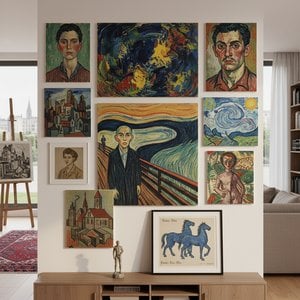
Expresionismul în Artă: Cele Mai Reprezentative 10 Capodopere | ArtsDot.ro
Descoperă cele mai importante 10 capodopere ale expresionismului! Explorează poveștile lui Munch, Van Gogh și Kandinsky. Reproduceri de artă de calitate muzeală pentru un decor interior unic. ArtsDot.ro
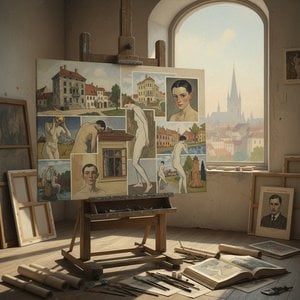
Egon Schiele: Cele Mai Remarcabile 25 De Opere – Artă, Decorațiuni și Inspirație
Descoperă cele mai importante 25 de opere ale lui Egon Schiele! Explorează expresionismul austriac, portretele intense și autoportretele emoționante. Reproduceri artă de calitate muzeală & inspirație decor pe ArtsDot.com.

Crimson Threads of Narrative: Exploring Symbolism & Representation in Artworks Featuring the Red Dress
Explore the rich symbolism of the red dress in art history! From ancient power displays to iconic portraits like Cézanne’s 'Madame Cezanne', discover the cultural and artistic significance behind this captivating color. Expert analysis & insights.

Egon Schiele: Expressionism, Anxiety & the Modern Condition – A Comprehensive Exploration
Explore the emotionally charged world of Egon Schiele (1890-1918). Discover his Expressionist masterpieces, psychological themes, and lasting impact on modern art. A comprehensive guide for collectors & enthusiasts.

Mark Rothko: Cele Mai Iconice 25 De Capodopere – Artă Abstractă pentru Decor Rafinat
Descoperă cele mai iconice 25 de picturi abstracte ale lui Mark Rothko! Explorează istoria, culorile și emoțiile din spatele fiecărei capodopere. Reproduceri artă de calitate muzeală & inspirație decor pe ArtsDot.com.


