Retrato de William Powell Frith

O seu Guia das 100 Pinturas Mais Famosas de William Powell Frith

Atualizado em Outubro 2026 · classificado pela nossa pontuação de popularidade (pesquisas, visitas e pedidos de cada obra) · 154 obras de William Powell Frith em nosso catálogo

Em resumo

A obra mais conhecida de William Powell Frith é The Derby Day (1858). Você pode encontrá-la no Tate Britain, em Londres. Os próximos da lista são Dr Johnson and Mrs Siddons in Bolt Court (1887) e João Knox Reproving Maria, Rainha das Escócia (1844). Temos 154 obras de William Powell Frith em nosso catálogo; este guia seleciona as 100 mais conhecidas, com o ano, o museu e a história de cada peça.

1819 – 1909, Aldfield Romanticism Mais obras: National Portrait Gallery

As 10 pinturas de William Powell Frith que você deve conhecer primeiro

1
The Derby Day (1858) de William Powell Frith

The Derby Day

1858 · Oil On Canvas · Tate Britain, Londres

William Powell Frith's “The Derby Day,” painted in 1858, isn’t merely a depiction of a horse race; it’s a meticulously crafted panorama of Victorian society at its most vibrant and, frankly, its most stratified. Exhibited to immediate acclaim at the Royal Academy, this large oil painting captures a single afternoon – a fleeting moment frozen in time – yet offers an astonishingly detailed window into the lives, aspirations, and social…

2
Dr Johnson and Mrs Siddons in Bolt Court (1887) de William Powell Frith

Dr Johnson and Mrs Siddons in Bolt Court

1887 · Oil On Canvas · dr Johnson's House, London

In this work, titled Dr Johnson and Mrs Siddons in Bolt Court, the artist William Powell Frith presents a quiet, intimate encounter between two significant figures of the era. The painting captures Dr. Samuel Johnson and Mrs. Siddons in a moment of shared presence. It is a study of character and connection, rendered with the meticulous observation that defined Frith's approach to his subjects.

3
João Knox Reproving Maria, Rainha das Escócia (1844) de William Powell Frith

João Knox Reproving Maria, Rainha das Escócia

1844 · Acrílico sobre tela · Sheffield City Art Galleries, Sheffield

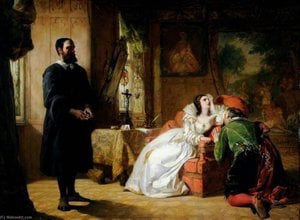
Uma Cena Histórica Capturada em Óleo Sobre Tela: John Knox Reproving Mary, Queen of Scots A pintura "John Knox Reproving Mary, Queen of Scots" de William Powell Frith é uma obra fascinante que transcende o mero registro histórico, oferecendo um profundo mergulho na psicologia humana e nas complexidades das relações políticas da Inglaterra Vitoriana. Criada em 1844, esta tela monumental, agora alojada nas Galerias Municipais de Sheffield, permanece como um…

4
William Powell Frith (1838) de William Powell Frith

William Powell Frith

1838 · Oil On Canvas · National Portrait Gallery, Londres

The young man in this oil on canvas is William Powell Frith, captured in a moment of quiet introspection. Painted in 1838, the work presents the artist as a nineteen-year-old student, peering out from a time when his professional path was just beginning to take shape. At this stage, he is a resident of 6 Charlotte Street, a location that marks his early presence in the London art scene. The…

6
Self-Portrait at the Age of 83 (1901) de William Powell Frith

Self-Portrait at the Age of 83

1901 · Oil On Canvas · Yale Center for British Art, New Haven

The oil painting titled Self-Portrait at the Age of 83 was executed by the artist William Powell Frith. Created in 1901, this work functions as a self-portrait, capturing the likeness of the artist himself. The subject depicted in the composition is William Powell Frith, presented in a bust-length view that focuses on the facial features and head of the sitter.

De 11 a 100: mais pinturas de William Powell Frith

11Feeding Time (My Lady's Pets) (1860) de William Powell FrithFeeding Time (My Lady's Pets)1860 · Rhode Island School of Design Museum of Art 12Barco da Ferry de Eastham (1862) de William Powell FrithBarco da Ferry de Eastham1862 · Williamson Art Gallery - Museum 13William Powell Frith (1867) de William Powell FrithWilliam Powell Frith1867 · National Portrait Gallery 14Queen Alexandra (1844-1925) when Princess of Wales (1867) de William Powell FrithQueen Alexandra (1844-1925) when Princess of Wales1867 · Royal Collection 15Olivia unveiling (1874) de William Powell FrithOlivia unveiling1874 16The Marriage of the Prince and Princess of Wales (later King Edward VII and Queen Alexandra) (1878) de William Powell FrithThe Marriage of the Prince and Princess of Wales (later King Edward VII and Queen Alexandra)1878 · Royal London Hospital 17Retribution (1880) de William Powell FrithRetribution1880 · Birmingham Museum and Art Gallery 18Self Portrait (1883) de William Powell FrithSelf Portrait1883 19After The Bath de William Powell FrithAfter The Bath 20Lovers de William Powell FrithLovers 21Portrait of a Lady La Marquise (1885) de William Powell FrithPortrait of a Lady La Marquise1885 · Auckland Art Gallery Toi o Tāmaki 22The railway station de William Powell FrithThe railway station 23My First Attempt from Nature (1837) de William Powell FrithMy First Attempt from Nature1837 24An English Merry Making, a Hundred Years Ago (1846) de William Powell FrithAn English Merry Making, a Hundred Years Ago1846 25Dolly Varden (1842) de William Powell FrithDolly Varden1842 26The Merry Wives of Windsor (1843) de William Powell FrithThe Merry Wives of Windsor1843 27The Highwayman (1848) de William Powell FrithThe Highwayman1848 28Measuring Heights (from Oliver Goldsmith's 'The Vicar of Wakefield') (1842) de William Powell FrithMeasuring Heights (from Oliver Goldsmith's 'The Vicar of Wakefield')1842 29The Sleeping Model (1853) de William Powell FrithThe Sleeping Model1853 · Royal Academy of Arts 30Mary, Queen of Scots Bidding Farewell to France, 1561 (1851) de William Powell FrithMary, Queen of Scots Bidding Farewell to France, 15611851 31Monsieur Jourdain's Dancing Lesson (from Molière's 'Le Bourgeois Gentilhomme', Act II, Scene 1) (1850) de William Powell FrithMonsieur Jourdain's Dancing Lesson (from Molière's 'Le Bourgeois Gentilhomme', Act II, Scene 1)1850 32Little Dorrit (1859) de William Powell FrithLittle Dorrit1859 33The Two Central Figures in Derby Day (1860) de William Powell FrithThe Two Central Figures in Derby Day1860 · Metropolitan Museum of Art 34Many Happy Returns of the Day (1856) de William Powell FrithMany Happy Returns of the Day1856 · Mercer Art Gallery 35Madame Jourdain Finds Her Husband Entertaining Dorimène and Dorante (1860) de William Powell FrithMadame Jourdain Finds Her Husband Entertaining Dorimène and Dorante1860 36Hugh and Dolly Varden (from the novel 'Barnaby Rudge' by Charles Dickens) (1863) de William Powell FrithHugh and Dolly Varden (from the novel 'Barnaby Rudge' by Charles Dickens)1863 37The Salon d'Or, Homburg (1870) de William Powell FrithThe Salon d'Or, Homburg1870 · Galeria Nacional do Canadá 38Isabelle Asleep (1867) de William Powell FrithIsabelle Asleep1867 39Little Seamstress (1865) de William Powell FrithLittle Seamstress1865 40The Knight and the Maid (1868) de William Powell FrithThe Knight and the Maid1868 41Mary Elizabeth Maxwell, née Braddon (1865) de William Powell FrithMary Elizabeth Maxwell, née Braddon1865 · National Portrait Gallery 42In Naples, Portrait of the Artist (1875) de William Powell FrithIn Naples, Portrait of the Artist1875 · Hospitalfield Centre For Art - Culture 43For Better, For Worse (1881) de William Powell FrithFor Better, For Worse1881 44The Invalid (1890) de William Powell FrithThe Invalid1890 · Nottingham Castle Museum And Art Gallery 45L'adieu de Marie Stuart (1893) de William Powell FrithL'adieu de Marie Stuart1893 · Mercer Art Gallery 46The Road To Ruin - de William Powell FrithThe Road To Ruin - 47The Road To Ruin de William Powell FrithThe Road To Ruin 48The Crossing Sweeper de William Powell FrithThe Crossing Sweeper 49At the Opera de William Powell FrithAt the Opera 50The Toilet de William Powell FrithThe Toilet 51Evening Prayer - de William Powell FrithEvening Prayer - 52Many Happy Returns of the Day de William Powell FrithMany Happy Returns of the Day 53Coming Of Age In The Olden Time - de William Powell FrithComing Of Age In The Olden Time - 54The Fair Toxophilites - de William Powell FrithThe Fair Toxophilites - 55Evening Prayer de William Powell FrithEvening Prayer 56When we devote our youth to god de William Powell FrithWhen we devote our youth to god 57The Lover's Seat - de William Powell FrithThe Lover's Seat - 58The Gossips de William Powell FrithThe Gossips 59La Coranto - de William Powell FrithLa Coranto - 60A scene from Molieres LAvare de William Powell FrithA scene from Molieres LAvare 61A may day celebration de William Powell FrithA may day celebration 62Juliet o that i were a glove upon that hand de William Powell FrithJuliet o that i were a glove upon that hand 63The ardour de William Powell FrithThe ardour 64O Pequeno Retrato (1883) de William Powell FrithO Pequeno Retrato1883 · New Walk Museum - Art Gallery 65Lancaster Sands, Lancashire (1848) de William Powell FrithLancaster Sands, Lancashire1848 · Touchstones Rochdale Arts And Heritage Centre 66The Railway Station - William Powell Frith (2026) de William Powell FrithThe Railway Station - William Powell Frith2026 67The derby day de William Powell FrithThe derby day 68The Village Clergyman de William Powell FrithThe Village Clergyman 69John Knox Reproving Mary - de William Powell FrithJohn Knox Reproving Mary - 70Coming Of Age In The Olden Time de William Powell FrithComing Of Age In The Olden Time 71Portrait Of A Lady Resting With Her Dog de William Powell FrithPortrait Of A Lady Resting With Her Dog 72Dolly Varden de William Powell FrithDolly Varden 73Coming Of Age In The Olden Time - de William Powell FrithComing Of Age In The Olden Time - 74Claude Duval de William Powell FrithClaude Duval 75The minstrel, de William Powell FrithThe minstrel, 76London Flower Girl de William Powell FrithLondon Flower Girl 77The Toilet - de William Powell FrithThe Toilet - 78The Miniature de William Powell FrithThe Miniature 79John Knox Reproving Mary de William Powell FrithJohn Knox Reproving Mary 80Wandering Thoughts de William Powell FrithWandering Thoughts 81Hogarth Brought Before The Governor de William Powell FrithHogarth Brought Before The Governor 82A Question Of Faith de William Powell FrithA Question Of Faith 83The proposal de William Powell FrithThe proposal 84The new frock de William Powell FrithThe new frock 85Sir Roger De Coverley And Addison de William Powell FrithSir Roger De Coverley And Addison 86Othello And Desdemona de William Powell FrithOthello And DesdemonaFitzwilliam Museum 87The Flower Seller de William Powell FrithThe Flower Seller 88Lovers - de William Powell FrithLovers -Art Institute of Chicago 89Study of Miss Mortimer holding a Parasol de William Powell FrithStudy of Miss Mortimer holding a Parasol 90The Lover's Seat de William Powell FrithThe Lover's Seat 91The Fair Toxophilites de William Powell FrithThe Fair Toxophilites 92The Artist's Model de William Powell FrithThe Artist's Model 93Bedtime de William Powell FrithBedtime 94The signal de William Powell FrithThe signal 95Village merrymaking de William Powell FrithVillage merrymaking 96Tenby prawn seller de William Powell FrithTenby prawn seller 97Lord Foppington Relating his Adventures de William Powell FrithLord Foppington Relating his Adventures 98Sterne's Maria de William Powell FrithSterne's Maria 99Poverty And Wealth de William Powell FrithPoverty And Wealth 100The novice de William Powell FrithThe novice

Pinturas de William Powell Frith, período por período

O que William Powell Frith mais pintou

Os quatro temas que surgem com mais frequência nestas obras, cada um com o seu exemplo mais conhecido.

Onde você pode ver as pinturas de William Powell Frith

Os 8 museus que detêm a maioria das pinturas desta página.

Museu Cidade Obras de William Powell Frith Pinturas desta lista
National Portrait Gallery, LondresNational Portrait Gallery Londres 3 William Powell Frith, William Powell Frith, Mary Elizabeth Maxwell, née Braddon
Royal Collection, LondresRoyal Collection Londres 4 Anne Page, Queen Alexandra (1844-1925) when Princess of Wales
Birmingham Museum and Art Gallery, BirminghamBirmingham Museum and Art Gallery Birmingham 2 Garden Flowers ( Making A Posy ), Retribution
Mercer Art Gallery, HarrogateMercer Art Gallery Harrogate 2 Many Happy Returns of the Day, L'adieu de Marie Stuart
Sheffield City Art Galleries, SheffieldSheffield City Art Galleries Sheffield 2 João Knox Reproving Maria, Rainha das Escócia
Rhode Island School of Design Museum of Art, ProvidenceRhode Island School of Design Museum of Art Providence 2 Feeding Time (My Lady's Pets)
Auckland Art Gallery Toi o Tāmaki, AucklandAuckland Art Gallery Toi o Tāmaki Auckland 2 Portrait of a Lady La Marquise
Tate Britain, LondresTate Britain Londres 1 The Derby Day

Década por década: a obra mais conhecida de cada William Powell Frith

Obras por década

Escolha uma década para ver a sua obra de destaque.

William Powell Frith: respostas rápidas sobre as pinturas

Qual é a pintura mais conhecida de William Powell Frith?Ver a resposta

No topo da lista está The Derby Day (1858), Tate Britain, Londres. Logo atrás: Dr Johnson and Mrs Siddons in Bolt Court (1887) e João Knox Reproving Maria, Rainha das Escócia (1844).

Qual era a idade de William Powell Frith quando criou The Derby Day?Ver a resposta

39 anos. William Powell Frith nasceu em 1819, e The Derby Day é de 1858.

Quais são as 10 principais pinturas de William Powell Frith?Ver a resposta

The Derby Day, Dr Johnson and Mrs Siddons in Bolt Court, João Knox Reproving Maria, Rainha das Escócia, William Powell Frith, King Henry And Anne Boleyn Deer Shooting, Self-Portrait at the Age of 83, The Duel Scene from 'Twelfth Night' by William Shakespeare, Garden Flowers ( Making A Posy ), Anne Page e Mr Honeywood Introduces the Bailiffs to Miss Richland as His Friends (also known as rom Oliver Goldsmith's 'The Good Natured Man', Act III, Scene 1). Encontrará o ano e o museu de cada uma na lista acima.

Quantas obras de William Powell Frith existem no seu catálogo?Ver a resposta

Temos 154 obras de William Powell Frith em nosso catálogo, datadas de 1837 a 1901.

Em quais museus é possível ver as obras famosas de William Powell Frith?Ver a resposta

Encontrará a maioria deles em National Portrait Gallery (Londres), Royal Collection (Londres) e Birmingham Museum and Art Gallery (Birmingham). A lista de museus acima apresenta o detalhamento completo.

Quando é que William Powell Frith criou as suas obras mais famosas?Ver a resposta

Em 1860s, mais do que em qualquer outro momento: 11 das 100 obras nesta página datam dessa época, sendo Feeding Time (My Lady's Pets) delas.

Quais são as primeiras e as últimas obras famosas de William Powell Frith?Ver a resposta

A obra mais antiga aqui é My First Attempt from Nature (1837); a mais recente é Self-Portrait at the Age of 83 (1901).

Quais temas William Powell Frith pintou com mais frequência?Ver a resposta

Victorian era (13), Portraiture (5) e Victorian society (4), de um total de 100 obras nesta página.

Qual técnica é mais presente nas pinturas de William Powell Frith?Ver a resposta

Oil On Canvas, utilizado em 7 das 100 obras nesta página.

Por qual estilo ou movimento William Powell Frith é conhecido(a)?Ver a resposta

Romanticism, como pode ver nas obras desta página.

Quais pinturas famosas de William Powell Frith estão no National Portrait Gallery?Ver a resposta

Pode ver 3 das obras nesta página no National Portrait Gallery, Londres, incluindo William Powell Frith, William Powell Frith e Mary Elizabeth Maxwell, née Braddon.

Onde posso encomendar uma reprodução de William Powell Frith?Ver a resposta

Sim. Todas as pinturas nesta página estão disponíveis como uma reprodução a óleo pintada à mão ou uma impressão, no tamanho que melhor lhe convier. Basta abrir a página da pintura para fazer o seu pedido.

A história de William Powell Frith

Early Life and Artistic Beginnings

William Powell Frith’s journey into the world of art began in a surprisingly modest setting: Aldfield, a small village nestled near Ripon in North Yorkshire, England. Born on January 9, 1819, he was the son of an innkeeper, a profession that initially seemed far removed from the realm of artistic creation. However, his father recognized and nurtured a nascent talent within young William, recognizing a keen eye for detail and a natural inclination towards visual representation.

Unlike many artists who benefited from privileged backgrounds, Frith’s early education was somewhat rudimentary. He received instruction in basic literacy and arithmetic before transitioning to the teachings of a local church school. Yet, it was his father's astute observation that steered him toward a more formal artistic training. This pivotal decision marked a turning point, setting him on a path towards becoming one of Britain’s most celebrated genre painters.

Frith’s initial aspirations leaned towards the practical profession of an auctioneer, a common pursuit for young men in his era. However, his father, recognizing his son's artistic potential, gently encouraged him to pursue his passion. This guidance led Frith to enroll at Sass’s Academy in Charlotte Street, London – a prestigious institution renowned for its rigorous training and exposure to the latest artistic trends. There, he honed his skills under the tutelage of accomplished instructors, laying the foundation for his future success.

Influences and Artistic Style

Frith's artistic development was profoundly shaped by several key influences, most notably the work of Sir David Wilkie, a prominent painter known for his captivating depictions of domestic scenes. Wilkie’s ability to capture the nuances of everyday life with remarkable realism and detail served as a significant model for Frith. He particularly admired Wilkie's approach to portraying social interactions within public spaces – a theme that would become central to Frith’s own artistic vision.

Furthermore, Frith was deeply impacted by the literary works of Charles Dickens, whose vivid descriptions of London life provided him with rich source material. He frequently drew inspiration from Dickens' novels and short stories, translating their scenes and characters onto canvas with meticulous precision. This collaboration between literature and art is evident in many of his most celebrated paintings.

Frith’s artistic style was characterized by an extraordinary level of detail and a commitment to realism. He meticulously observed the world around him, capturing the appearance of clothing, architecture, and human expressions with remarkable accuracy. His compositions often featured numerous figures arranged within complex, crowded scenes – a hallmark of his distinctive approach. He skillfully employed photographic studies, particularly those created by Robert Howlett, to ensure that every element in his paintings was rendered with utmost precision.

Notable Works and Artistic Achievements

William Powell Frith’s career produced a remarkable body of work, each painting offering a unique glimpse into Victorian society. Among his most iconic creations are Ramsgate Sands (1854), a vibrant depiction of seaside life that captures the energy and excitement of a popular resort town; The Derby Day (1858), a sprawling panorama of the Epsom Downs Racecourse, teeming with elegantly dressed spectators and spirited horses; and The Railway Station (1862), a detailed portrayal of Paddington Station, showcasing the bustling activity of London’s transportation hub.

His painting *The Sleeping Model* (1853) holds particular significance as his Diploma work at the Royal Academy. This piece demonstrated his technical mastery and artistic vision, solidifying his position within the art world. Another notable work is *The Crossing Sweeper* (1858), a poignant scene that starkly contrasts the opulence of the wealthy with the poverty of the working class – a commentary on social inequality that resonated deeply with Victorian audiences.

Frith’s success was not merely artistic; it was also commercial. His paintings were immensely popular, attracting large crowds to exhibitions and generating significant revenue. He became one of the most commercially successful artists of his time, a testament to his talent and the appeal of his subject matter.

Later Years and Legacy

As he matured, Frith continued to produce works that reflected both his artistic skill and his social awareness. His later paintings often explored themes of wealth, poverty, and morality, offering critical observations on Victorian society. He wrote two autobiographies, *My Autobiography* (1887) and *Further Reminiscences* (1888), providing valuable insights into his life, artistic process, and the cultural context in which he worked.

Frith remained active as an artist until his death on November 2, 1909, at the age of 90. He continued to exhibit his work throughout his later years, maintaining a strong presence within the British art scene. His legacy endures as one of the most important genre painters of the Victorian era, celebrated for his meticulous realism, social commentary, and captivating depictions of everyday life.

His paintings continue to be exhibited in museums and galleries around the world, offering a valuable window into 19th-century England. Frith’s work serves as a reminder of the power of art to document history, explore social issues, and capture the essence of human experience.

Todas as 154 obras de William Powell Frith →