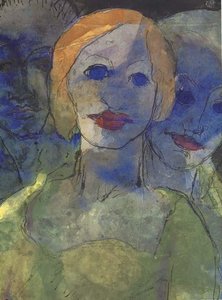
Portrait of Emil Nolde

Your Guide to the 100 Most Famous Emil Nolde Paintings

Updated Outubro 2026 · ranked by our popularity score (searches, visits and orders for each work) · 394 works by Emil Nolde in our catalogue

In short

Emil Nolde's best-known piece is Sunset. Next on the list are Sea with Red Sky and Couple on the beach (1903). We have 394 works by Emil Nolde in our catalogue; this guide picks out the 100 best known, with the year, the museum and the story of each piece.

1867 – 1956, Nolde German expressionism Most works: Bavarian State Painting Collections

The 10 Emil Nolde paintings to know first

1
Sunset by Emil Nolde

Sunset

Oil On Canvas

The sun hangs as a heavy, bright circle at the center of the sky, a singular eye watching the descent of the day. Below it, the atmosphere burns with shades of yellow, orange, and red, bleeding into one another to create a warm, thick air. The ocean receives this light, its waves rolling gently toward the shore in a rhythmic, quiet motion. A lone boat floats upon the water, a…

2
Sea with Red Sky by Emil Nolde

Sea with Red Sky

Oil

Sea with Red Sky is an expressionist painting by Emil Nolde. The canvas captures a moment of intense color, where the sky burns with a deep, saturated red. This work belongs to the early movements of expressionism, a style that prioritizes the internal pulse of a subject over its literal likeness. The artist sought to translate raw sensation into pigment, moving beyond the surface of the natural world to reach…

3
Couple on the beach (1903) by Emil Nolde

Couple on the beach

1903 · Oil

In "Couple on the beach" by Emil Nolde, painted about 1903, the arrangement of figures creates a quiet sense of intimacy against a vast landscape. At the center of the composition, a man and a woman stand close together. He has his arm around her, and she is dressed in a long dress. Their bodies are oriented toward the water, their gazes fixed on the horizon. This shared focus directs…

4
Masks (1911) by Emil Nolde

Masks

1911 · Acrylic On Canvas · Nelson-Atkins Museum of Art, Kansas City

Emil Nolde's "Masks," painted in 1911, isn’t merely a depiction of carnival revelry; it’s a profound exploration of identity, hidden desires, and the unsettling duality inherent within human nature. Created during his time as a key member of Die Brücke – “The Bridge” – a group pushing the boundaries of German Expressionism in Dresden and Berlin, the painting embodies the movement's core tenets: a rejection of academic realism in favor…

5
Christ among the Children by Emil Nolde

Christ among the Children

Oil On Canvas

Emil Nolde’s “Christ Among the Children” is not merely a depiction of a biblical scene; it’s an immersive experience, a visceral outpouring of emotion rendered with the raw energy characteristic of his mature style. This large-scale painting captures a moment of profound intimacy – Christ surrounded by children – yet it vibrates with a primal intensity that speaks to the core of human connection and faith. The photograph reveals a…

6
The Great Gardener by Emil Nolde

The Great Gardener

The Great Gardener emerges from the brush of Emil Nolde, a man whose very name carries the weight of his birthplace. Born in 1867 in Nolde, Denmark, the artist carries the essence of his origins into every stroke. He moves through the world of color with a sense of purpose, much like the subject of this work. The painting, titled The Great Gardener, captures a moment of quiet connection within…

7
Light-flooded Sea (Green) by Emil Nolde

Light-flooded Sea (Green)

Watercolor

Light-flooded Sea (Green) is a work by Emil Nolde. This piece presents a highly stylized and abstracted seascape, stripping the horizon of its literal boundaries. The subject matter focuses on the meeting of water and sky, rendered through a lens of intense, personal feeling rather than precise representation.

8
Marshy Landscape under the Evening Sky by Emil Nolde

Marshy Landscape under the Evening Sky

Watercolor

The scene unfolds in Marshy Landscape under the Evening Sky, a work that carries the unmistakable hand of the artist Emil Nolde. This piece captures a specific, quiet moment where the land meets a heavy, atmospheric sky. The artist, Emil Nolde, was born in Nolde, Denmark, in 1867, and his connection to the natural world remains palpable in the way he approaches the canvas. He lived until 1956, leaving behind…

9
Animal and Figures (1912) by Emil Nolde

Animal and Figures

1912 · Black and White Photography · Bavarian State Painting Collections, Munique

A monochrome stillness settles over the scene. Two men stand in the rigid geometry of early 20th-century military attire, their forms anchored against a dark, featureless void. They are framed by a slender pedestal that divides the composition with mathematical precision. On the left, a hand rests firmly on a hip; on the right, a hand finds rest upon the stand. The fabric of their tunics, the heavy weave of…

10
Anna Wieds Garden by Emil Nolde

Anna Wieds Garden

Acrylic

Emile Nolde, a prominent German-Danish painter and printmaker, is renowned for his vibrant and expressive works of art. One of his notable pieces, Anna Wieds Garden, exemplifies the essence of Expressionism, a modernist movement that emerged in the early 20th century. This captivating oil painting is a testament to Nolde's unique style, which blends elements of Expressionism with a deep appreciation for nature. The Expressionist Style Expressionism, as described by…

Numbers 11 to 100: more Emil Nolde paintings

11Festival Girls (1918) by Emil NoldeFestival Girls1918 · Bavarian State Painting Collections 12Child and Large Bird by Emil NoldeChild and Large Bird 13Sea and ship in the sunset by Emil NoldeSea and ship in the sunset 14Nordermühle (1932) by Emil NoldeNordermühle1932 · Bavarian State Painting Collections 15untitled (1534) by Emil Noldeuntitled (1534) 16Shivering Russians (1914) by Emil NoldeShivering Russians1914 · Statens Museum For Kunst 17Summer Clouds by Emil NoldeSummer Clouds 18Landscape in Red Light by Emil NoldeLandscape in Red Light 19Light Sea Mood by Emil NoldeLight Sea Mood 20Mountain Slope over the Sea by Emil NoldeMountain Slope over the Sea 21Mountain Giant by Emil NoldeMountain Giant 22Two Women (Yellow and Red Hair) by Emil NoldeTwo Women (Yellow and Red Hair) 23Two Women against a Blue Sky by Emil NoldeTwo Women against a Blue Sky 24Wild Animals (1921) by Emil NoldeWild Animals1921 · Bavarian State Painting Collections 25Autumn Sea by Emil NoldeAutumn Sea 26Prophet by Emil NoldeProphet 27Phantasie by Emil NoldePhantasie 28Friends by Emil NoldeFriends 29The dancer (Mary Wigman) by Emil NoldeThe dancer (Mary Wigman) 30Old Man Nude Girl by Emil NoldeOld Man Nude Girl 31The enthusiastic by Emil NoldeThe enthusiastic 32Dance around the golden calf by Emil NoldeDance around the golden calf 33Mills (1924) by Emil NoldeMills1924 · Bavarian State Painting Collections 34Robbers at Bombüll (1917) by Emil NoldeRobbers at Bombüll1917 · Statens Museum For Kunst 35Mask Still Life III, (1911) by Emil NoldeMask Still Life III,1911 36A Zombaria de Cristo (1909) by Emil NoldeA Zombaria de Cristo1909 37Jardim de Flores (Menina e Lavagem) (1908) by Emil NoldeJardim de Flores (Menina e Lavagem)1908 · Museum Kunstpalast 38The Blacksmith (1912) by Emil NoldeThe Blacksmith1912 · Statens Museum For Kunst 39untitled (1000) by Emil Noldeuntitled (1000) 40untitled (3444) by Emil Noldeuntitled (3444) 41Autumn Sunset by Emil NoldeAutumn Sunset 42Flower Garden. Pansies by Emil NoldeFlower Garden. Pansies 43Green Landscape with Red Colud by Emil NoldeGreen Landscape with Red Colud 44Seacoast (Red Sky, Two White Sails) by Emil NoldeSeacoast (Red Sky, Two White Sails) 45Christ and the Children (1910) by Emil NoldeChrist and the Children1910 46Dancing Children (1909) by Emil NoldeDancing Children1909 47Autumn Sea XVIII (1911) by Emil NoldeAutumn Sea XVIII1911 48Ridicule (Verspottung) (1909) by Emil NoldeRidicule (Verspottung)1909 · Brücke Museum 49Round Dance (1909) by Emil NoldeRound Dance1909 50Dolls and Parrot (1912) by Emil NoldeDolls and Parrot1912 · Bavarian State Painting Collections 51Russian II (1914) by Emil NoldeRussian II1914 52Bright Sea (1915) by Emil NoldeBright Sea1915 53Girl in the Garden (1915) by Emil NoldeGirl in the Garden1915 54Papua Youths (1914) by Emil NoldePapua Youths1914 55Tulips (1915) by Emil NoldeTulips1915 56Entry into Jerusalem (1915) by Emil NoldeEntry into Jerusalem1915 57Papua Youths (1914) by Emil NoldePapua Youths1914 58At the Fountain (1916) by Emil NoldeAt the Fountain1916 · Staatliche Kunsthalle Karlsruhe 59Garden with flowers (1916) by Emil NoldeGarden with flowers1916 60Masks IV (1920) by Emil NoldeMasks IV1920 61Water Lilies Still Life (1922) by Emil NoldeWater Lilies Still Life1922 62Tall Sunflowers (1926) by Emil NoldeTall Sunflowers1926 · Bavarian State Painting Collections 63Tiger Lilies (1925) by Emil NoldeTiger Lilies1925 64Flower Garden (1924) by Emil NoldeFlower Garden1924 65Hülltoft Hof (1932) by Emil NoldeHülltoft Hof1932 66Begonias, Red and Yellow (1929) by Emil NoldeBegonias, Red and Yellow1929 67Turtle by Emil NoldeTurtle 68Legend (1935) by Emil NoldeLegend1935 · Statens Museum For Kunst 69Young Women (1947) by Emil NoldeYoung Women1947 · Statens Museum For Kunst 70Large Sunflowers (1928) by Emil NoldeLarge Sunflowers1928 · Metropolitan Museum of Art 71Figures and Dahlias (1919) by Emil NoldeFigures and Dahlias1919 · Statens Museum For Kunst 72Garden path by Emil NoldeGarden path 73Sea by Emil NoldeSea 74untitled by Emil Noldeuntitled 75Sea in autumn by Emil NoldeSea in autumn 76Marsh landscape with farm by Emil NoldeMarsh landscape with farm 77Dark Sea (Green Sky) by Emil NoldeDark Sea (Green Sky) 78Sunflower image I by Emil NoldeSunflower image I 79Masks (1911) by Emil NoldeMasks1911 · Nelson-Atkins Museum of Art 80Mother and Child by Emil NoldeMother and Child 81Blue Sea and Red Clouds by Emil NoldeBlue Sea and Red Clouds 82In the coffee by Emil NoldeIn the coffee 83Marsh landscape by Emil NoldeMarsh landscape 84Steamers and sailing boat by Emil NoldeSteamers and sailing boat 85Hamburg, Katharinenkirche by Emil NoldeHamburg, Katharinenkirche 86Hamburg's harbor, tugs and mooring posts by Emil NoldeHamburg's harbor, tugs and mooring posts 87Marsh bridge by Emil NoldeMarsh bridge 88Sailors and three small steamers by Emil NoldeSailors and three small steamers 89Marsh landscape with peasent houses by Emil NoldeMarsh landscape with peasent houses 90Dahlias by Emil NoldeDahlias 91Red Clouds by Emil NoldeRed Clouds 92Life by the Sea (in Evening Light) by Emil NoldeLife by the Sea (in Evening Light) 93Vibrant Blooming by Emil NoldeVibrant Blooming 94Irises by Emil NoldeIrises 95Hunting Lodge at Alsem by Emil NoldeHunting Lodge at Alsem 96Sea in autumn IX by Emil NoldeSea in autumn IX 97Dancing Women (with Green Skirts) by Emil NoldeDancing Women (with Green Skirts) 98Farmstead under Red Evening by Emil NoldeFarmstead under Red Evening 99untitled (8174) by Emil Noldeuntitled (8174) 100Child and Large Bird (1912) by Emil NoldeChild and Large Bird1912 · Statens Museum For Kunst

Emil Nolde's paintings, period by period

What Emil Nolde painted most

The four subjects that come up most often in these pieces, each with its best-known example.

Where you can see Emil Nolde's paintings

The 7 museums that hold the most of the paintings on this page.

Museum City Works by Emil Nolde Paintings from this list
Bavarian State Painting Collections, MuniqueBavarian State Painting Collections Munique 10 Animal and Figures, Festival Girls, Nordermühle
Statens Museum For Kunst, CopenhagueStatens Museum For Kunst Copenhague 10 Shivering Russians, Robbers at Bombüll, The Blacksmith
Nelson-Atkins Museum of Art, Kansas CityNelson-Atkins Museum of Art Kansas City 2 Masks, Masks
Staatliche Kunsthalle Karlsruhe, KarlsruheStaatliche Kunsthalle Karlsruhe Karlsruhe 4 At the Fountain
Brücke Museum, BerlimBrücke Museum Berlim 2 Ridicule (Verspottung)
Museum Kunstpalast, DüsseldorfMuseum Kunstpalast Düsseldorf 1 Jardim de Flores (Menina e Lavagem)
Metropolitan Museum of Art, Nova YorkMetropolitan Museum of Art Nova York 1 Large Sunflowers

Decade by decade: the best-known Emil Nolde piece of each

Works per decade

Pick a decade to see its standout piece.

Emil Nolde: quick answers about the paintings

What is Emil Nolde's best-known painting?See the answer

Top of the list is Sunset. Right behind it: Sea with Red Sky and Couple on the beach (1903).

What are Emil Nolde's top 10 paintings?See the answer

Sunset, Sea with Red Sky, Couple on the beach, Masks, Christ among the Children, The Great Gardener, Light-flooded Sea (Green), Marshy Landscape under the Evening Sky, Animal and Figures and Anna Wieds Garden. You'll find the year and the museum of each in the list above.

How many works by Emil Nolde are in your catalogue?See the answer

We have 394 works by Emil Nolde in our catalogue, dated 1903 to 1947.

In which museums can you see Emil Nolde's famous works?See the answer

You'll find most of them in Bavarian State Painting Collections (Munique), Statens Museum For Kunst (Copenhague) and Nelson-Atkins Museum of Art (Kansas City). The museum list above has the full breakdown.

When did Emil Nolde make the most famous pieces?See the answer

In 1910s, more than any other time: 22 of the 100 pieces on this page date from then, Masks among them.

What are Emil Nolde's first and last famous pieces?See the answer

The earliest piece here is Couple on the beach (1903); the most recent is Young Women (1947).

Which subjects did Emil Nolde paint most often?See the answer

Sea (10), Clouds (10) and Beach (10), out of the 100 pieces on this page.

Which medium shows up most in Emil Nolde's paintings?See the answer

Oil On Canvas, used in 13 of the 100 pieces on this page.

What style or movement is Emil Nolde known for?See the answer

German expressionism, as you can see in the pieces on this page.

Which famous Emil Nolde paintings are at the Bavarian State Painting Collections?See the answer

You can see 7 of the pieces on this page at the Bavarian State Painting Collections, Munique, including Animal and Figures, Festival Girls and Nordermühle.

Where can I order a Emil Nolde reproduction?See the answer

Yes. Every painting on this page is available as a hand-painted oil reproduction or a print, in the size that suits you. Just open the painting's page to order.

Emil Nolde's story

A Vida e a Identidade de Emil Nolde

Nascido como Hans Emil Hansen em 7 de agosto de 1867, o homem que viria a ser conhecido como Emil Nolde cresceu nas proximidades da aldeia de Nolde, no Ducado de Schleswig. Seus primeiros anos foram moldados pela vida rural e agrária de sua família, um cenário de tradições profundas que acabaria por influenciar sua visão artística. Eventualmente, ele se afastou desse caminho, optando por trabalhar como entalhador de madeira e decorador de móveis. Esse trabalho manual e tátil precedeu sua transição para a pintura e a gravura, servindo como uma base fundamental para sua sensibilidade estética. Ele adotou seu nome artístico como uma forma de estabelecer uma identidade própria, desvinculada das expectativas de sua família.

Sua presença no início do século XX foi marcada por um movimento em direção ao interno e ao subjetivo. Como um dos primeiros expressionistas, ele buscou transcender a superfície das coisas. Tornou-se membro do grupo Die Brücke, um coletivo que buscava romper com as tradições acadêmicas. Sua obra frequentemente focava no psicológico e no primordial, utilizando a cor e a forma para alcançar algo mais profundo do que uma simples semelhança visual. Ele foi um pintor que contemplou o mundo através de uma lente de sentimento intenso e profundamente pessoal.

Início da Vida e Primeiros Passos Artísticos

Nascido como Hans Emil Hansen, ele cresceu em uma fazenda no Ducado de Schleswig. Seus pais eram camponeses dinamarqueses e frísios, e os ritmos da vida rural moldaram seus primeiros anos. Com o tempo, ele percebeu que a vida de um agricultor não era o seu destino. Sentia uma profunda inadequação para o trabalho pesado e repetitivo da terra; em vez do arado, suas mãos buscavam a textura e o grão da madeira.

Ele se voltou para a talha em madeira como um ofício, trabalhando o material de uma forma que exigia uma conexão tátil e constante. Esse período de trabalho manual não foi um desvio, mas sim o alicerce de sua arte. Mais tarde, ele passou por estudos em Karlsruhe e Munique, embora as restrições acadêmicas dessas instituições muitas vezes lhe parecessem limitantes. Ele acabou adotando o nome Emil Nolde, uma escolha que marcou um afastamento das expectativas de sua família e um passo decisivo em direção à sua própria identidade.

Desenvolvimento Artístico e Influências

A maneira como Emil Nolde abordava uma tela era moldada por uma conexão profunda com o estilo pós-impressionista. Ele voltou seu olhar para a obra de Paul Gauguin e encontrou um caminho para transcender a simples representação. Essa mudança permitiu que ele se concentrasse no peso interior de um tema, em vez de sua aparência externa. Seu interesse pelo mundo natural manifestava-se frequentemente em sua preocupação com as flores, um hábito que espelhava a influência de Vincent van Gogh. Ele não se limitava a pintar um jardim; ele buscava o pulsar contido dentro das pétalas.

Seu caminho nunca foi uma linha reta. Embora tenha encontrado seu lugar entre os artistas do grupo Die Brücke, seus interesses frequentemente o atraíam para círculos distintos. Em 1912, ele expôs ao lado dos membros do grupo Der Blaue Reiter, de Wassily Kandinsky. Este período de sua vida foi marcado por uma busca constante por uma linguagem visual capaz de sustentar a intensidade de suas observações. Ele transitou entre o estudo da cor e o estudo da forma, sempre procurando uma maneira de fazer a tinta falar de algo que fosse além da superfície do mundo.

A Participação no Grupo Die Brücke

No início de 1906, ocorreu uma mudança fundamental quando sua obra foi exibida na galeria de Arnold, em Dresden. Esse encontro resultou em um convite para integrar o grupo Die Brücke, coletivo do qual ele fez parte de fevereiro de 1906 até novembro de 1907. O grupo já estava ativo em Dresden desde 1905, movido pelo desejo de romper com as tradições acadêmicas através da busca por uma linguagem pictórica inteiramente nova.

Sua passagem pelo grupo foi profundamente marcada por uma conexão com as influências pós-impressionistas. Embora os membros compartilhassem o objetivo comum de romper com as normas estabelecidas, o caminho de Emil Nolde manteve-se singular. Ele trouxe para as explorações coletivas um interesse específico pelo poder expressivo de máscaras e entalhes primitivos, herdado de sua nativa Schleswig-Holstein. Este período em Dresden foi crucial para definir sua abordagem inicial em relação à cor e à forma, antes de ele seguir em direção a uma trajetória mais independente.

Técnica e Estilo Expressivo

A sua pincelada revela uma preocupação constante com a sensação imediata da cor. Emil Nolde foi um dos primeiros pintores a óleo e aquarelistas do início do século XX a desafiar os limites do uso cromático. A sua paleta inclina-se frequentemente para amarelos dourados densos e vermelhos profundos, escolhas que conferem um certo peso à superfície, fazendo com que as cores se sintam presentes e tangíveis, em vez de meramente decorativas. Ele não se contentava com as transições subtis de luz vistas nas tradições anteriores, optando, em vez disso, por uma expressividade direta que prioriza a emoção de um tema sobre a sua semelhança literal.

A aguarela tornou-se o seu meio principal desde a década de 1930 até à sua morte. Ele descobriu que este suporte lhe permitia transpor ideias e conceitos para o papel com uma rapidez muito superior à da pintura a óleo. Essa agilidade é visível na forma como manipulava o pigmento, criando paisagens de tempestades vívidas e melancólicas, bem como composições florais deslumbrantes. A tinta move-se muitas vezes com um sentido de urgência, capturando um momento específico de luz ou de clima antes que este se transforme. Nas suas paisagens, a cor não é apenas uma camada sobre uma forma; ela é a própria substância da forma.

Perseguição e o Regime Nazista

A relação entre Emil Nolde e o regime nazista foi profundamente complexa e contraditória. Embora fosse membro do Partido Nazista, suas próprias pinturas foram condenadas pelo Estado. Sua obra foi rotulada como "degenerada" pelo regime, o que desencadeou um conflito direto entre suas afiliações políticas e sua produção criativa. Essa tensão culminou na remoção de 1.052 de suas obras dos museus pelo Partido Nazista.

As restrições impostas à sua prática artística tornaram-se cada vez mais severas com o passar dos anos. Após 1941, ele foi proibido de pintar. Durante esse período de silêncio forçado, ele recorreu a outros meios para manter sua visão artística viva. Criou centenas de aquarelas que manteve escondidas, frequentemente referidas como suas "Imagens Não Pintadas". Essas obras permaneceram longe dos olhos do público enquanto o mundo artístico oficial se afastava de seu estilo vibrante e transgressor.

Obras Notáveis e Conquistas Artísticas

A pincelada de Emil Nolde buscava frequentemente a essência de um tema através de uma aplicação direta e visceral da cor. Em 1912, ele produziu Man, Woman and Cat, uma obra que reflete seu profundo interesse pelas formas de objetos e figuras. Por volta de 1917, seu olhar voltou-se para o mundo natural em Blumengarten (Utenwarf). Estas peças revelam um compromisso constante com sua forma singular de enxergar o mundo, utilizando camadas densas de tinta para construir uma superfície tátil e vibrante.

Com o passar dos anos, sua relação com o meio artístico transformou-se. Da década de 1930 até o seu falecimento, a aquarela tornou-se sua principal forma de expressão, permitindo-lhe transpor suas ideias para o papel com uma agilidade que o óleo não proporcionava. Essa urgência é evidente na aquarela de 1930, Stormy Sea, onde o movimento das águas é capturado por traços rápidos e expressivos. Mesmo quando lhe foi proibido pintar publicamente, ele continuou a criar em segredo, produzindo centenas de aquarelas ocultas que chamava de suas "Imagens Não Pintadas".

Seus anos tardios foram marcados por uma exploração contínua da forma humana e do peso psicológico do retrato. Em 1937, ele criou Doppelbildnis, um autorretrato duplo que emergiu de uma série de seus estudos em aquarela. Sua obra permanece como o registro de um homem que utilizou a cor para alcançar uma verdade específica e profundamente interna.

  • Man, Woman and Cat (1912)
  • Blumengarten (Utenwarf) (1917)
  • Stormy Sea (1930)
  • Doppelbildnis (1937)

Legado e Impacto Histórico

O peso de sua influência é sentido na maneira como a cor foi libertada para ir além da mera descrição. Ao desafiar os limites do que uma tela poderia conter, ele ajudou a moldar o rumo do Expressionismo. Sua obra distanciou-se das regras acadêmicas do passado, favorecendo uma assertividade que priorizava o estado interno em detrimento da semelhança externa. Essa mudança permitiu o surgimento de um novo tipo de linguagem visual, onde a aplicação da tinta e a escolha do matiz eram utilizadas para comunicar um sentido de existência bruto e imediato.

Sua presença nos primeiros movimentos do século XX ajudou a estabelecer um precedente para o artista como uma voz individual, muitas vezes em conflito com o clima político ou social predominante. Mesmo quando sua obra foi retirada da vista do público e rotulada como degenerada, ele continuou a produzir arte em segredo. Essa persistência garantiu que sua abordagem específica de cor e forma fosse, eventualmente, reconhecida como uma contribuição significativa para a arte moderna. Ele deixou para trás um corpo de trabalho que continua a ser estudado por sua intensidade e por sua recusa em conformar-se às expectativas de sua época.

  • The Mocking of Christ
  • Autumn Sea
  • Masks

Onde Ver Suas Obras Hoje

Rastrear a presença de Emil Nolde em coleções públicas revela um rastro disperso, porém profundamente significativo. Em Hanôver, o Sprengel Museum abriga sua paisagem em aquarela, Stormy Sea. Seguindo para o norte, em Estocolmo, na Suécia, o Moderna Museet guarda a obra Blumengarten (Utenwarf). Estas peças oferecem uma janela para compreendermos como sua mão deslizava por diferentes superfícies e temas, capturando a essência do mundo com uma vivacidade única.

Os Böttcherstraße Museums, em Bremen, também guardam suas obras, mantendo sua presença viva dentro da paisagem cultural alemã. Para aqueles que buscam uma visão mais concentrada de sua vida e de sua produção artística, a Nolde Stiftung Seebüll foi criada em 1956. Esta fundação permanece como um ponto central e vital para o seu legado artístico.

  • Stormy Sea
  • Blumengarten (Utenwarf)

All 394 works by Emil Nolde →