A Legacy Forged in Stone: The Life and Art of Pierre-Jean David d’Angers
Born in Angers, France, in 1789, Pierre-Jean David embarked on his artistic journey imbued in the republican fervor that would define much of his life and oeuvre. Initially apprenticed to a local wood carver – his father – young David swiftly demonstrated an aptitude for sculpting that propelled him toward greater ambitions. He arrived in Paris in 1808, a city pulsating with both classical tradition and revolutionary spirit, seeking tutelage under Philippe-Laurent Roland at the École des Beaux-Arts. This formative period instilled within him neoclassical principles while simultaneously exposing him to the burgeoning Romantic movement—a duality that would profoundly shape his artistic vision. A pivotal moment arrived in 1809 when he entered the studio of Jacques-Louis David, adopting “David d’Angers” not merely as a professional designation but as a deliberate assertion of lineage and artistic aspiration – a distinction from his revered master. This adoption signaled a desire to forge his own path while acknowledging the monumental influence of the era's foremost painter. Early years in Paris were marked by financial struggles, yet David persevered with unwavering determination, garnering recognition for works like “Othryades” in 1810 and ultimately securing the prestigious Prix de Rome in 1811 for his sculpture "Epaminondas."From Roman Reverie to Neoclassical Mastery
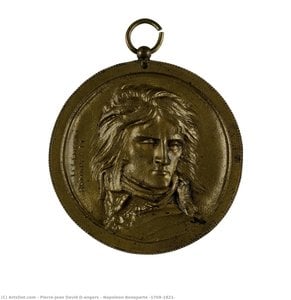
The five years David d’Angers spent in Rome, from 1811 to 1816, constituted a transformative crucible for his artistic maturation. Immersed in the world of classical antiquity and guided by masters such as Antonio Canova—whose idealized sculptures served as an exemplar—his creative sensibilities honed into a distinctly personal idiom. He absorbed the core tenets of Greek sculpture: its unwavering focus on idealized form, heroic narrative, and restrained emotional expression—principles he skillfully integrated into his own artistic practice. This period transcended mere academic study; it was also one of intellectual awakening. The restoration of the Bourbon monarchy in France cast a shadow over his return, prompting a brief sojourn in England where he encountered both admiration and scrutiny due to his association with Jacques-Louis David—a connection that reflected the complex political landscape of the time. Back in Paris, however, David’s talent swiftly gained acclaim. He became renowned for his portrait medallions – exquisitely detailed representations capturing not only physical likeness but also psychological nuance—as well as monumental sculptures celebrating civic virtue and national heroes. His commissions for the Arc de Triomphe and the Louvre showcased an early mastery of large-scale projects, establishing him as a sculptor capable of tackling ambitious undertakings.A Sculptor of Heroes and Ideals
David’s artistic output was remarkably diverse, encompassing statues, bas-reliefs, tombs, and, most notably, portrait medallions. He possessed an extraordinary ability to convey emotion—a skill evident in masterpieces like “Wounded Philopoemen,” housed in the Louvre, which powerfully portrays the tragic fate of the Greek general—and "La Douleur," demonstrating his mastery of expressive sculpture. Yet it was his monumental commissions that truly cemented his reputation. The pediment sculpture for the Pantheon in Paris stands as perhaps his most significant achievement—a sweeping allegorical depiction embodying French patriotism and intellectual heritage. Other notable works include the Gutenberg monument in Strasbourg and the equestrian statue of General Gobert in Père Lachaise Cemetery, both testament to his skill in conveying dynamism through sculpted form. He also created a bust of Goethe for the poet’s library at Weimar—a gesture reflecting his admiration for intellectual brilliance and artistic innovation.A Sculptor Shaped by Republican Spirit
David d’Angers was more than simply a sculptor; he was a product of his era—a witness to revolution, empire, and restoration. His art reflects the political convictions that underpinned his life—his ardent embrace of republican ideals and his unwavering dedication to honoring figures who embodied courage, integrity, and civic responsibility. While firmly rooted in neoclassical tradition, his work foreshadowed the Romantic movement’s emphasis on emotional intensity and dramatic narrative—a stylistic fusion that distinguishes him from many of his contemporaries. His influence extended beyond sculpture itself, inspiring generations of artists and shaping the visual culture of France. Today, David’s works reside in prominent museums across Europe and North America—including The Walters Art Museum in Baltimore and The Metropolitan Museum of Art in New York—preserving his legacy for future scholars and admirers alike. David d’Angers remains a sculptor whose artistic vision transcended stylistic boundaries, securing his place as one of France's most enduring figures—a testament to the transformative power of art and its capacity to embody the spirit of an epoch.Perguntas e Respostas
De onde é Pierre-Jean David D’Angers?
Pierre-Jean David D’Angers nasceu em França.
Em qual período histórico Pierre-Jean David D’Angers trabalhou?
Pierre-Jean David D’Angers trabalhou no período Século XIX. O período situa a atividade do artista na história.
Qual é a cidade e o país de nascimento de Pierre-Jean David D’Angers?
Pierre-Jean David D’Angers nasceu em Angers, em França.
Posso estudar o uso de cores de Pierre-Jean David D’Angers em todas as suas obras?
O perfil de cores da obra de Pierre-Jean David D’Angers pode ser visualizado na página Genoma da Paleta do artista.
Posso visitar um museu virtual das obras de Pierre-Jean David D’Angers?
Uma visita virtual é possível: a página Museu 3D de Pierre-Jean David D’Angers apresenta as obras do artista em uma galeria tridimensional.
Quais obras de Pierre-Jean David D’Angers são as mais visualizadas?
Existe uma página de Estatísticas para Pierre-Jean David D’Angers, apresentando estatísticas sobre as obras do artista no este site.
Qual é o local e o ano de nascimento de Pierre-Jean David D’Angers?
Pierre-Jean David D’Angers nasceu em Angers, em 1788.