The Soul of Florence: The Artistic Journey of Ottone Rosai
Ottone Rosai stands as a singular figure in the tapestry of Italian art history, embodying a complex and beautiful interplay between avant-garde experimentation and a profound reverence for humanist tradition. Born in Florence in 1895, his life was shaped by the fervent artistic renewal of his era—a period marked by both the radical energy of Futurism and the burgeoning shadows of the Fascist era. Rosai’s oeuvre reflects this inherent duality, presenting a world where luminous landscapes imbued with Impressionistic sensibilities exist alongside portraits that subtly echo the timeless ideals of the Renaissance. His journey was one of constant evolution, moving from the frenetic dynamism of his youth toward a mature, contemplative style that cemented his reputation as one of Italy's most significant landscape painters and a master of stylistic synthesis.
The early years of Rosai’s career were defined by an intense engagement with the Futurist movement. During his formative time at the Florence Academy of Fine Arts, he became deeply entwined with the Lacerba group, working alongside influential figures such as Ardengo Soffici. This period was characterized by an embrace of speed, technology, and the transformative power of modernity. The influence of Umberto Boccioni’s explorations of movement can be felt in Rosai's early canvases, where he sought to translate the chaotic energy of the new century into visual form. His participation in notable exhibitions, such as the 1914 show at the Galleria Sprovieri in Rome, showcased a commitment to challenging established artistic hierarchies and celebrating the pulse of contemporary life.
A Return to Order and the Renaissance Spirit
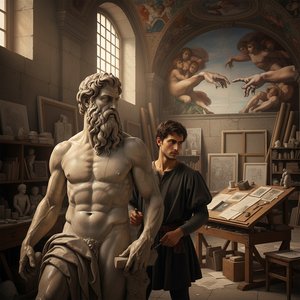
Following the profound upheaval of World War I—a conflict in which Rosai served with distinction, earning medals for military valor—his artistic vision underwent a significant transformation. As the European art world moved toward a "return to order," Rosai turned his gaze away from the fractured planes of Futurism and toward the enduring beauty of the Italian masters. He began a meticulous study of painters ranging from Giotto to Raphael, seeking a sense of stability and classical grace. This shift was not a rejection of his modern roots but rather an integration of them; he utilized the expressive potential of color and texture learned from Impressionism to breathe new life into more traditional, structured compositions.
This period of his life saw him developing a unique aesthetic that bridged the gap between the old world and the new. His landscapes began to capture the essence of the Tuscan countryside with a poetic, atmospheric quality. In works such as his depictions of the hills near Poggio a Caiano, one observes a mastery of light and earth tones, where rich brushstrokes define surfaces rather than mere details. By blending the soft, light-drenched techniques of Impressionism with the solid, monumental forms of the Renaissance, Rosai created a visual language that felt both ancient and strikingly modern.
Legacy and Historical Significance
The later years of Rosai’s life were marked by increasing recognition and institutional respect. He became a prominent figure in the Italian art scene, contributing to influential publications like Il Selvaggio and participating in prestigious events such as the Venice Biennale. His ability to navigate the shifting political and cultural landscapes of mid-20th century Italy allowed him to maintain an artistic integrity that resonated across generations. In 1956, a large-scale retrospective at the Venice Biennale served as a profound testament to his enduring impact on the Italian canon.
Today, the significance of Ottone Rosai lies in his role as a bridge-builder. He successfully navigated the tension between the radicalism of the avant-garde and the weight of historical tradition. His work remains a vital study in how an artist can honor their cultural heritage while simultaneously participating in the dialogue of modernism. Through his evocative landscapes and nuanced figures, Rosai left behind a legacy that continues to invite viewers into a world of quiet contemplation, where the light of the past illuminates the complexities of the present.