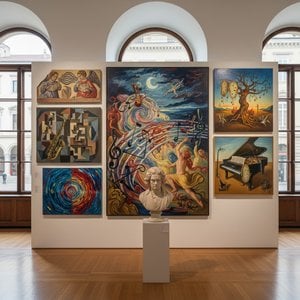
A Kaleidoscope of Color and Texture: The Artistic Journey of Nancy Clearwater Herman
In the vibrant landscape of contemporary American art, few creators possess the multidisciplinary breadth and sensory depth found in the work of Nancy Clearwater Herman. Born in Reading, Pennsylvania, in 1939, Herman has cultivated a career that transcends the boundaries of traditional medium, weaving together painting, collage, needle felting, and even the ephemeral realms of visual music and video. Her artistic identity is defined by a profound fascination with how light, color, and texture can interact to evoke the very essence of experience. Growing up in Glenside, Pennsylvania, her early years were marked by an intense observational passion—a trait that would later become the cornerstone of her sophisticated aesthetic.
Herman’s technical mastery is rooted in a rigorous academic foundation, having pursued advanced studies at the University of Pennsylvania and Cornell University. These prestigious institutions provided more than just technical instruction; they offered her a deep immersion into color theory and composition that would inform every subsequent endeavor. This scholarly background allowed her to approach art with both a contemplative spirit and a scientific precision, enabling her to treat a canvas or a textile piece as a laboratory for chromatic experimentation. Her work often seeks to capture the atmospheric depth of landscapes, imbuing them with a luminosity that feels both grounded in reality and elevated by imagination.
The Interplay of Medium and Motion
What truly distinguishes Herman is her refusal to be confined to a single discipline. She approaches each medium as a unique language capable of telling different facets of a larger story. In her paintings, one finds a celebration of vibrant palettes and tactile surfaces that invite the viewer into a world of sensory richness. This same spirit of exploration manifests in her intricate collages, where she meticulously arranges postage stamps and posters to create layered narratives reflecting cultural influences and personal reflections. Her work in needle felting further demonstrates this tactile curiosity, as she transforms soft wool fibers into delicate, sculptural forms that embody an exquisite, intricate beauty.
Perhaps most avant-garde is her foray into visual music—a daring attempt to bridge the gap between auditory and visual perception. By combining sound with imagery, Herman pushes the boundaries of how art is experienced, turning a static observation into a rhythmic, multisensory event. This pursuit of "translating music to color" is a central theme in her evolution, as seen in her published explorations of how melodic structures can be rendered through pigment and form. Her ability to move between the structured geometry of a quilt and the fluid motion of video art speaks to an artist who views creativity as a continuous, evolving process of discovery.
Symbolism, Memory, and the Art of Transition
Beyond the striking visual impact of her work lies a profound layer of symbolism and emotional resonance. A notable example is her 1994 masterpiece, Moving On Quilt, which serves as a powerful metaphor for the rhythmic pulse of life. Through a mesmerizing checkered pattern of deep reds, cerulean blues, and sun-drenched yellows, Herman explores the duality of existence—the interplay of light and shadow, joy and sorrow, presence and absence. The quilt transcends its functional origins to become a visual symphony, where each stitch and patch acts as a note in a larger, harmonious composition that speaks to the beauty found within structured chaos.
Much of Herman’s inspiration is drawn from the immediate and the overlooked, finding magic in the subtle shifts of her surroundings. Whether it is an early spring flower emerging through snow near her Merion home or the fleeting light on a rainy Lancaster Avenue, her work serves as a tribute to the beauty of the everyday. Through her diverse body of work—ranging from the nostalgic Postcards from Merion to her experimental textile art—Nancy Clearwater Herman remains a significant and vital voice, reminding us that art is not merely something to be seen, but something to be felt, heard, and lived.
Perguntas e Respostas
Existe uma linha do tempo das obras de Nancy Clearwater Herman?
Existe uma linha do tempo das obras de Nancy Clearwater Herman: a página Linha do tempo das obras do artista organiza as obras por data de criação.
Por quais outros nomes Nancy Clearwater Herman é conhecido(a)?
Nancy Clearwater Herman também é conhecido pelos nomes Nancy Herman.
Como posso encontrar obras de Nancy Clearwater Herman em uma paleta específica?
As obras de Nancy Clearwater Herman podem ser exploradas por paleta de cores na página de Por paleta de cores do artista.