A Life Shaped by Solitude and Observation
Born into the quiet surroundings of Mafra, José António Benedito Soares de Faria e Barros lived a life that moved from the shadows of monastic influence to the independent rhythms of Setúbal. His early years were spent in the presence of the Convent dos Padres Arrábidos, where his father served as a clerk. This proximity to religious life and the scholarly atmosphere of his uncle, an astronomer, likely planted the seeds of a keen, observant eye. Around 1770, his family moved toward Setúbal, where he eventually came into possession of the Morgado dos Soares. He lived much of his life as a man apart, never marrying, yet deeply connected to the physical world through a singular, self-taught devotion to the brush.
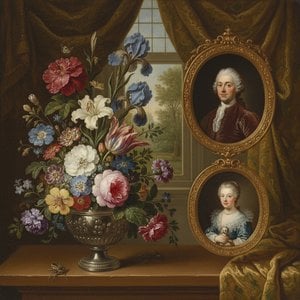
His path was not one of formal academies or polished apprenticeships. Instead, he relied on an individual and solitary effort to master the complexities of the natural world. This lack of traditional training left certain traces in his work, particularly in the way he prepared his canvases and handled his materials. Yet, where technical instruction might have been absent, a profound sensitivity to texture took its place. He possessed a rare ability to mimic the flicker of fire, the cold sheen of metal, the softness of feathers, and the coarse grain of animal hair with such fidelity that his subjects seemed almost tangible.
The Art of Natural Truth
The work of Morgado de Setúbal is defined by a pursuit of natural realism. He did not seek to idealize his subjects but rather to capture their essential, physical presence. His paintings often focused on the small, overlooked details of life: a piece of fruit, a common bird, or the humble contents of a kitchen. In one notable work from 1782, he rendered kitchen items alongside a cat and a hen, demonstrating a focus on the everyday. This dedication to accuracy was so profound that his depictions of animals were said to be so lifelike they could startle a passing dog.
His skill extended into the realm of portraiture and the imitation of great masters. He could replicate the works of others with such precision that religious figures in seminaries were often unable to distinguish his copies from the originals. His talent for capturing light and surface allowed him to recreate the delicate nuances of skin, cloth, and bone. Even when he moved away from pure still life to depict scenes like old men in a tavern, the same commitment to the truth of the subject remained at the heart of his compositions.
A Legacy Held in Quiet Collections
Though he passed away in Setúbal following an attack of apoplexy, the traces of his vision survived through the collections of those who recognized his peculiar talent. His paintings found homes in various repositories, including the Museo Évora and the Museo Carlos Machado in Ponta Delgada. These collections hold pieces that reflect the evolution of his style, from his early experiments to the more mature works of the 1790s. His ability to translate the textures of the earth onto canvas ensured that his name remained linked to a specific kind of visual honesty.
The significance of his work lies in this very authenticity. He bypassed the stylistic trends of his era to focus on a direct engagement with reality. While his technical methods lacked the refinement of the trained elite, his results offered a window into a world of precise detail and unadorned beauty. Today, his presence is still felt in the history of Portuguese painting, remembered as an artist who found greatness in the careful study of a single feather or the glint of light on a metal bowl.