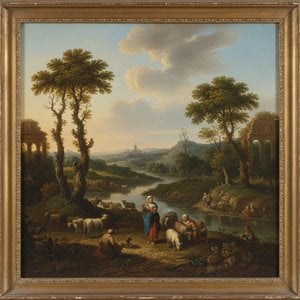
Herman Saftleven the Younger: Painter of Tranquil Landscapes and Botanical Detail
Herman Saftleven the Younger (1609 – 1685) stands as a prominent figure within the Dutch Golden Age, renowned for his masterful depictions of riverside vistas and meticulously rendered botanical studies. Born in Utrecht, he was part of a family deeply rooted in artistic tradition—his father, Herman Saftleven I, established himself as a painter in Rotterdam, shaping Herman II’s early exposure to artistic principles and fostering an appreciation for observation and representation. While his brothers, Cornelis Saftleven (1607–1681) and Abraham Saftleven, pursued distinct artistic paths specializing in genre scenes, Herman II carved out a unique niche as a landscape painter, particularly focused on capturing the serene beauty of Dutch rivers and their surrounding environments.- Early Life & Artistic Training: Herman II’s formative years were spent absorbing the artistic ethos of Rotterdam, where his father instilled in him a dedication to realism and compositional skill. Although biographical details remain somewhat sparse, evidence suggests he honed his craft under the tutelage of Pieter Steenhouck, a respected Utrecht artist known for his landscapes.
- Style & Technique: Saftleven’s distinctive style is characterized by an unwavering commitment to atmospheric perspective—a technique perfected during this period—which imbues his canvases with palpable depth and luminosity. He skillfully employed glazing methods, layering translucent washes of color to achieve subtle tonal variations and conveying the ethereal quality of light filtering through foliage. His meticulous attention to detail extended beyond mere topographical accuracy; he painstakingly depicted individual plants and flowers with astonishing realism, reflecting a burgeoning interest in scientific observation.
Notable Works & Artistic Achievements
Saftleven’s oeuvre comprises approximately 150 paintings, predominantly landscapes featuring rivers—the Rhine, Meuse, Scheldt—and their environs. Among his most celebrated compositions are “View on the Rhine,” showcasing a breathtaking panorama of the river valley bathed in soft sunlight, and “Barn Interior,” which exemplifies Saftleven’s ability to capture the subtle nuances of domestic life with remarkable precision. His botanical drawings, commissioned by Agnes Block, demonstrate an exceptional understanding of plant anatomy and coloration—a testament to his intellectual curiosity alongside his artistic prowess. Particularly noteworthy is his contribution to Utrecht's ecclesiastical art scene; he produced detailed depictions of several churches before their destruction during the Great Fire of 1670, securing a legacy as a visual recorder of Utrecht’s architectural heritage.- Influence & Legacy: Saftleven’s work aligns closely with the broader artistic currents of the Dutch Golden Age—particularly the influence of Caravaggio and Rembrandt—though he developed a distinctly personal aesthetic. His meticulous observation of nature and his masterful use of technique established him as one of the foremost landscape painters of his time, influencing subsequent generations of artists.
- Guild Membership & Artistic Recognition: Herman II was elected Dean of St Luke’s Guild in Utrecht—a prestigious honor reflecting his standing within the artistic community. This position afforded him considerable influence and ensured that he remained at the forefront of Utrecht's artistic endeavors.
Botanical Drawings & Scientific Observation
Beyond his landscapes, Saftleven’s botanical drawings stand out as a remarkable intersection of art and science. Commissioned by Agnes Block—a wealthy amateur botanist—he undertook the ambitious task of documenting the flora surrounding her estate near Utrecht with unparalleled accuracy. These drawings represent not merely visual representations but detailed anatomical studies informed by scientific principles—a pioneering effort that foreshadowed the burgeoning interest in botanical illustration during the Enlightenment. Saftleven’s meticulous rendering of plant specimens underscores his intellectual engagement alongside his artistic talent, cementing his place as a pivotal figure in both disciplines.- Later Life & Artistic Output: Following the devastating fire of 1670 that ravaged Utrecht, Saftleven sold several drawings he had made of churches before their destruction—a poignant reminder of the artistic heritage threatened by urban catastrophe. He continued to produce artwork until his death in Utrecht in 1685, leaving behind a substantial body of work that continues to captivate viewers today.
Concluding Remarks: A Master of Tranquility and Detail
Herman Saftleven the Younger’s artistic legacy resides primarily in his evocative landscapes—particularly those depicting Dutch rivers—which convey a profound sense of serenity and beauty. However, it is equally important to recognize his contribution to botanical illustration—a field where he achieved unparalleled precision and demonstrated an exceptional understanding of plant anatomy. His unwavering dedication to realism, combined with his masterful technique, ensured that Saftleven’s paintings would endure as timeless expressions of the Dutch Golden Age's artistic spirit.Perguntas e Respostas
Onde posso ver o perfil de cores da obra de Herman Saftleven The Younger?
O perfil de cores da obra de Herman Saftleven The Younger pode ser visualizado na página Genoma da Paleta do artista.
Em quais movimentos Herman Saftleven The Younger trabalhou?
As obras de Herman Saftleven The Younger podem ser exploradas por movimento na página de Todos os Movimentos do artista.
Onde as obras de Herman Saftleven The Younger estão agrupadas por técnica?
As obras de Herman Saftleven The Younger podem ser exploradas por técnica na página de Todos os Meios do artista.