A Roman Beginning and Apprenticeship Under a Master
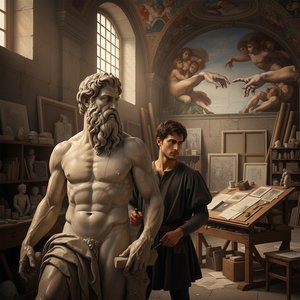
Giulio Romano, born Giulio Pippi around 1499 in Rome, emerged during a period of intense artistic transformation. Details surrounding his early life remain somewhat shrouded in mystery, yet it’s known he swiftly entered the orbit of Raphael Sanzio, arguably the most celebrated painter of the High Renaissance. This apprenticeship proved to be profoundly formative, shaping not only his technical skills but also laying the foundation for his future stylistic explorations. He wasn't merely a studio assistant; Giulio rapidly evolved into an indispensable collaborator, contributing significantly to projects of immense importance, notably the decoration of the Vatican Stanze – those magnificent rooms commissioned by Popes Julius II and Leo X. His hand is readily identifiable in *The Fire in the Borgo*, where he assisted Raphael in depicting a dramatic scene of miraculous intervention, a work brimming with dynamic energy and unsettling realism. Following Raphael’s untimely death in 1520, Giulio inherited responsibility for completing numerous unfinished commissions, including the ambitious decoration of Villa Madama for Cardinal Giuliano de' Medici – a project that would become a cornerstone of his career. This early exposure to large-scale projects and the demands of aristocratic patronage instilled within him a remarkable confidence and ambition, qualities that would define his later artistic endeavors.The Birth of Mannerism: A Departure from Classical Harmony
While firmly rooted in the Renaissance tradition, Giulio Romano’s artistic trajectory soon diverged significantly from the prevailing emphasis on classical balance and harmony. He became a pivotal figure in the development of Mannerism – a style characterized by its deliberate artificiality, elegant distortions, and often unsettling psychological depth. Heavily influenced by Michelangelo's powerful figures and dynamic compositions—particularly his use of dramatic foreshortening—as well as a broader climate of artistic experimentation within Rome, Giulio began to embrace asymmetry, tension, and emotional intensity in his work. This wasn’t a rejection of Renaissance ideals so much as a deliberate exploration of their limits, pushing beyond the constraints of naturalism to create works that were more expressive and intellectually stimulating. He increasingly modified Raphael's plans, injecting a new sensibility into Roman art—a statement of Mannerism on a grand scale. His drawings are particularly revealing, exhibiting a remarkable freedom of line and a penchant for dramatic foreshortening, hinting at the complex spatial arrangements he would later employ in his frescoes.Mantua’s Master: Palazzo Te and Architectural Innovation
In 1524, Giulio accepted the invitation of Federico Gonzaga, Duke of Mantua, to become court painter and architect – a move that fundamentally altered the course of his career. This provided him with unprecedented creative freedom and resources, effectively transforming him into the principal artistic force within the duchy. He oversaw not only paintings and frescoes but also architectural projects, garden designs, and even theatrical productions, leaving an indelible mark on Mantua’s cultural landscape. His most celebrated achievement during this period is undoubtedly Palazzo Te, an extraordinary suburban villa that stands as a testament to his innovative genius. The palace's interiors are adorned with illusionistic frescoes of breathtaking complexity and psychological depth—a veritable feast for the eyes and mind. *The Sala dei Giganti* (Hall of the Giants), for example, depicts a chaotic battle between gods and giants, engulfing the viewer in a swirling vortex of figures and architectural fragments, creating an immersive experience that is both awe-inspiring and unsettling. Beyond Palazzo Te, Giulio also undertook significant renovations to Mantua’s ducal palace and cathedral, shaping the city's urban fabric with his distinctive vision.Legacy and Lasting Influence
Giulio Romano died in Mantua in 1546, leaving behind a legacy that extended far beyond Italy’s borders. His drawings were highly prized by collectors throughout Europe, and engravings based on his work—particularly those by Marcantonio Raimondi—played a crucial role in disseminating Italian artistic styles. He was so renowned after his death that he is the only “modern” artist mentioned by William Shakespeare in *Cymbeline*, a testament to his widespread renown. His influence can be seen in the works of numerous subsequent artists, who adopted his dynamic compositions, elongated figures, and expressive use of color. While Mannerism eventually gave way to other stylistic movements, Giulio Romano’s contributions remain essential to understanding the evolution of Western art. He represents a pivotal moment—a transition from the harmonious ideals of the High Renaissance to the more complex and emotionally charged aesthetic of the late 16th century. His work continues to captivate and challenge viewers today, reminding us of the power of art to both reflect and shape our understanding of the world.- Key Works: *The Fire in the Borgo*, Palazzo Te (including *Sala dei Giganti*), Villa Madama
- Influences: Raphael, Michelangelo, and the broader artistic climate of Rome during the High Renaissance.
- Style: Mannerism – characterized by asymmetry, tension, emotional intensity, and illusionistic techniques.
Perguntas e Respostas
Como posso encontrar obras de Giulio Romano em uma paleta específica?
Para encontrar obras de Giulio Romano em uma paleta específica, acesse a página de Por paleta de cores do artista.
Posso ordenar as obras de Giulio Romano por cor?
As obras de Giulio Romano podem ser exploradas por cor na página Índice de Cores do artista.
Quantas obras de Giulio Romano estão disponíveis para explorar?
Você pode explorar 114 obras de arte obras de Giulio Romano na página Todas as obras.