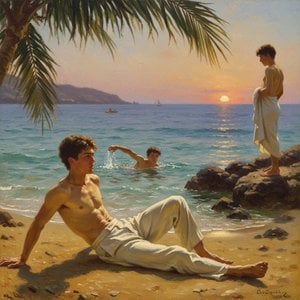
Elizabeth Adela Forbes (1859–1912): A Pioneer of Impressionistic Landscape Painting
Elizabeth Adela Armstrong Forbes (née Armstrong; 29 December 1859 – 16 March 1912) stands as a remarkable figure in the annals of Victorian and Edwardian art history—a woman artist who defied societal expectations and achieved considerable renown, particularly within the burgeoning Newlyn Art Colony. Born in Kingston, Ontario, Canada West, Forbes’s artistic journey began with a privileged upbringing steeped in intellectual curiosity and nurtured by her mother's unwavering support for pursuing creative endeavors. This early education laid the foundation for her subsequent studies at South Kensington Art School (later Royal College of Art), where she honed her skills in traditional academic painting before embracing the liberating spirit of plein air painting—a pivotal moment that irrevocably shaped her artistic style.- Early Style: Initially influenced by the meticulous techniques of academic art, Forbes’s formative years instilled a disciplined approach to observation and representation.
- Brittany Period (1882): Her relocation to Pont-Aven, Brittany, proved transformative. Surrounded by fellow artists—including James Abbott McNeill Whistler and Walter Sickert—Forbes immersed herself in the Impressionistic movement, capturing the ethereal beauty of Breton landscapes with vibrant colors and loose brushstrokes.
- Key Influences: Whistler’s emphasis on tonal harmony and Sickert's exploration of urban realism profoundly impacted Forbes’s artistic vision. These mentors championed a departure from idealized depictions, advocating for an honest portrayal of life’s complexities.
The Newlyn School and Artistic Flourishing
In 1885, Forbes embarked on a new chapter in her life—establishing herself as a studio artist in Newlyn, Cornwall. This decision coincided with the rise of the Newlyn Art Colony, a collective of painters dedicated to documenting Cornish rural life and portraying working-class individuals with empathy and accuracy. Among these luminaries was Stanhope Alexander Forbes, whom she married in 1889—a union that solidified their artistic partnership and cemented their connection to the colony’s ethos. Forbes's contribution to Newlyn extended beyond her own paintings; she founded the Newlyn Art School in 1899 alongside her husband, fostering a generation of artists committed to mastering observation and capturing the essence of nature. Her work—characterized by luminous watercolors, evocative pastels, and meticulously crafted etchings—became synonymous with the colony’s distinctive aesthetic.- Notable Works: *School Is Out* (1886), depicting children playing in a Cornish meadow, exemplifies Forbes's masterful blend of realism and lyrical sentiment. Similarly, *Blackberry Gathering* captures the rustic charm of rural Cornwall with meticulous detail—a testament to her dedication to portraying everyday life with profound sensitivity.
- Recognition: Forbes garnered international acclaim for her artistic achievements. She secured a medal at the Paris International Exhibition (1891) and received a gold medal at the World’s Columbian Exposition in Chicago (1893)—recognitions that underscored her talent and validated her commitment to artistic excellence.
A Legacy of Impressionism and Female Artistic Empowerment
Elizabeth Forbes's oeuvre embodies the spirit of Victorian genre painting—a genre that sought to elevate the commonplace into artful contemplation. Yet, she transcends mere stylistic imitation; her paintings resonate with a deeper philosophical inquiry into the relationship between observation and emotion. Forbes’s success as a female artist during a period marked by considerable gender inequality stands as an inspiring testament to perseverance and artistic vision. Her influence extended beyond her own creations—inspiring subsequent generations of artists, particularly women—to embrace experimentation and challenge conventional norms. Today, Forbes's paintings reside in collections across Canada, the United States, and England—a lasting legacy that ensures her contribution to art history will continue to inspire admiration for centuries to come. Forbes’s artistic exploration was enriched by her friendship with Whistler and Sickert, who championed a new aesthetic based on tonal harmony and psychological depth. Her work reflects these influences in its careful rendering of light and color—a hallmark of Impressionistic painting.Perguntas e Respostas
Quais cores Elizabeth Adela Forbes utilizou com mais frequência?
O Genoma da Paleta de Elizabeth Adela Forbes é uma página que apresenta o perfil cromático da obra do artista.
Onde posso ver todas as obras de Elizabeth Adela Forbes?
Todas as obras de Elizabeth Adela Forbes no este site podem ser visualizadas na página de Todas as Obras de Arte do artista.
Qual é a cidade e o país de nascimento de Elizabeth Adela Forbes?
Elizabeth Adela Forbes nasceu em Kingston, em Canadá.