A Scottish Voice in the Age of Enlightenment
David Allan, born in Alloa, Scotland, in 1744, emerged as a significant figure during a period of profound artistic and intellectual change. His father’s position as harbor master instilled an early connection to the world beyond Scotland's shores, hinting at influences that would later shape his artistic vision. Though details of his earliest training remain scarce, it is clear that a natural talent blossomed from youth, setting him on a path toward becoming one of Scotland’s most celebrated painters. This path led him, in 1764, to Rome – a pivotal journey for any aspiring artist of the time. For ten years, Allan immersed himself in the study of classical art and architecture, diligently copying masterpieces like the Borghese Gladiator, honing his skills in form and technique under the guidance of Gavin Hamilton. This Italian sojourn wasn’t merely about technical mastery; it was an immersion into a world of ideals that would subtly permeate his later work. The influence of Roman sculpture and painting is evident in his meticulous attention to detail and his embrace of classical composition, yet he never lost sight of his Scottish roots.Blending Worlds: Neoclassicism with Scottish Life
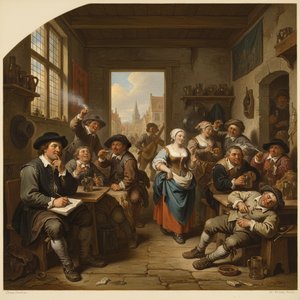
Upon returning to Scotland around 1770, Allan established himself in Edinburgh, quickly becoming a leading artist within the city’s vibrant cultural scene. His style is remarkable for its unique synthesis of Neoclassical precision and Rococo elegance. While embracing the classical ideals of order, balance, and clarity – hallmarks of the Neoclassicism movement – he retained a decorative sensibility evident in his use of color and composition. This wasn’t a rigid adherence to any single school but rather a thoughtful blending of influences. Allan excelled in both portraiture and genre painting, demonstrating a keen observational skill and an ability to capture the essence of his subjects. His portraits weren’t simply likenesses; they possessed psychological depth, revealing character and personality. He skillfully rendered the nuances of social standing and individual temperament, creating images that were both flattering and insightful. However, it was perhaps in his genre scenes that Allan truly distinguished himself, offering intimate glimpses into 18th-century Scottish life – from bustling market days to quiet domestic moments. Works like “Lead Processing at Leadhills Washing the Ore” are not merely depictions of industry but insightful social commentaries rendered with remarkable realism and attention to detail. He also ventured into historical subjects, such as "Hope (triptych, centre panel)", showcasing his ambition and versatility while skillfully integrating classical influences with religious themes.The ‘Scottish Hogarth’ and a Legacy Forged in Observation
Allan’s dedication to depicting contemporary life earned him the moniker “the Scottish Hogarth,” a comparison that highlights his contributions to genre painting and social commentary through art. While not directly emulating Hogarth’s often satirical style, Allan shared a similar interest in portraying everyday scenes with honesty and insight. He possessed an exceptional ability to capture the nuances of human interaction and the textures of daily life, elevating seemingly ordinary subjects to artistic significance. His association with the Foulis Academy, a prominent center for artistic training in Edinburgh, further solidified his role in shaping Scottish art during this period. Allan wasn’t just creating paintings; he was contributing to the development of a distinct national artistic identity. He influenced subsequent generations of Scottish artists, encouraging them to look inward and find inspiration in their own culture and surroundings.Major Works and Techniques
Allan’s oeuvre is characterized by a remarkable range of subjects and techniques. His portraits are renowned for their psychological depth and realistic portrayal of character, capturing not just physical likeness but also the inner lives of his sitters. His historical paintings demonstrate a mastery of classical composition and a keen understanding of narrative storytelling. However, it was in his genre scenes that he truly excelled – works such as “The Family of Procida”, “James Craig, Architect”, “The Children of David Allan” and “Lead Processing at Leadhills Washing the Ore” offer vivid glimpses into Scottish society, capturing the everyday lives of ordinary people with remarkable detail and sensitivity. He employed a meticulous technique, often utilizing oil paints on canvas to achieve a rich, textured surface. His use of light and shadow was particularly effective in creating a sense of depth and realism, while his color palette reflected both classical influences and the natural beauty of Scotland.A Lasting Impression
David Allan’s impact extends beyond his individual artworks. His illustrations for Allan Ramsay’s *The Gentle Shepherd* are particularly noteworthy, demonstrating a playful wit and an ability to capture the spirit of Scottish pastoral life. He was a master of both large-scale historical compositions and intimate domestic scenes, showcasing a remarkable range of skill and sensitivity. His death in 1796 marked the loss of a truly original voice in British art. Today, his paintings continue to be admired for their technical brilliance, insightful portrayals of Scottish society, and enduring artistic merit. Allan’s legacy lies not only in the beauty of his creations but also in his ability to bridge classical ideals with distinctly Scottish subject matter, leaving an indelible mark on the cultural landscape of his time and inspiring artists for generations to come. He remains a testament to the power of observation, the importance of artistic training, and the enduring appeal of capturing the human experience.Perguntas e Respostas
Quantas obras de David Allan estão disponíveis para visualização?
Você pode explorar 58 obras de arte obras de David Allan na página Todas as Obras de Arte.
Existe um tour virtual 3D das obras de David Allan?
Uma visita virtual é possível: a página Museu 3D de David Allan apresenta as obras do artista em uma galeria tridimensional.
Por quais outros nomes David Allan é conhecido(a)?
David Allan também é conhecido como Davie Allan, Dave Allan.