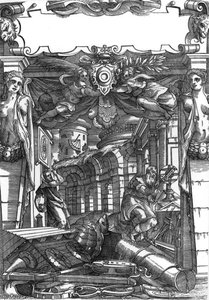
The Renaissance Polymath: A Vision of Venice
Daniele Matteo Alvise Barbaro was far more than a mere inhabitant of the sixteenth century; he was a profound embodiment of the Renaissance ideal, a man whose intellect bridged the gap between the earthly and the divine. Born in Venice in 1514 into the prestigious Barbaro lineage, his life was shaped by an extraordinary confluence of aristocratic privilege and rigorous humanist scholarship. To understand Barbaro is to understand the very essence of the Venetian Renaissance—a period where art, science, and diplomacy danced in a delicate, sophisticated harmony. His early years, though marked by the personal tragedy of losing his father, Zaccultia Barbaro, were defined by an insatiable thirst for knowledge. Under the guidance of learned tutors, he immersed himself in the classical traditions of literature and philosophy, developing a mind that was as comfortable navigating the complexities of ecclesiastical politics as it was contemplating the mathematical precision of the cosmos.
A Symphony of Stone and Symmetry
Nowhere is Barbaro’s enduring legacy more palpable than in the realm of architecture, where his collaboration with the legendary Andrea Palladio helped redefine the visual language of Europe. He did not merely commission buildings; he conceptualized spaces that acted as physical manifestations of classical order and humanist grace. The most breathtaking achievement of this partnership remains the Villa Barbaro, a masterpiece located in the evocative landscape of Matera. In this structure, one finds a sublime dialogue between the rigid, monumental geometry of Palladian design and the fluid, luminous beauty of the natural world. Through his architectural foresight, Barbario sought to honor the ancient Roman principles of proportion and symmetry, creating environments where light and shadow could perform a silent, eternal drama. This architectural vision was further enriched by the presence of masters like Paolo Veronese, whose frescoes transformed the villa's interiors into immersive narratives of mythological splendor, effectively turning stone and pigment into a living testament to human aspiration.
The Scholar’s Eye and the Eternal Legacy
Beyond the tangible grandeur of his architectural works, Barbaro’s true brilliance lay in his ability to synthesize disparate disciplines. He was a scholar of profound depth, leaving behind significant contributions to the study of Vitruvius, whose ancient architectural treatises he sought to interpret and revitalize for his contemporary era. His intellectual pursuits were vast, spanning the realms of:
- Mathematics and Astronomy: Disciplines that informed his understanding of structural balance and celestial harmony.
- Diplomacy and Theology: Roles that allowed him to exert influence within the highest echelons of the Church and international statecraft.
- Classical Philology: The study of ancient texts that provided the foundation for his humanist worldview.
This multifaceted existence allowed him to act as a vital patron to the greatest artists of his age, including Titian, whose portraits captured the very essence of Barbaro’s commanding presence. As a figure who moved seamlessly between the pulpit, the drafting table, and the diplomatic court, Daniele Barbaro remains a towering symbol of an era when the pursuit of beauty was inseparable from the pursuit of truth. His life serves as a reminder that true greatness lies in the ability to see the interconnectedness of all things—the mathematical, the artistic, and the spiritual.