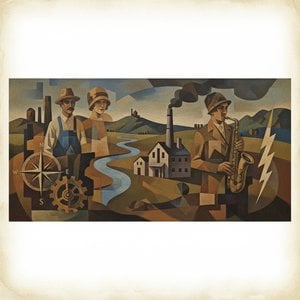
A Legacy Forged in Stone and Spirit: The Life of Allan Houser
Allan Capron Houser, a name resonating deeply within the heart of Native American art, stands as a monumental figure of the 20th century. Born in 1914 near Apache, Oklahoma, his journey was one of profound convergence—a seamless blending of the ancestral traditions of the Chiricahua Apache and the burgeoning currents of modernist sculpture. Houser wasn’t merely an artist; he was a cultural translator, meticulously crafting visual narratives that spoke to the very soul of his people while simultaneously engaging with the wider world of art. His lineage itself held immense weight—a grandnephew of the legendary Geronimo, carrying within him the echoes of resistance, resilience, and an unbreakable connection to the land. This heritage wasn’t simply a biographical detail; it was the bedrock upon which his artistic vision was firmly established, informing every curve, every texture, every evocative gesture in his remarkable sculptures. The early years were marked by displacement and adaptation, as his parents, survivors of imprisonment following Geronimo's surrender, sought to rebuild their lives amidst the challenges of a changing landscape. It was within this environment—a poignant blend of hardship and cultural preservation—that Houser’s creative spirit began to ignite, fueled by an innate desire to express what it meant to be Apache.Early Training and the Seeds of Artistic Exploration
Houser's formal artistic education commenced at the Fort Apache Indian School, a vital institution dedicated to preserving and nurturing Native American crafts and traditions. This early immersion provided him with foundational skills in painting and drawing, introducing him to traditional motifs and techniques—a grounding that would later inform his work. However, Houser quickly recognized that these established methods, while valuable, weren’t sufficient to fully capture the essence of his artistic vision. He felt a compelling need for something more expansive, a way to translate the intangible – the spirit, the history, the very *feeling* of Apache life—into a visual language that resonated beyond the confines of conventional representation. This nascent desire for artistic freedom led him on a deliberate and often challenging path of experimentation, seeking new forms and techniques that could authentically embody his cultural heritage. A pivotal moment arrived in 1939 when, alongside Gerald Nailor, he secured a commission to create murals for the U.S. Department of Interior Building in Washington D.C. This early recognition brought him into contact with the wider art world, exposing him to new ideas and perspectives while simultaneously reinforcing his yearning for a more personal artistic expression.Modernist Influences and the Sculptural Transformation
The experience of creating murals proved transformative, sparking within Houser an intense interest in sculpture. He began to study the works of European modernist masters—artists like Jean Arp, Constantin Brancusi, Henry Moore, and Barbara Hepworth—whose emphasis on abstract forms, organic shapes, and the inherent qualities of materials deeply resonated with his artistic sensibilities. These artists weren’t simply creating beautiful objects; they were exploring fundamental questions about form, space, and the relationship between art and reality. Houser didn't merely imitate these influences; he skillfully synthesized them, weaving together modernist aesthetics with the spiritual depth and narrative power of Apache storytelling. His sculptures began to embody a unique blend of abstraction and figuration—often depicting figures in motion – dancers, warriors, families – capturing moments of profound cultural significance. Works like *Vision Seeking* (1950), a poignant diorama exploring themes of spirituality, and *Moving Camp* (1950) – with its warm tones and layered composition – exemplify this masterful synthesis. The shift towards sculpture wasn’t simply a stylistic choice; it was a fundamental realignment of his artistic practice, allowing him to express the complexities of Apache life in a way that painting couldn't fully achieve.Mastering Bronze and Establishing a Distinctive Style
Houser’s mastery of bronze casting became central to his distinctive style. He meticulously honed his skills, learning to manipulate molten metal with precision and sensitivity—a process that demanded both technical expertise and profound artistic intuition. His sculptures weren’t merely representations of figures; they were imbued with a palpable sense of movement, energy, and emotion. The use of negative space, the subtle shifts in texture, and the carefully considered placement of hands and arms all contributed to this powerful expressive effect. He began to incorporate elements of Apache symbolism—geometric patterns, animal motifs, and references to traditional ceremonies – into his sculptures, creating works that were both visually striking and deeply rooted in Native American culture. His work became increasingly recognized for its emotional intensity, its evocative power, and its unique blend of abstraction and figuration.A Legacy of Teaching and Artistic Influence
Beyond his own prolific artistic output, Allan Houser dedicated a significant portion of his life to nurturing the next generation of Native American artists. He served as a faculty member at both the Inter-Mountain Indian School in Brigham City, Utah, and the Institute of American Indian Arts (IAIA) in Santa Fe, New Mexico—institutions that played a crucial role in preserving and promoting Native American arts and culture. As the only sculptor at IAIA, he established its sculpture department, fostering a vibrant community of artists who shared his passion for exploring their cultural heritage through contemporary means. Houser’s teaching philosophy wasn't about imposing a particular style; rather, he encouraged each student to discover their own unique voice, to delve into their personal experiences and traditions, and to translate them into compelling works of art. His influence extended far beyond the students who directly studied with him—his legacy lives on through the countless artists whose work has been inspired by his vision.Enduring Significance and a Continuing Dialogue
Allan Houser’s impact on American art is undeniable. His sculptures, now housed in prestigious museums across the nation – including the Smithsonian Museum of American Art, the National Museum of the American Indian, and the Oklahoma State Capitol Building – serve as powerful reminders of his artistic vision and cultural significance. More than simply depicting Native Americans, Houser’s work engages in a complex dialogue about identity, history, spirituality, and the enduring strength of indigenous cultures. His art continues to provoke contemplation and inspire new generations of artists and viewers alike. The Allan Houser Foundation diligently preserves his legacy through the maintenance of the Houser Compound near Santa Fe, offering visitors a unique opportunity to connect with his life, work, and the rich cultural heritage he so passionately championed. His enduring significance lies not only in the beauty of his sculptures but also in their profound ability to bridge cultures, challenge perspectives, and celebrate the resilience of the human spirit.- ArtsDot: Explore his artwork on ArtsDot
- Wikipedia: Learn more on Wikipedia
- Allan Houser Foundation: Discover the Allan Houser Compound and his legacy
Perguntas e Respostas
Qual é o local e o ano de nascimento de Allan Houser?
Allan Houser nasceu em Apache Junction, em 1914.
De onde é Allan Houser?
Allan Houser nasceu em Estados Unidos da América.
Existe um relato cronológico de Allan Houser?
A Crônica de Allan Houser é uma linha do tempo interativa que apresenta as obras do artista em ordem cronológica, agrupadas por períodos de sua carreira.
Que sentimentos as obras de Allan Houser expressam?
A página de Sala de Humor do artista mostra as obras de Allan Houser organizadas por sua atmosfera.
Onde posso encontrar estatísticas sobre as obras de Allan Houser?
Existe uma página de Estatísticas para Allan Houser, apresentando estatísticas sobre as obras do artista no este site.
Quais cores Allan Houser utilizou com mais frequência?
O perfil de cores da obra de Allan Houser pode ser visualizado na página Genoma da Paleta do artista.
Qual é a cidade e o país de nascimento de Allan Houser?
Allan Houser nasceu em Apache Junction, em Estados Unidos da América.