


 Visualizar em escala
 Enviar
 Compartilhar
 Ver detalhes
 Guia de Obras do Aluno

 Baixar imagem
 Semelhantes
 Raio X
 Apresentação de slides
 Estatísticas
Pragerstrasse


 Ver mais
A obra de arte exibida nesta página é protegida por leis de direitos autorais, o que significa que não podemos criar ou vender legalmente uma reprodução idêntica. Esta proteção é aplicada por meio de acordos internacionais, tais como a Convenção de Berna e pelas leis nacionais, incluindo as estabelecidas por Lei de Direitos Autorais dos EUA - Título 17.
Este método cumpre plenamente as regulamentações de direitos autorais, pois não envolve a cópia ou duplicação da obra protegida. Em vez disso, trata-se de uma reinterpretação criativa — uma nova pintura que é influenciada pela original, mas não idêntica a ela.
Giclée / Impressão de Arte
Impressão giclée ou em tela de qualidade de museu, com produção rápida e opções flexíveis de acabamento. ( Encomendar reprodução pintada à mão Ver Imagem Digital)




P118B €10

P118H €10

P118W €10

P438Z €10

P508JH €12

P508YH €12

P805H €10

P805Z €10

P919BZ €10

P919G €10

P919XJ €10

P959ZH €10

P968JZ €12

W106C €8

W218G €10

W218JH €8

W218Y €10

W307PJ €10

W316G €10

W316PJ €8

W316Y €10

W398PJ €8

W4111J €10

W500HY €15

W500JH €15

W692G €12

W849H €8

W940BG €15

W953PJ €8




Escolha entre os nossos tamanhos pré-definidos que respeitam as proporções originais da obra de arte.

Digite a largura e a altura de que necessita, para se ajustar à sua moldura ou à sua parede. Uma impressão só pode ser cortada, nunca ampliada além da imagem original, pelo que um tamanho com uma proporção diferente perderá parte da imagem. Enviamos-lhe uma maquete digital para aprovação antes de imprimirmos qualquer coisa. A imagem apresentada nesta página não mostra o corte real — apenas a maquete o faz.
Entrega mundial () em 2 semanas, em vez das 4/5 semanas padrão. (22 Outubro)

Envio expresso gratuito para todo o mundo

Tela de Linho Premium

Seguro de transporte total

Garantia de Reembolso de Impostos Alfandegários

Garantia de Fidelidade de Cor

Política de Devolução em 100 Dias (Apenas para Defeitos)

Garantia de reembolso de 100%

Desconto para múltiplas unidades
 A opção de vidro está disponível apenas para tamanhos inferiores a 110 cm

Pragerstrasse
Giclée / Impressão de Arte
Dimensões da Reprodução
-


Preço Total
€ 54
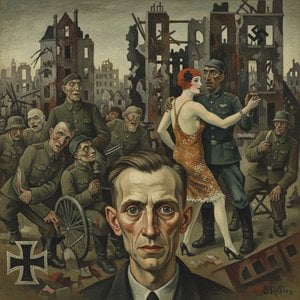
A Snapshot of Weimar Disillusionment: Exploring Otto Dix’s Pragerstrasse
Otto Dix's "Pragerstrasse," painted in 1920, stands as a hauntingly beautiful emblem of the disillusionment that gripped Germany following World War I. More than just a depiction of a social gathering—a café scene on Pragerstrasse itself—it’s a meticulously crafted manifesto of Dadaism and Neue Sachlichkeit, movements determined to dismantle artistic conventions and confront societal hypocrisy. As a specialist at ArtsDot.com, offering exceptional handmade oil painting reproductions, I want to illuminate the profound layers embedded within this iconic artwork.The Dadaist Aesthetic: Chaos Embraced
Dix’s approach immediately distinguishes itself from traditional portraiture or landscape painting. The Dadaists rejected logic and reason, prioritizing spontaneity and absurdity as tools for artistic expression. This is vividly realized in “Pragerstrasse.” Figures are rendered with jarring distortions—faces stretched, limbs exaggerated—a deliberate tactic to destabilize the viewer's perception and challenge accepted notions of beauty. The artist employs a deliberately unsettling color palette dominated by reds and yellows, colors associated with violence and decay, juxtaposed against muted blues and greens that offer fleeting glimpses of tranquility. These contrasting hues amplify the emotional tension inherent in the scene.Technique and Composition: A Calculated Discomfort
Dix’s masterful technique contributes significantly to the artwork's impact. He utilizes thick impasto—heavy application of paint—creating palpable textural surfaces that convey a sense of immediacy and unease. The composition is deliberately asymmetrical, guiding the eye across the canvas in an unsettling dance. Despite the apparent chaos, Dix employs careful geometric structuring beneath the surface distortions, anchoring the scene within a framework of visual order. The placement of chairs and tables reinforces this underlying structure, subtly highlighting the artificiality of the setting.Historical Context: Weimar’s Fractured Psyche
“Pragerstrasse” is inextricably linked to the turbulent era of Weimar Republic Germany—a period marked by economic instability, political polarization, and simmering anxieties about the legacy of militarism. Dix's work captures the pervasive atmosphere of cynicism and moral compromise that characterized this society. The inclusion of a book on the floor symbolizes intellectual disillusionment – questioning established dogma and embracing alternative perspectives. It’s a visual record of a moment frozen in time, reflecting the profound psychological scars inflicted by the Great War.Symbolism Beyond Representation: An Emotional Resonance
Beyond its formal elements, “Pragerstrasse” resonates with deeper symbolic meanings. The figures themselves represent fragments of humanity—individuals grappling with trauma and uncertainty. Their expressions convey a spectrum of emotions ranging from boredom to despair, mirroring the anxieties of an entire nation struggling to reconcile itself with its past. Dix’s deliberate distortions serve not merely as stylistic devices but as conduits for conveying psychological states – fear, anxiety, and disillusionment. The painting compels viewers to confront uncomfortable truths about human nature and societal failings.- This striking reproduction captures the essence of Dix's Dadaist vision.
- Ideal for interior design projects seeking a bold statement piece.
Perguntas e Respostas
Quais temas aparecem em "Pragerstrasse" de Otto Dix?
"Pragerstrasse" de Otto Dix retrata: dadaism, social commentary, weimar society, postwar art, chaos harmony, human interaction, street scene.
Como posso visualizar "Pragerstrasse" de Otto Dix em formato de apresentação de slides?
Um slideshow está disponível: a página Apresentação de slides de "Pragerstrasse" de Otto Dix.
De que material é feita a obra "Pragerstrasse"?
"Pragerstrasse" é executada em Oil On Canvas.
Obras Relacionadas


Biografia do Artista
Early Life and the Shadow of War
Wilhelm Heinrich Otto Dix, born in 1891 in Untermhaus, Germany, emerged from a world steeped in industrial labor and quiet artistic yearning. His father toiled as an iron foundry worker, while his mother nurtured a poetic spirit, creating a domestic landscape that subtly fostered young Otto’s creative inclinations. Crucially, it was the influence of his cousin, the painter Fritz Amann, that truly ignited Dix's ambition. Hours spent in Amann’s studio weren’t merely lessons in technique; they were an immersion into a world where artistic expression held tangible power. This early exposure led to an apprenticeship with Carl Senff and subsequent studies at the Kunstgewerbeschule in Dresden, though initially focused on applied arts rather than fine painting. However, it was the cataclysm of World War I that irrevocably shaped Dix’s artistic trajectory. Volunteering for service, he experienced the brutal realities of trench warfare firsthand, a trauma that would haunt his work for decades to come. The horrors witnessed during battles like the Somme and in Flanders left an indelible mark, transforming him from a promising landscape painter into a chronicler of human suffering and societal decay.The Weimar Republic and Neue Sachlichkeit
Returning from the war profoundly changed Dix. He channeled his experiences into unflinching depictions of its aftermath. His early post-war work reflected Expressionist tendencies, but he soon gravitated towards a new aesthetic—*Neue Sachlichkeit*, or New Objectivity. This movement rejected emotional abstraction in favor of stark realism and critical social commentary. Dix became one of its leading figures alongside George Grosz and Max Beckmann. Paintings like *The Trench* (1923) caused public outrage with their graphic portrayal of dismembered bodies, forcing museums to hide the work from view. This wasn’t merely shock value; it was a deliberate attempt to confront viewers with the brutal truth of war, stripping away any romanticized notions of heroism or glory. He didn't shy away from depicting the physical and psychological wounds inflicted upon soldiers, nor did he ignore the societal indifference towards their plight. His series of paintings *War Cripples* further underscored this theme, portraying veterans marginalized and forgotten by a society eager to move on. Beyond war, Dix turned his gaze toward the excesses and moral bankruptcy of Weimar Germany. *Metropolis* (1928) is a scathing indictment of urban life, filled with scenes of debauchery, prostitution, and social alienation. His portraits from this period are equally unflinching, capturing the cynicism and decadence of the era’s elite.Influences and Artistic Style
Dix's artistic style was remarkably eclectic, drawing inspiration from a diverse range of sources. Initially influenced by Expressionism, he quickly embraced *Neue Sachlichkeit*, characterized by its precise observation, stark realism, and rejection of subjective emotion. He studied the works of Northern Renaissance masters like Lucas Cranach, Hans Baldung Grien, and Albrecht Dürer, incorporating their compositional techniques and attention to detail into his own work. The photographs of war casualties taken by Ernst Friedrich profoundly impacted his depictions of the wounded, providing a stark visual record of the physical consequences of conflict. Dix’s use of color was often muted and somber, reflecting the bleakness of his subject matter. He employed a distinctive technique of hatching and cross-hatching to create texture and depth, lending his paintings a gritty, almost photographic quality. His work is notable for its unflinching honesty and willingness to confront uncomfortable truths about human nature and society.Major Works and Historical Significance
Otto Dix’s oeuvre encompasses a vast range of subjects, but he is perhaps best known for his war-themed works. *The Trench* (1923) remains one of the most powerful depictions of trench warfare ever created, capturing the claustrophobia, filth, and despair of life in the trenches. *War Cripples* (1920s) offers a poignant portrayal of the long-term consequences of war on veterans’ lives. *Metropolis* (1928) is a critical commentary on the social ills of Weimar Germany. His series of paintings *The War* (1929-32) provides a comprehensive and harrowing account of the conflict, exploring themes of loss, trauma, and disillusionment. Dix's work served as a vital document of its time, offering a starkly realistic portrayal of a society grappling with the aftermath of war and the challenges of modernity. He was a key figure in *Neue Sachlichkeit*, a movement that profoundly influenced German art and culture in the 1920s and 30s.Legacy and Artistic Impact
Otto Dix’s artistic legacy is multifaceted and enduring. He remains one of the most important German painters of the 20th century, renowned for his uncompromising realism, scathing social critique, and unflinching portrayal of human suffering. His influence can be seen in the work of subsequent generations of artists who have sought to confront difficult truths and challenge societal norms. Dix’s ability to blend technical skill with emotional intensity sets him apart; he wasn't simply documenting reality, but interpreting it through a lens of profound empathy and moral outrage. His exploration of themes such as war, trauma, social injustice, and the human condition continues to resonate with audiences today. He demonstrated that art could be both aesthetically powerful and politically engaged, serving as a potent force for social change. Dix’s work serves as a stark reminder of the horrors of war and the fragility of human existence—a testament to his courage, vision, and enduring commitment to truth.- Dix’s work is featured in major museums worldwide, including the Museum of Modern Art in New York and the Suermondt-Ludwig-Museum in Germany.
- His etchings, particularly *The War*, are considered masterpieces of graphic art.
- He remains a pivotal figure in understanding the artistic and social landscape of Weimar Germany.

Otto Dix
1891 - 1969 , Alemanha
Informações Rápidas
- Artistic Movement Or Style: Neue Sachlichkeit
- Artists Or Movements Influenced By This Artist: ['George Grosz']
- Date Of Birth: 2 de dezembro de 1891
- Date Of Death: 25 de julho de 1969
- Full Name: Wilhelm Heinrich Otto Dix
- Nationality: Alemão
- Notable Artworks:
- A Trincheira
- Metrópole
- Guerra de Trincheiras
- Place Of Birth: Untermhaus, Alemanha
Artigos Relacionados

Oil on Canvas: A Historical & Technical Exploration of a Timeless Artistic Medium
Explore the rich history & enduring techniques of oil painting on canvas. Discover the science behind its longevity, conservation practices, and contemporary relevance. Expert insights for art enthusiasts.

Neue Sachlichkeit: Objectivity, Realism & Social Commentary in Interwar German Art
Explore Neue Sachlichkeit – the pivotal German art movement critiquing Weimar society with unflinching realism. Discover key artists like Dix & Grosz, its historical context, and collecting insights for discerning investors.

The Enduring Power of Painting: A Historical & Contemporary Exploration of Form and Emotion
Explore the rich history & enduring techniques of oil painting with ArtsDot. Discover masterpieces, learn about art collecting, and find authentic handmade reproductions crafted by skilled artists.

The Enduring Legacy of Oil on Canvas: Technique, History & Aesthetic Impact
Explore the rich history & techniques of oil painting – from Renaissance masters to Impressionism. Discover pigments, layering methods, and why this timeless medium endures. Expert insights for artists & art enthusiasts.
Otto Dix: Trauma, Society & Artistic Rebellion in Weimar Germany
Explore the powerful and unsettling art of Otto Dix, a key figure of Neue Sachlichkeit. Discover his unflinching depictions of Weimar Germany's trauma, society, and war through insightful analysis & iconic masterpieces.


