


A imagem segue as suas escolhas: , .
Descrição do Item
A dramatic volcanic landscape featuring snow-capped peaks and tropical palms by Hudson River School master Frederic Edwin Church invites you to bring the grandeur of 1858 into your collection.
 Ler mais
Biografia do Artista
Frederic Edwin Church (1826-1900) foi um mestre da Escola do Rio Hudson, conhecido por paisagens grandiosas e detalhadas que capturam a beleza natural americana com luzes dramáticas e cores vibrantes. Suas obras icônicas, como "O Coração dos Andes", refletem o romantismo e a conexão com a natureza.
Encomende a sua em quatro passos simples
Não tenha pressa. Você pode alterar qualquer resposta; o preço no seu carrinho de compras será atualizado conforme cada escolha.
1 Passo um de quatro
Qual tamanho você gostaria?
Estes tamanhos mantêm as proporções da pintura original. A ilustração mostra a sua escolha numa parede, acima de um sofá de dois metros.
Ou informe suas próprias medidas
Escolha entre os nossos tamanhos pré-definidos que respeitam as proporções originais da obra de arte.

Insira a largura e a altura desejadas para se ajustarem à sua moldura ou parede. Como esta obra é pintada à mão, para um tamanho com proporções diferentes, o artista poderá pintar um pouco mais ao redor da imagem ou reduzir ligeiramente a composição — você escolhe. Enviamos uma maquete digital para sua aprovação antes de iniciar a pintura. A imagem exibida nesta página não representa o resultado real — apenas a maquete mostra o resultado final.
2 Passo dois de quatro
Como deve ser preparado: enrolado, esticado ou emoldurado?
Os preços abaixo referem-se ao tamanho escolhido na primeira etapa.
Escolha as bordas da tela esticada
Escolha sua moldura

Branco €1

Bordas esfumaçadas €1

Bordas estendidas €1

P118B €10

P118H €10

P118W €10

P438Z €10

P508JH €12

P508YH €12

P805H €10

P805Z €10

P919BZ €10

P919G €10

P919XJ €10

P959ZH €10

P968JZ €12

W106C €8

W218G €10

W218JH €8

W218Y €10

W307PJ €10

W316G €10

W316PJ €8

W316Y €10

W398PJ €8

W4111J €10

W500HY €15

W500JH €15

W692G €12

W849H €8

W940BG €15

W953PJ €8

H24-GOLD €30

H24-SILVER €30

H36-GOLD €45

H36-SILVER €45
Com moldura
Moldura: . Dimensões totais com a moldura: .
3 Passo três de quatro
Gostaria de alterar algo na pintura?
A maioria das pessoas responde que não. Como cada pintura é feita à mão, nosso artista também pode adaptá-la para você.
Após o pedido, a equipe da ArtsDot.com enviará um e-mail ao cliente para instruções e fornecerá uma prévia da montagem
4 Passo quatro de quatro
Algumas opções de acabamento
Todos eles são opcionais. As respostas já selecionadas não têm custo adicional.
Quem o pintou?
Entrega mundial () em 3 a 4 semanas, em vez das 5 semanas padrão. (20 Novembro). Sem comprometer a qualidade.
Uma placa de identificação, como em um museu?
Detalhes da Placa de Bronze Gravada
This elegant plaque features the artist's name and the title of the artwork, finely engraved for a timeless presentation.
It is made from bronze with a refined, elegant finish. The text is precisely laser-engraved for a sharp and permanent result. Measuring 9x2 cm, the plaque is compact yet easy to read. It's built to be durable and scratch-resistant, offering a professional, museum-quality look. Mounting is simple thanks to the included adhesive backing.
Detalhes da Placa de Acrílico Transparente
The plaque includes essential engraved details such as the artist's name, the title of the artwork, the date it was created, the type of media used-like oil on canvas or watercolor-a brief description of the piece, and a QR code that links to the complete artwork information.
It is crafted from clear acrylic, offering a sleek, modern appearance. The text is UV-engraved in black to ensure strong visual contrast. With a size of 10x15 cm, it ensures optimal readability. It comes equipped with two metal hooks for secure wall mounting. The plaque is designed to be weather-resistant, making it suitable for various environments, and it includes interactive features that work seamlessly with smartphone scanning.
Detalhes da Placa de Acrílico Preto
This elegant plaque includes engraved information such as the artist's name, the title of the artwork, the date it was created, the type of media used (like oil on canvas or watercolor), a short description of the artwork, and a QR code for quick access to more information.
The plaque itself is made from refined black acrylic with a premium finish. The text is laser-engraved in white for high contrast and readability. Its size is 10x15 cm, designed to be easy to read. It comes with two metal hooks for professional mounting. The design is sleek and fits any interior style. It is also weather-resistant and durable, with built-in digital integration for mobile compatibility.
Um verniz protetor?
Para quando você precisa?
✓ Verifique e peça
A sua pintura, conforme encomendada

Cayambe
Técnica de Reprodução
Tamanho da Reprodução
-

Artista Sênior de Elite
Mais detalhes, refinamento e tempo de produção adicional
-

Moldura para Reprodução
-
-
Para obras de arte ou reproduções com mais de 105 cm (aproximadamente 41 polegadas) em qualquer um dos lados, a moldura será enviada como um kit desmontado. Este método garante uma entrega segura e evita danos durante o transporte.
Montagem profissional necessária — este não é um produto DIY (faça você mesmo).
O kit deve ser montado e a tela esticada por um profissional de molduraria experiente, utilizando cola de madeira (não inclusa), um alicate de esticar tela e grampos para manter as travessas alinhadas enquanto a cola seca. A montagem incorreta ou a tensão desigual da tela podem danificar permanentemente a obra de arte e não estão cobertas pela nossa garantia.
 Para obras de arte ou reproduções com mais de 105 cm (aproximadamente 41 polegadas) em qualquer um dos lados, a moldura será enviada como um kit desmontado. Este método garante uma entrega segura e evita danos durante o transporte.
Todas as barras de madeira maciça estão incluídas, precisamente cortadas ao tamanho certo.
Montado com os parafusos fornecidos, além de cola para madeira para as junções dos cantos, que não está inclusa e deve ser providenciada pelo seu moldurista.
São necessárias ferramentas profissionais não incluídas: um alicate de estiramento de tela (esticador) e grampos para manter as ripas alinhadas enquanto a cola seca.
Importante:
As junções dos cantos requerem cola para madeira, as ripas devem ser mantidas com grampos até que a cola esteja completamente seca, e o estiramento da tela na moldura montada requer um alicate de esticar tela. Nenhum destes itens está incluído no kit. Por favor, certifique-se de contar com um profissional de molduraria experiente antes de encomendar este tamanho.

Etiqueta de identificação
-
-

Verniz de Proteção
Verniz brilhante (realça as cores e protege contra a luz e a umidade)
-

Personalizar minha obra
Exemplos de alterações possíveis: Substituir o rosto por uma foto do cliente; Adicionar um animal de estimação (ex.: substituir gato por cachorro); Incluir uma mensagem oculta no fundo; Alterar a paisagem ou os elementos do fundo.
-

Urgente
Entrega mundial () em 3 a 4 semanas, em vez das 5 semanas padrão. (20 Novembro). Sem comprometer a qualidade.
-
Envio Expresso
Entrega mundial para em 5 semanas. (27 Novembro).
Com envio incluído
Preço Total
€ 234
A opção de vidro está disponível apenas para tamanhos inferiores a 110 cm
Incluído em todos os pedidos
- Envio expresso gratuito para todo o mundo
- Tela de Linho de Alta Qualidade
- Seguro de transporte completo
- Garantia de Reembolso de Impostos Alfandegários
- Garantia de Fidelidade Cromática
- Política de Devolução em 100 Dias (Apenas para Defeitos)
- Garantia de reembolso de 100%
- Oferta de desconto por quantidade


A Vision of Andean Grandeur
In the breathtaking masterpiece Cayambe, painted in 1858, Frederic Edwin Church invites the viewer on a sublime journey to the heart of the Andes. As a preeminent figure of the Hudson River School, Church possessed an unparalleled ability to translate the raw, untamed majesty of the natural world onto canvas. This particular work captures the dramatic essence of the Ecuadorian landscape, where the snow-capped volcanic peak of Cayambe rises with a silent, commanding authority against the sky. The composition is a masterclass in contrast, juxtaposing the icy, eternal stillness of the mountain summit with the lush, vibrant vitality of the tropical foreground. Through his meticulous eye, Church does not merely depict a location; he orchestrates an encounter with the divine proportions of nature.
The technical brilliance of this painting lies in Church’s signature use of light and atmospheric perspective. He employs a highly detailed, almost hyper-realistic technique that allows every element—from the delicate fronds of the palm trees to the shimmering surface of the water—to resonate with life. The artist utilizes a sophisticated layering of tones to create depth, leading the eye from the intimate details of the tropical flora and the solitary boat near the shore toward the distant, ethereal glow of the glaciers. This sense of immense scale is further enhanced by the interplay of light, which seems to dance across the water and catch the edges of the clouds, evoking a sense of movement within an otherwise tranquil scene.
Symbolism and the Spirit of Discovery
Beyond its topographical accuracy, Cayambe serves as a profound symbol of the nineteenth-century fascination with exploration and the "sublime." During this era, the discovery of exotic landscapes was viewed as a spiritual pilgrimage. The presence of the small boat, nestled near the water's edge, acts as a poignant metaphor for humanity's humble place within the vastness of the cosmos. It suggests a narrative of voyage and discovery, representing the intrepid spirit of the explorer navigating the unknown. For the collector, this piece offers more than just aesthetic beauty; it embodies the romantic tension between the civilized world and the wild, untouched frontiers of the earth.
For interior designers and connoisseurs of fine art, a reproduction of Cayambe provides a commanding focal point that breathes life into any space. The painting’s rich palette of deep greens, brilliant whites, and cerulean blues offers a sophisticated color story that can anchor a room with both tranquility and drama. Whether placed in a sunlit gallery or a stately study, the artwork evokes an atmosphere of intellectual curiosity and timeless elegance. It is a window into a world where nature remains sovereign, offering a perennial source of inspiration and a profound emotional connection to the grandeur of our planet.
Perguntas e Respostas
Quanta luz as cores de "Cayambe" parecem refletir?
"Cayambe", de Frederic Edwin Church possui uma luminância Soft Shadow. A luminância descreve quanta luz as cores parecem refletir.
Quando foi criada a obra "Cayambe" e a qual movimento ela pertence?
"Cayambe" foi criada em 1858 como uma obra do movimento Hudson River School. A data e o movimento situam a obra na história da arte.
Quem criou "Cayambe" e em qual estilo se encontra?
Por trás de "Cayambe" estão Frederic Edwin Church e o movimento Hudson River School.
Saiba mais sobre esta pintura
 Visualizar na parede

 Alternar para Impressão
 Compartilhar
 Compartilhar
 Detalhes
 Guia


 Baixar imagem
 Semelhantes
 Raio X
 Ver diaporama
 Perguntas e Respostas
 Estatísticas
Obras Relacionadas


Frederic Edwin Church
1826 - 1900, Estados Unidos
Biografia do Artista
A Pioneer of American Landscape: The Life and Art of Frederic Edwin Church
Frederic Edwin Church, born in Hartford, Connecticut, on May 4th, 1826, emerged as a pivotal figure in the blossoming landscape tradition of 19th-century America. His lineage was steeped in New England history—a direct descendant of Puritan pioneers—and his family’s prosperity afforded him opportunities rare for aspiring artists of the time. This financial stability allowed Church to dedicate himself wholeheartedly to his artistic pursuits, a path that would ultimately lead him to become one of the most celebrated and influential painters of the Hudson River School. His early training began at the age of eighteen under the tutelage of Thomas Cole, the very founder of this distinctly American art movement. These formative years spent in Catskill, New York, were crucial, instilling in Church a deep reverence for nature and a commitment to capturing its grandeur on canvas. The apprenticeship wasn’t merely technical; it was an immersion into a philosophy that saw landscape not just as scenery, but as a reflection of the divine and a symbol of national identity.Early Influences and Artistic Development
Church quickly distinguished himself from his contemporaries through a remarkable ability to blend meticulous realism with a romantic sensibility. His paintings are characterized by an astonishing level of detail, capturing the textures of foliage, the play of light on water, and the imposing scale of mountains with breathtaking accuracy. However, this wasn’t simply photographic representation; Church infused his work with a dramatic flair, employing sweeping panoramic views, vibrant color palettes, and a masterful command of atmospheric perspective. He was deeply influenced by the scientific explorations of Alexander von Humboldt, whose writings on the interconnectedness of nature resonated profoundly with the artist. This influence is evident in Church’s later expeditions to South America and his attempts to convey not just the visual beauty of these landscapes but also their underlying geological and botanical complexities. The Oxbow, completed in 1836, stands as an early testament to this synthesis of observation and imagination—a romantic vision of the American wilderness that would become a hallmark of his style. His technique involved “hidden” brushstrokes, creating smooth surfaces that enhanced the realism and luminosity of his paintings. The influence of Thomas Cole was paramount; Church absorbed Cole’s emphasis on dramatic light and atmospheric effects, while developing his own distinctive approach to composition and color.Ventures into the Wild: Travels and Major Works
Church’s ambition extended beyond the familiar landscapes of New England and New York. Driven by a thirst for firsthand experience and inspired by Humboldt's writings, he embarked on daring expeditions to remote corners of the world. These journeys—to South America in 1853 and 1857, and later to the Arctic regions—provided him with an unparalleled wealth of visual material. The Heart of the Andes, completed in 1859, is perhaps his most ambitious undertaking, a monumental canvas that sought to encapsulate the entire ecosystem of the Andean mountains. The painting was exhibited in a specially constructed gallery, illuminated by skylights, creating an immersive experience for viewers and solidifying Church’s reputation as a master showman as well as an artist. His subsequent series of paintings inspired by his Arctic travels, such as Icebergs: The North, demonstrated his versatility and willingness to tackle challenging subjects. These works weren't merely depictions of remote landscapes; they were statements about the power and fragility of nature, reflecting a growing environmental consciousness in the mid-19th century. He meticulously documented these expeditions, creating detailed sketches and watercolors that served as the basis for his larger paintings.A Master of Exhibition: Innovation and Public Engagement
Church’s approach to presenting his art was revolutionary for its time. Rather than simply displaying paintings in galleries, he conceived of elaborate exhibitions designed to transport viewers into the heart of the landscapes he depicted. For *The Heart of the Andes*, he constructed a specially designed gallery with darkened walls and concealed skylights, simulating the experience of being immersed in the Andean highlands. This innovative approach captivated audiences and transformed the viewing experience from a passive observation to an active engagement. He also pioneered single-painting exhibitions, showcasing his works in grand spaces and creating a sense of spectacle that drew large crowds. These practices not only elevated Church’s status as an artist but also helped to popularize landscape painting and establish it as a major form of artistic expression. His ability to connect with the public through immersive experiences cemented his legacy as a visionary artist and a master showman.Legacy and Enduring Influence
Frederic Edwin Church died in 1900, leaving behind a legacy of breathtaking paintings and a profound appreciation for the enduring power of nature. His work bridged the gap between Romanticism and Realism, capturing both the sublime beauty of the natural world and the scientific understanding of its complexities. He pioneered immersive exhibition techniques that captivated audiences and set a precedent for future art displays. Beyond his painting, Church was also a dedicated conservationist, advocating for the preservation of Niagara Falls and playing a role in the establishment of national parks. His art continues to resonate with viewers today, reminding us of the beauty that surrounds us and the importance of preserving it for future generations. He remains one of the most celebrated figures of the Hudson River School, an artist whose vision continues to inspire awe and wonder.


Artigos Relacionados
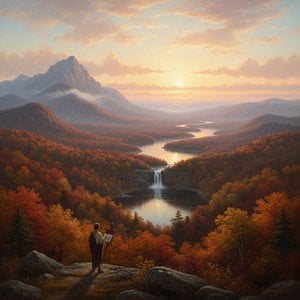
The Sublime Landscape: Exploring the Hudson River School Movement
Explore the captivating world of the Hudson River School! Discover the history, artists, and defining characteristics of this iconic American art movement. Learn about Romanticism's influence & find inspiration for your collection.

Evocations of Place: A Historical Journey Through Landscape Art
Explore the rich history of landscape art with ArtsDot. Discover renowned artists, movements like Impressionism & tonalism, and expert guidance for collecting timeless pieces. Find your perfect serene escape today!

Evoking Tranquility: A Study of Serene Beauty in Visual Art Across Historical Movements
Explore the history of serene art & discover how landscape paintings evoke tranquility across movements. Find inspiration for calming home decor & museum-quality reproductions at ArtsDot.