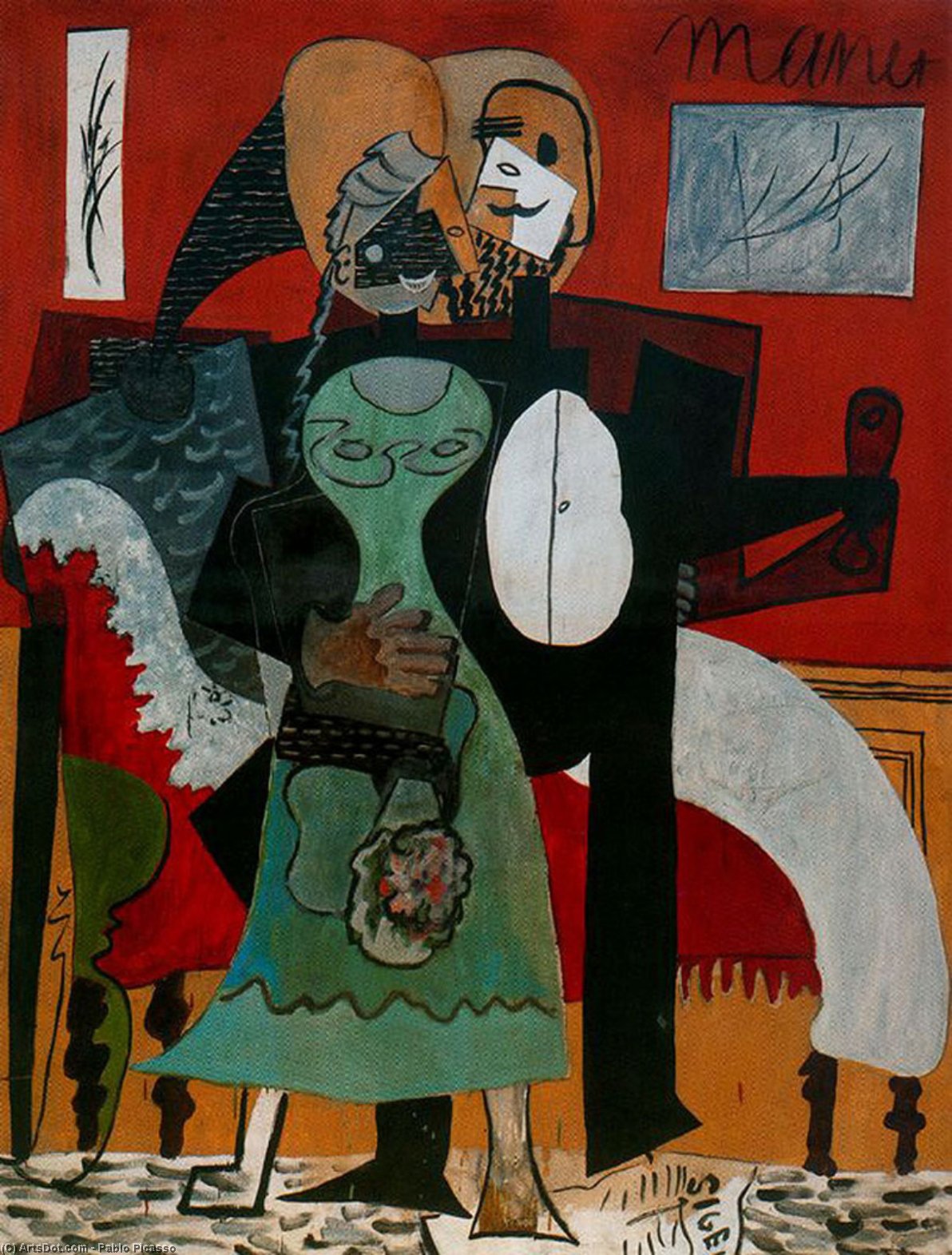
Lovers: A Window into Picasso’s Primitivist Soul
Pablo Picasso's *Lovers*, painted in 1919, isn’t merely a depiction of two figures embracing; it’s a deliberate and profound exploration of Naïve Art – a stylistic choice that reveals the artist’s restless quest for new forms of expression and his fascination with primal emotion. This work, born from a period of intense experimentation within Picasso's studio, stands as a pivotal moment in his artistic evolution, bridging the gap between his earlier academic training and the radical innovations of Cubism while simultaneously drawing inspiration from ancient African sculpture and folk art traditions. The painting’s power resides not just in its subject matter but in the raw, unadorned manner in which Picasso renders it – a deliberate rejection of traditional perspective and realistic representation in favor of direct emotional impact.
The Roots of Primitivism: A Break from Tradition
Picasso’s embrace of Naïve Art during this period was part of a broader artistic movement, fueled by a desire to break free from the constraints of academic art and tap into a more elemental form of expression. Naïve Art, also known as Primitivism, sought to emulate the style of self-taught artists – those who created without formal training – often found in rural communities or marginalized groups. This approach prioritized direct emotional communication over meticulous detail or illusionistic realism. Picasso, already a pioneer of Cubism, recognized the potential of this style to bypass intellectual analysis and connect directly with the viewer’s subconscious. The influence of African masks and sculptures, particularly those from Gabon and Côte d'Ivoire, is strikingly evident in *Lovers*. The simplified forms, flattened perspective, and use of bold outlines mirror the aesthetic principles found in these ancient artifacts, suggesting a deliberate attempt to access a more fundamental, universal language of imagery.
A Stylized Embrace: Technique and Composition
*Lovers* is characterized by its strikingly direct and simplified style. The two figures are rendered with broad, gestural strokes, their faces reduced to essential planes of color and form – almost mask-like in their anonymity. The bodies are depicted in a stylized manner, lacking anatomical precision, yet conveying a palpable sense of intimacy and connection. Picasso employs vibrant, contrasting colors—a rich ochre for the man’s tunic and a warm red for the woman's dress—to heighten the emotional intensity of the scene. Geometric shapes, particularly triangles and rectangles, are strategically incorporated into the composition, adding to the painting’s dynamic energy and reinforcing its primitive aesthetic. The background is deliberately vague, further emphasizing the central figures and their embrace. The composition itself feels almost like a snapshot, capturing a fleeting moment of connection with remarkable immediacy.
Beyond Representation: Symbolism and Emotional Resonance
While *Lovers* avoids explicit narrative, it’s rich in symbolic potential. The anonymous couple embodies the universal themes of love, intimacy, and vulnerability. The shield held by both figures—a detail often overlooked—can be interpreted as a symbol of protection, defense, or perhaps even sacrifice. Picasso's deliberate simplification of the figures allows viewers to project their own emotions and experiences onto the scene, fostering a deeply personal connection with the artwork. The painting’s raw emotionality is arguably its most enduring quality – it speaks to the fundamental human need for connection and belonging, transcending any specific context or narrative. It's a testament to Picasso’s ability to distill complex feelings into a powerfully evocative image.
A Legacy of Innovation: Relevance Today
Picasso’s exploration of Naïve Art was not merely a stylistic experiment; it represented a fundamental shift in his artistic approach. *Lovers* exemplifies his willingness to challenge conventional notions of beauty and representation, paving the way for future generations of artists to explore new forms of expression. The influence of this period can be seen throughout Picasso’s oeuvre, as well as in the work of numerous 20th-century artists who sought to break free from academic constraints. Today, *Lovers* continues to resonate with viewers, reminding us of the power of art to communicate directly and emotionally – a quality that remains profoundly relevant in our increasingly complex world. For those seeking a captivating piece of modern art, or a high-quality reproduction of this iconic work,
Lovers by Pablo Picasso is available on ArtsDot. Additionally, the
Hermitage Museum in Saint Petersburg, Russia, houses many of Picasso's notable works, including
Nude (Bust), which also reflects his experimentation with Cubism and Naïve Art.