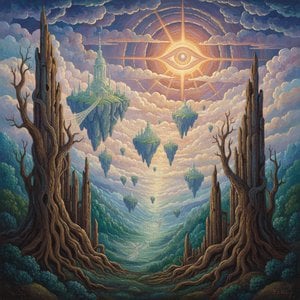
Walter Owen: A Welsh Vision of the Cosmos
Walt Owen (1912-2007) wasn’t merely a painter; he was an explorer, translating the vastness and mystery of space into deeply personal and emotionally resonant works. Born in Wales, his artistic journey took him across continents, culminating in a unique style that blended surrealism, folk art, and a profound sense of wonder. Owen's career, spanning nearly seven decades, offers a fascinating glimpse into a creative spirit shaped by both Welsh heritage and an enduring fascination with the cosmos – a subject he pursued with relentless dedication and a distinctive visual language.
Owen’s early life in Wales instilled within him a deep connection to folklore and traditional storytelling. This influence is evident in his later work, particularly in the dreamlike quality of many of his paintings. He began his artistic training at the Cardiff School of Art, where he honed his skills in watercolor and drawing. However, it was his relocation to London in 1936 that truly ignited his passion for space exploration. The burgeoning field of astronomy captivated him, fueling a lifelong pursuit of capturing its beauty and grandeur on canvas.
The mid-20th century witnessed a surge of interest in space travel, and Owen was deeply affected by this phenomenon. He began to incorporate celestial imagery into his work, initially depicting the moonlit landscapes of Wales with an ethereal quality. Gradually, his focus shifted towards the stars and planets, reflecting a growing sense of awe and wonder at the scale of the universe. His style evolved, incorporating elements of abstraction and symbolism, creating images that were both visually arresting and deeply evocative.
The Language of Dreams: Style and Technique
Owen’s artistic style is immediately recognizable for its distinctive blend of realism and surrealism. He employed loose watercolor techniques, often layering washes of color to create a sense of depth and atmosphere. His compositions frequently feature floating forms, distorted perspectives, and symbolic imagery – elements that contribute to the dreamlike quality of his paintings. He was particularly adept at capturing light and shadow, using subtle gradations of color to evoke a sense of mystery and wonder.
A key characteristic of Owen’s work is his use of symbolism. Many of his paintings feature recurring motifs – stars, planets, rockets, and figures reaching towards the heavens – each imbued with personal meaning. He often drew inspiration from Welsh folklore and mythology, incorporating elements of Celtic art into his compositions. His meticulous attention to detail, combined with a willingness to experiment with color and form, resulted in works that are both technically accomplished and emotionally resonant.
Notable Works & Influences
Several of Owen’s paintings stand out as particularly significant examples of his artistic vision. “As Man Soars” (1971), a watercolor depicting a lone figure gazing at the stars, is arguably his most famous work. The painting captures a sense of both isolation and connection, reflecting Owen's own fascination with the vastness of space and humanity’s place within it. “John F. Kennedy Portrait Bust” (1963) showcases his skill in portraiture, capturing the iconic image of the president with remarkable detail and sensitivity.
Owen’s work was influenced by a diverse range of artists and movements. He admired the works of Romantic painters such as Caspar David Friedrich, whose landscapes evoked a sense of awe and wonder. He also drew inspiration from Surrealist artists like Salvador Dalí and René Magritte, incorporating elements of dream imagery and psychological symbolism into his paintings. The influence of Welsh folk art is also apparent in his use of bold colors and simplified forms.
Legacy & Historical Significance
Walt Owen’s contribution to the world of art lies not only in his distinctive style but also in his unwavering dedication to a subject that many considered esoteric – space exploration. His paintings offer a unique perspective on humanity's relationship with the cosmos, capturing both the beauty and the mystery of the universe. Owen’s work gained recognition throughout his career, including exhibitions at galleries across Wales and England.
Today, Owen is remembered as one of the most important Welsh artists of the 20th century. His paintings continue to inspire viewers with their dreamlike quality and profound sense of wonder. His legacy extends beyond the realm of art, serving as a reminder of the importance of curiosity, imagination, and a willingness to explore the unknown.
Pytania i odpowiedzi
Gdzie mogę zobaczyć dzieła Walt Owen w porządku chronologicznym?
Strona Chronologia dzieł prezentuje dzieła Walt Owen uporządkowane chronologicznie, rok po roku.
Do jakiej epoki należał/a Walt Owen?
Walt Owen tworzył w okresie Modern. Epoka ta osadza twórczość artysty w kontekście historycznym.
Jak zmieniała się twórczość Walt Owen na przestrzeni lat?
Kariera Walt Owen rozwija się etap po etapie na stronie Osiągnięcia artystyczne: jako pozioma oś czasu dzieł, pogrupowanych w rozdziały odpowiadające poszczególnym okresom twórczości.